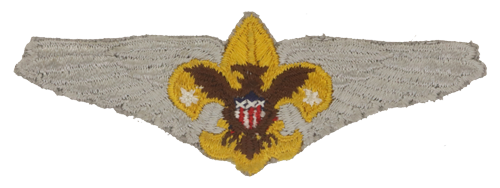
Air Scouts (1941-1949)
Overview
Air Scouts were established as an Air Force inspired program, much in the same way that Sea Scouts is a Naval inspired program. As it was established during the war years when aviation was truly coming into its own, it was very successful. In September, 1949, with Senior Scouts becoming Explorers, the Air Scout program became the Air Explorer program.
Air Scout program
The basic Air Scout program had scouts learn about the world of aeronautics, as a pre-flight training program. This entailed them learning a great deal about flight, about how aircraft were built and operated, and how to fly them, short of actually doing so. They learned about a wide range of topics relating to flying, including engines, weather, radio, and more. The Army Air Corp and Navy helped out, considering we were involved in WWII at the time.
Air Scout Uniforms
Air Scouts and adult leaders wore uniforms of sky blue. Community strips, state strips, and unit numbers were available in these colors to match. There are many pictures of Air Scouts in elaborate uniforms with blouse coats and the like, but these were apparently experimental uniforms, and were not adopted as the official uniforms.


Air Scout Advancement Program
There were actually two parts to the Air Scout advancement program. There was the main advancement used by Air Scouts themselves. Inspired by the four level Sea Scouts Advancement program, Air Scouts also had a four level program of Apprentice, Observer, Craftsman, and Ace. There were also the Air Candidate awards. These existed from 1941-48, and were intended for Tenderfoot, Second Class, and First Class Scouts in Boy Scout Troops to earn. The idea to get these boys interested in Air Scouting, so that they might participate when they turned 15.
The Air Scout advancement program was fairly tough. In January of 1947, the Air Scout advancement program was revamped, and Specialist Badges (also called Ratings strips) were introduced. Under the new scheme, general Air Scout accomplishments was recognized by advancement in rank, while specialized aviation knowledge was recognized by advancement in the ratings. This lead to an increase in the numbers of awards given out. This was understandable, as the Ace Award was the hardest award to earn, having 130 requirements compared to 39 for the Ranger Award or 75 for Quartermaster. Requirements were reduced to 45. This is also seen by the fact that it was three years before anyone earned Ace! The success of the ratings strips would lead to them being added to the revised Explorer advancement program of the 50s, but here the earning of Ratings was necessary to advance in rank. These new requirements were optional for 1947, becoming manditory in 1948.
Air Scouts earned the Specialist Badges (Ratings) by completing 5 of the 6 requirements and taking part in service, outdoor, and social activities, and had to earn the Ratings in order. So an Air Scout would have to advance from Observer Airman Rating to Craftsman Airman Rating to Ace Airman Rating. In earning the ranks, they completed 14 requirements from 9 groups, and at least one from each group. The six Ratings where included in these 9 groups. But they did not have to complete the Ratings, just complete at least one requirement from each.
In addition to this, National also took the Aviation Merit Badge and in 1941, split it into 4 merit badges: Aerodynamics, Aeronautics, Airplane Design, and Airplane Structure. These lasted until 1952, when Aviation was brought back. Earning of these 4 merit badges was necessary for the Air Scout Candidate Awards and for the earlier Air Scout Advancement program. With the revamped requirments that came out in 1947, it was no longer necessary for Air Scouts to earn these 4 merit badges. These merit badges were all embroidered with a blue background. There was also a sky blue merit badge sash made for the Air Scouts.
Air Scout Unit Organization
Air Scout Units were called Squadrons. These were subdivided into smaller groups called Flights. In 1946, offices and unit terms were renamed to bring everything in line with other Senior Scouting units. Flights were renamed Crews, so that all Senior Scout units had the same subdivisions. Squadrons were now lead by Senior Crew Leaders and Squadron Advisors. Many Squadrons, however, continued to use the old terminology. To better understand the terms used, here is a comparison with Boy Scout Troops and Explorer Posts.
| Boy Scout Troop | Explorer Post | Air Scout Squadron 1941-1946 | Air Scout Squadron 1947-1949 |
| Scoutmaster | Post Advisor | Squadron Leader | Squadron Advisor |
| Senior Patrol Leader | Senior Crew Leader | Squadron Pilot | Senior Crew Leader |
| Patrol | Crew | Flight | Crew |
| Patrol Leader | Crew Leader | Flight Pilot | Crew Leader |
| Scribe | Post Secretary | Squadron Secretary | Squadron Secretary |
Literature
The basic manual for Air Scout was the Air Scout Manual, which went through several printings in the first couple of years. Interesting enough, no more were printed after 1943! One would expect that there would still be the need for manuals for several years, and especially after the revised advancement program a revised manual would have been produced. What they did was drop in a short 16pg pamphlet called Air Scout Advancement Requirements (#3022) with the last printing, which gave the new requirements.
The only manual for adult leaders was the Hints to Squadron Leaders, which would be later replaced by the more generic Hints for Senior Scout Leadership. Why nothing equivalent to a Scoutmaster Handbook was produced is unknown.
| year | membership | units | ace awards |
| 1942 | 2025 | ? | 0 |
| 1943 | 9549 | ? | 0 |
| 1944 | 11233 | ? | 0 |
| 1945 | 7856 | ? | 5 |
| 1946 | 7656 | ? | 23 |
| 1947 | 8539 | ? | 81 |
| 1948 | 6809 | ? | 95 |
| 1949 | 6055 | ? | 150 |
Statistics taken from BSA Annual Reports as given in Art Hyman's The Scout in Aviation