- Rover Scout
- Explorer Scout
- Emergency Service
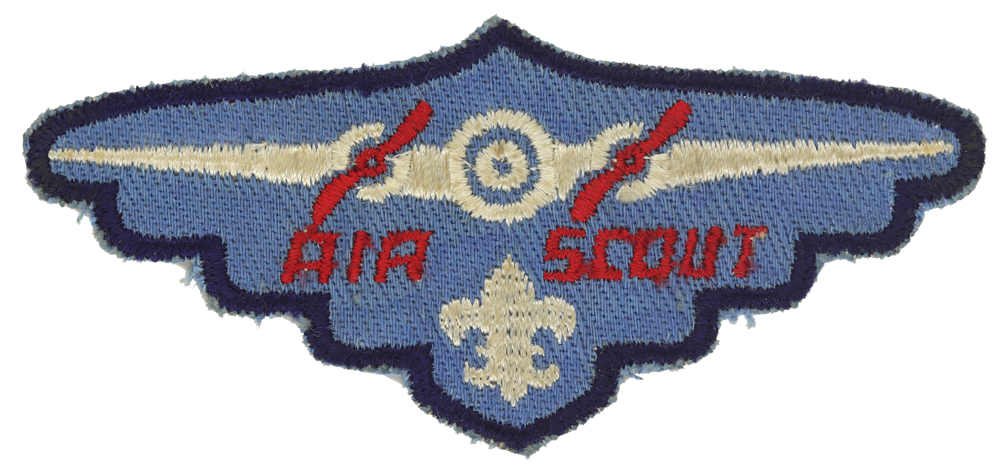
Fig. 1: AS-13-Front
- Size: 93 mm x 43 mm
- Shape: Wing
- Material: Twill
- Border: Cut-edge blue
- Background: Powder Blue
- Lettering Color: Red
- Design: Plane with 2 Red Propellers & white FDL
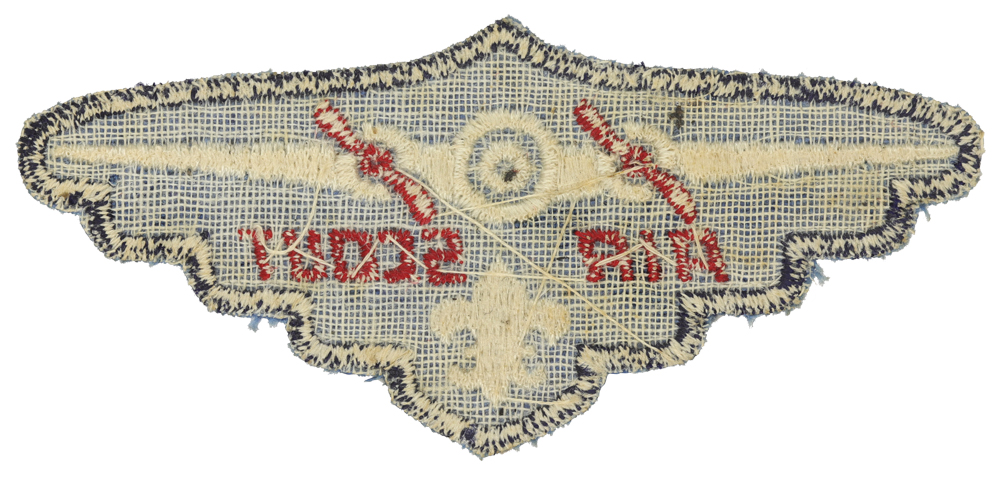
Fig. 2: AS-13-Reverse
- Back: Gauze reinforced starched
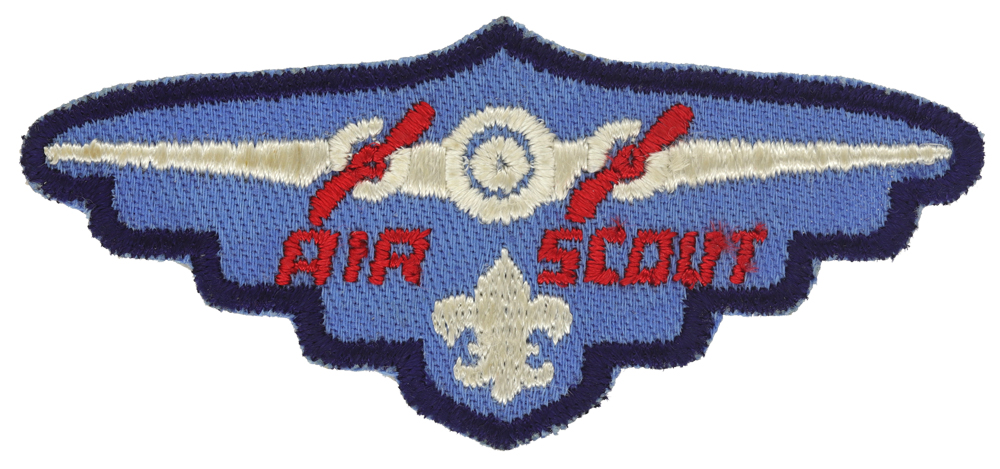
Fig. 3: AS-13-mve1-Front
- Size: 93 mm x 43 mm
- Shape: Wing
- Material: Twill
- Border: Cut-edge blue
- Background: Powder Blue
- Lettering Color: Red
- Design: Plane with 2 Red Propellers & white FDL
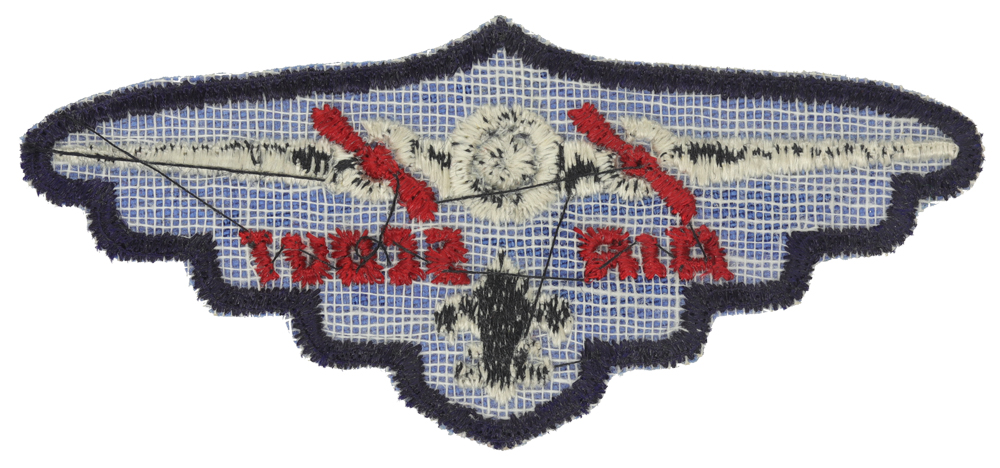
Fig. 4: AS-13-mve1-Reverse
Item Name: Air Scout Observer
Item ID: AS-13
Collector Rating: 0
Requirements (1942-46)
I. General Aeronautics
a) Meet the requirements of the Aeronautics Merit Badge
b) Build a flat working model of an internal combustion engine; OR make an Airway Map; OR build and compare two identical simple stick flying models (rubber band), one to be Rise-Off-Ground and the other Rise-Off-Water.
II. Lighter-than-Air Craft
a). Explain with rough diagrams, the chief structural differences between rigid, semi rigid airships, non rigid blimps, free and captive balloons, pointing out the advantages and uses of each.
b) Make a small captive, propeller driven airship for demonstration purposes; OR, demonstrate the Montgoldier experiment with a small captive paper aerostat.
III Airplane Design
a) Meet the requirements of the Airplane Structure Merit Badge
b) Build a working model of airplane controls; OR, make a plane identification wall chart
c) Build a flying model plane, leaving sections uncovered or covered with transparent material to show structural details; OR, build a small indoor rubber band flying model. Kits may be used.
IV. Airplane Propellers
a) Demonstrate with sketches, or with a model, an understanding of the following terms: blade, hub, tip, diameter, leading edge, trailing edge, blade area, blade element, pitch, slip, thrust, and torque.
b) Explain the general principles and advantages of adjustable, controllable, and constant speed propellers.
c) Carve, for one of your flying models, two new propellers having the same diameter (about 2/5 of the wing span) and approximately the same pitch, but with different blade areas, one 1/10 and the other 1/6 of the wing area. Test in flight and report.
V. Elements of Aerology
a) Explain why these six basic atmospheric conditions concern a pilot: atmospheric pressure, temperature, humidity, clouds, winds, precipitation.
b) Identify in the sky, or from photographs and sketches if necessary, the ten forms of clouds in the International Classification grouped in the four classifications: high, middle, low, and vertical. Describe them.
c) Present rough outline map marking the dense fog areas of the United States
d) Interpret a weather map, with particular reference to the highs, lows, cold and warm fronts.
VI. Air Maps and Charts
a) Explain, with rough sketches, the problem of making an accurate map of the surface areas of the globe.
b) Draw a North Polar equidistant projection map for demonstrating northern air routes
c) Draw a similar South Polar map; OR make a spot map of neighboring airports, using auto road map as base.
d) Interpret the radio beams and symbols on a United States sectional air map.
VII. Airway Communication
a) Explain the five types of US Civil Airway communications maintained.
b) Send and receive a message by International Morse Code auditory, signals at not less than 35 characters per minute.
c) Send and receive a message by International Morse Code visual signals at not less than 20 characters per minute
d) Make own equipment for either (B) or (C).
VIII. Personal Scout and Group Projects
a) Have six month's satisfactory service as an Apprentice Scout, putting into practice in your daily life the Scout Oath and Law and the Scout ideals of service and leadership.
b) Follow an approval personal health program
c) Take part in the meetings and group projects of your Squadron or Patrol
d) Take a cross country hike of at least five miles through territory as near like wilderness as possible, making note of everything an aviator who has been forced down would use to get back to civilization. Write a report of the trip.
Requirements (1947-49)
Complete 14 requirements, including one from each of the 9 groups below:
1. Airman Specialist Badge
2. Builder Specialist Badge
3. Communicator Specialist Badge
4. Mechanic Specialist Badge
5. Navigator Specialist Badge
6. Outdoorsman Specialist Badge
7. Life Exploration
8. Community Participation
9. Group Participation
Air Scouts earned the Specialist Badges (Ratings) by completing 5 of the 6 requirements and taking part in service, outdoor, and social activities, and had to earn the Ratings in order. So an Air Scout would have to advance from Observer Airman Rating to Craftsman Airman Rating to Ace Airman Rating. In earning the ranks, they completed 14 requirements from 9 groups, and at least one from each group. The six Ratings where included in these 9 groups. But they did not have to complete the Ratings, just complete at least one requirement from each.
Life Exploration
1. Demonstrate a reasonable degree of proficiency in a physical skill or sport, such as gymnastics, weight lifting, football, basketball, swimming, track, archery, skiing, etc.
2. Hold a job for 30 days or more and present evidence of success.
3. Visit and make a written report on the vocational opporunities in some industry preferably related to aviation.
4. Demonstrate accepted social usage in introducing two people; handling formal and informal invitations; the role of an escort; respect due ladies and older people; calling at a home; entertaining at restaurants and theatres.
Community Participation
1. Carry out, alone or jointly, at least one community service project developed in consultation with your Squadron Leader. Report on what provision is made by your municipal or county government to protect health.
2. Do your share as a volunteer leader in the community through church, school, Scouting, or other community project.
3. Make a study of the aviation program of your community, and suggest what immediate projects are needed for the growth of the community in aviation.
Group Participation
Render at least three months satisfactory service as an Air Scout Apprentice