- Rover Scout
- Explorer Scout
- Emergency Service
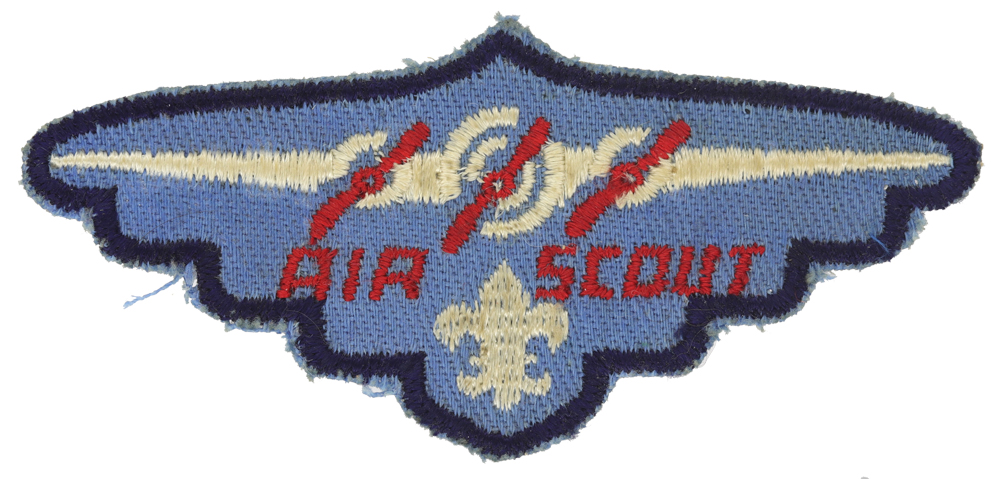
Fig. 1: AS-14-Front
- Size: 93 mm x 43 mm
- Shape: Wing
- Material: Twill
- Border: Cut-edge blue
- Background: Powder Blue
- Lettering Color: Red
- Design: Plane with 3 Red Propellers & white FDL
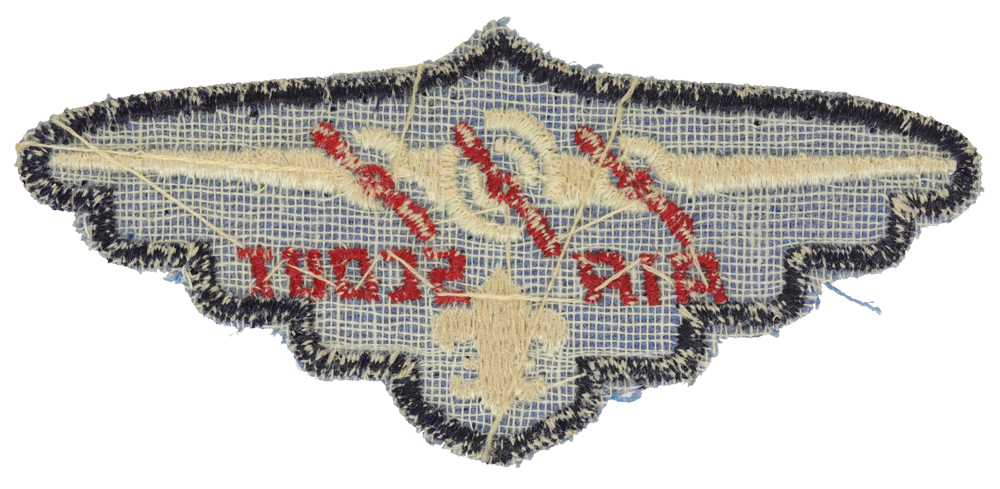
Fig. 2: AS-14-Reverse
- Back: Gauze reinforced starched

Fig. 3: AS-14-mve1-Front
- Size: 93 mm x 43 mm
- Shape: Wing
- Material: Twill
- Border: Cut-edge blue
- Background: Powder Blue
- Lettering Color: Red
- Design: Plane with 3 Red Propellers & white FDL

Fig. 4: AS-14-mve1-Reverse
Item Name: Air Scout Craftsman
Item ID: AS-14
Collector Rating: 0
Requirements (1942-46)
I. History of Aeronautics
Present a list of 10 historical events in Aeronautics which you consider most important, telling in what sense they seem most important.
II. Elements of Aerodynamics
a) Meet the requirements for the Aerodynamics Merit Badge.
b) Measure the relative air resistance of the three airfoils in Requirement 4-a of Aerodynamics Merit Badge, using pulley and weights or suspension and pointers; record and report these measurements; OR
Build one of the following:
1) An airfoil pressure manometer testing set;
2) A demonstration wind tunnel, any design;
3) A model of any historical plane.
III Airplane Design
a). Meet the requirements for the Airplane Design Merit Badge.
b). Make an airplane design wall chart identifying main modern design types.
c) Submit a design analysis of not fewer than five modern planes.
IV. Airplane Engines
a) Prepare rough diagrams contrasting two and four cycle internal combustion engines.
b) Explain with rough sketches various engine cylinder arrangements showing crank-shaft and connecting rod assembly differences
c) Contrast airplanes and automobile engines as to 1) general lubrication, 2) fuel supply systems, including injectors and superchargers, 3) electrical systems
d) Take down and reassemble, or assist in taking down and reassembling, an internal combustion engine- report on the main steps.
V. Airplane Instruments
Explain with rough sketches the operation and use of these six primary flight instruments: tachometer, oil pressure gauge, oil temperature gauge, altimeter, magnetic compass, and airspeed indicator.
VI. Elements of Flight Control
a) Explain the use of controls and desirable engine speed for the following nine initial flight elements: taxing, straight and level flight, turns, climbs, glider, rectangular course, stalls, take-offs, landings.
b) Demonstrate the adjustment of the control surfaces of a flying model in each of these nine flight elements and of a glider where possible.
VII. Radio Communications
a) Meet the requirements for the Electricity Merit Badge.
b) Meet the requirements for the Radio Merit Badge.
VIII. Personal and Group Projects
a) Have six month's satisfactory service as an Observer Air Scout, putting into practice in your daily life the Scout Oath and Law and the Scout ideals of service and leadership.
b) Take part in the meetings and group projects of your Squadron or Patrol, including not fewer than one outdoor, one social, and one service project; continue your approved personal health program.
c) At night, hike from a wilderness spot where an aviator might make a forced landing, travel a distance of not less then five miles finding compass directions by stars in order to arrive at predetermined point.
Requirements (1947-49)
Complete 14 requirements, including one from each of the 9 groups below:
1. Airman Specialist Badge
2. Builder Specialist Badge
3. Communicator Specialist Badge
4. Mechanic Specialist Badge
5. Navigator Specialist Badge
6. Outdoorsman Specialist Badge
7. Life Exploration
8. Community Participation
9. Group Participation
Air Scouts earned the Specialist Badges (Ratings) by completing 5 of the 6 requirements and taking part in service, outdoor, and social activities, and had to earn the Ratings in order. So an Air Scout would have to advance from Observer Airman Rating to Craftsman Airman Rating to Ace Airman Rating. In earning the ranks, they completed 14 requirements from 9 groups, and at least one from each group. The six Ratings where included in these 9 groups. But they did not have to complete the Ratings, just complete at least one requirement from each.
Life Exploration
1. Select and develop a new hobby or skill from the list described in the Air Scout Manual, and report or demonstrate in Squadron Meeting.
2. Explore and report in Squadron Meeting on qualities and preparation needed as well as the future outlook for a young man in any vocation related to aviation.
3. Give evidence of knowledge of proper table etiquette including table arrangement, seating of guests, grace at meals, and the serving and passing of food.
Community Participation
1. Continue in effort, alone or jointly, to do your part in helping with community affairs. Report what non-governmental agencies there are in your community which seek to benefit youth.
2. Develop and carry out an original conservation or development project in consultation with his squadron and government or other community leaders.
3. Help find others to help as needed community leaders in church, school, Scouting, etc, in addition to your own continuing service.
Group Participation
Render at least three months satisfactory service as an Air Scout Observer.