- Rover Scout
- Explorer Scout
- Emergency Service
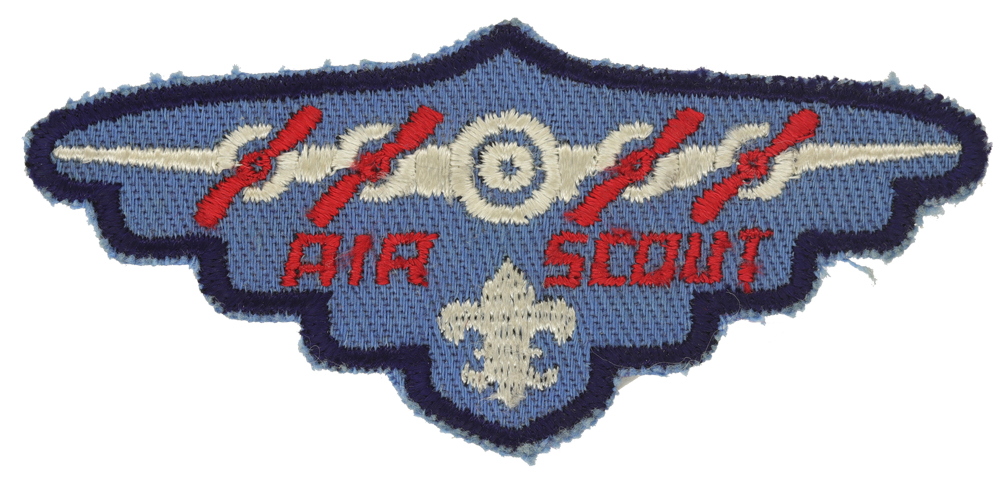
Fig. 1: AS-15-Front
- Size: 93 mm x 43 mm
- Shape: Wing
- Material: Twill
- Border: Cut-edge blue
- Background: Powder Blue
- Lettering Color: Red
- Design: Plane with 4 Red Propellers & white FDL
Fig. 1: AS-15-Front
- Size:
- Shape:
- Material: Sterling
- Border:
- Background:
- Lettering Color:
- Design: Silver Medal with compass, flying eagle and four airplane propellers suspended from a even stripped red-blue-red ribbon

Fig. 2: AS-15-Reverse
- Back: Gauze reinforced starched
Fig. 2: AS-15-Reverse
- Back:
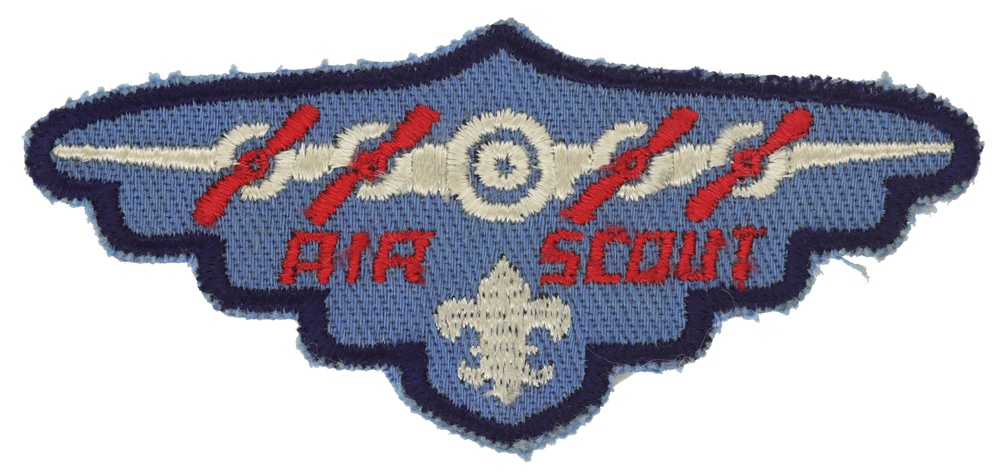
Fig. 3: AS-15-mve1-Front
- Size: 93 mm x 43 mm
- Shape: Wing
- Material: Twill
- Border: Cut-edge blue
- Background: Powder Blue
- Lettering Color: Red
- Design: Plane with 4 Red Propellers & white FDL
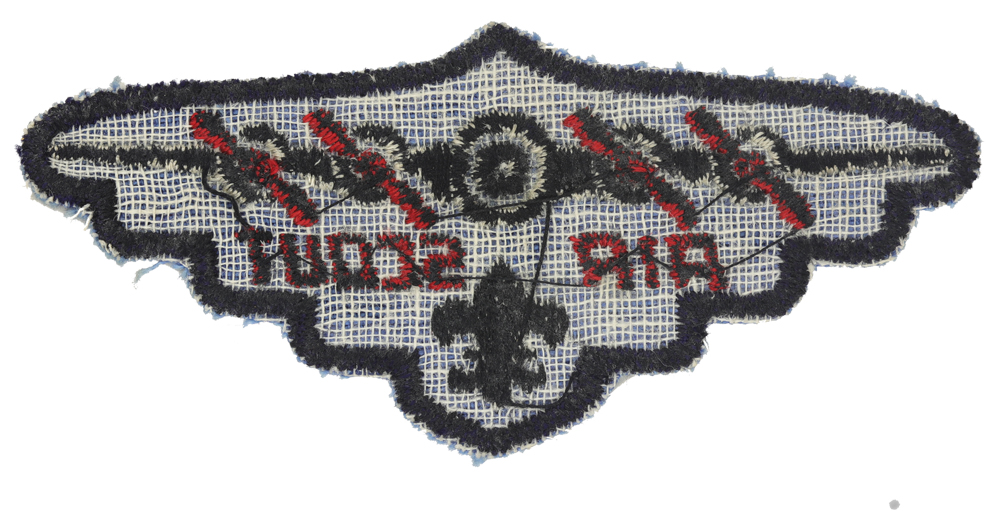
Fig. 4: AS-15-mve1-Reverse
Item Name: Air Scout Ace
Item ID: AS-15
Collector Rating: 0
Requirements (1942-46)
I Top Air Records and Types
a) Report the top ceiling, speed and distance air records
b) Identify 25 different airplanes from photographs, models or silhouettes
c) Make a set of silhouette cards for identification game; OR, make one solid model of a plane.
II Applied Aerodynamics- Gliding and Soaring
a) Explain the relation between Chanute's and the Wright's glider experiments and the achievement of power flight.
b) Make one or more light cardboard gliders; determine their glide angle and report; demonstrate the action of thermals.
III Airplane Design Project
Construct a flying model, any type, of original design, explaining the reasons for main design features
IV Gas Model Plane- CAA Inspections
a) Construct and fly a gas model airplane
b) Subject it, before flight, to CAA inspection routine
V Elements of Navigation
a) Tell the conditions of flight which make it difficult to hold a course and the minimum navigation instruments required.
b) List and explain some instrumental errors which may occur in the use of altimeter, airspeed indicator and magnetic compass
c) Explain the general differences between holding a course by pilotage, dead reckoning, radio side and by celestial observations
d) Make a simple sextant and use it to demonstrate the home latitude.
VI. Flight Maneuvers and the Pilot
a) Demonstrate by hand with a model plane or glider the official test and precision maneuvers for the Private Pilot Certificate.
b) Describe the following aerobatics maneuvers: loop, chandelle, wing over, snap roll, falling leaf, slow roll, Immelman, whip stall.
c) Explain the physical effects of altitude and speed maneuvers
d) Meet the requirements for the Personal Health Merit Badge.
VII. CAA Airport and Airway Rules
a) Present a list of the main requirements for certification of a private pilot and for the air worthiness of an aircraft
b) Present list of the principal air traffic rules and give reasons for them.
VIII. Personal and Group Projects.
a) Have six month's satisfactory service as an Craftsman Air Scout, putting into practice in your daily life the Scout Oath and Law and the Scout ideals of service and leadership.
b) Present evidence that your physical examination has been checked according to the CAA standards for Private Pilot Certificate; and meet the requirements for the First Aid Merit Badge.
c) Hold at least two vocational conferences with counselors in life work fields.
d) Make and report on a two-day trip through a reasonably wild and sparsely settled territory, carrying only emergency rations ad light shelter, living of the country as far as possible.
Requirements (1947-49)
Complete 14 requirements, including one from each of the 9 groups below:
1. Airman Specialist Badge
2. Builder Specialist Badge
3. Communicator Specialist Badge
4. Mechanic Specialist Badge
5. Navigator Specialist Badge
6. Outdoorsman Specialist Badge
7. Life Exploration
8. Community Participation
9. Group Participation
Air Scouts earned the Specialist Badges (Ratings) by completing 5 of the 6 requirements and taking part in service, outdoor, and social activities, and had to earn the Ratings in order. So an Air Scout would have to advance from Observer Airman Rating to Craftsman Airman Rating to Ace Airman Rating. In earning the ranks, they completed 14 requirements from 9 groups, and at least one from each group. The six Ratings where included in these 9 groups. But they did not have to complete the Ratings, just complete at least one requirement from each.
Life Exploration
1. Select and carry on a new hobby or advance an old one, and show evidence of fair mastery of one added craft skill.
2. Compare the three vocations which seem most attractive to you, and outline in conference with Squadron Leader or Aviation Counselor a practical plan that can be followed to enter any of them.
3. Give evidence of having read a book or pamphlet on social usages; present directions for five social games appropriate for informal Air Scout occasions; assist social committee in arranging and conducting a formal social event.
Community Participation
1. In addition to providing leadership to an approved community service requirement, report to your Squadron on what services, protective and developmental, are carried out by your local government primarily for the benefit of youth.
2. Survey and report the main plants and animals discovered at any one season in an approved area, indicating their relation to human life; or explore and report on some one form of plant or animal life, as its prevalence, how it lives, what part it plays in its natural setting, and its possible values.
3. Assist in training others as needed, as part of your continuing help to the community through church, school, Scouting, or other community projects.
Group Participation
Render at least six months satisfactory service as an Air Scout Craftsman.