-
Merit Badges
- Legend to identify Merit Badges
- 1910 British Merit Badges
- Square 1911 - 33
- Wide Crimped 1934 & 35
-
Narrow Tan Crimped 1936 - 42
- Tan Heavyweight Cloth with Silk Embroidery and Printed Back 1936 - 37
- Tan Heavyweight Cloth with Silk Embroidery and Plain Back 1937 - 38
- Tan Lightweight Cloth with Silk Embroidery and Plain Back 1938 - 39
- Tan Lightweight Cloth with Cotton Continuous Loop Embroidery and Plain Back 1939 - 42
- Tan Lightweight Cloth with Cotton Lockstitch Embroidery and Plain Back 1939 - 42
- Blue Background 1942 - 46
- Wartime 1942 - 46
- Khaki Narrow Crimped 1946 - 59
- Green Twill Gauze Back 1960 - 68
- Fully Embroidered Merrowed Edge 1960 - 72
- Unprinted Plastic Back 1972 - 01
- Printed Plastic Back 2002 - Current
-
Merit Badge Paper
- Merit Badge Applications
- Merit Badge Cards
-
Merit Badge Pamphlets
- Type 1 White Cover - Rectangle Drawing On Cover
- Type 2 White Cover 5-375" x 8" Title at Top
- Type 3A Tan Cover - 200 Fifth Avenue
- Type 3B Tan Cover - 2 line address New York City
- Type 3C Tan Cover - 2 line address New York N.Y.
- Type 3D Tan Cover - 1 line address New York N.Y.
- Type 4 Standing Scout Cover
- Type 5A War Cover
- Type 5B Red and White
- Type 6 Photo-Red Cover
- Type 7 Full Photo Cover or Bulls-eye Cover
- Type 8 Full Photo - Green Stripe Cover
- Type 9 Full Photo - Red Stripe Cover
- Type 10A Blue Stripe - Logo above bottom blue stripe - FDL centered
- Type 10B - Blue Stripe in bottom of photo area. FDL to left of text
- Special Covers
- Boy Craft Helps
- Merit Badge Counselor's Guides
-
Youth Position
- Junior Assistant Scoutmaster
- Senior Patrol Leader
- Assistant Senior Patrol Leader
- Patrol Leader
- Assistant Patrol Leader
- Troop Guide
- Scribe
- Quartermaster
- Instructor
- Chaplain Aide
- Den Chief
- Librarian
- Musician
- Webmaster
- Bugler
- Troop Historian
- Troop Representative
- Unit Representative
- Leadership Corps
- Honor Guard
- Leave No Trace Trainer
- Outdoor Ethics Guide
-
Patrol Medallions
- Patrol Medallions Introduction
- Legend to identify Patrol Medallions
- Patrol Shoulder Knot-Ribbons
- Felt Handmade Patrol Medallions
- Square Felt Patrol Medallions
- Round Broadcloth Patrol Medallions
- Red Twill Patrol Medallions
- Multi-Color Cloth Patrol Medallions
- Tan Cloth Patrol Medallions
- Patrol Medallion Back Patches
- Woodbadge Patrol Medallion
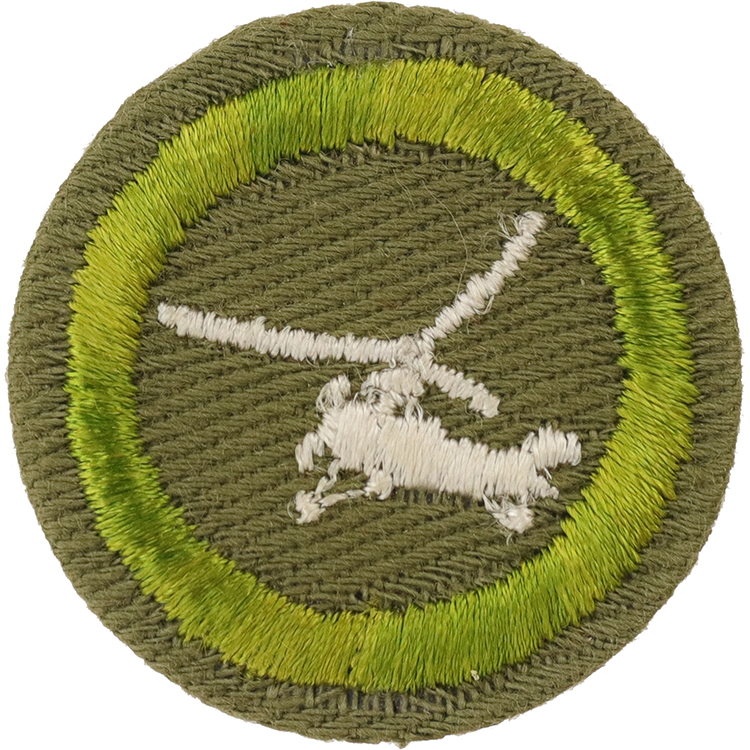
Fig. 1: AirDes-E2b-Front
- Cloth: Khaki right twill
- Embroidery: Cotton lock stitch
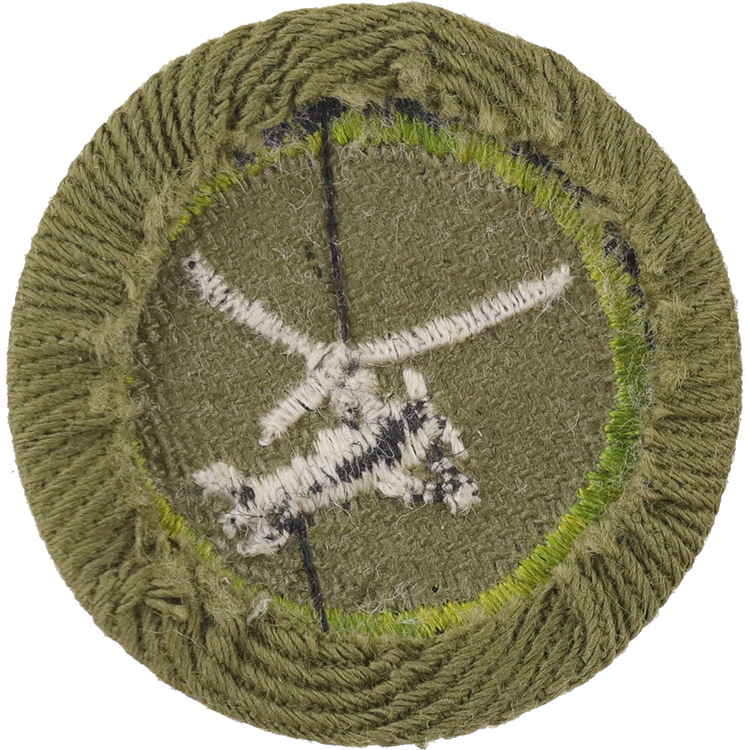
Fig. 2: AirDes-E2b-Reverse
- Back: Plain NO imprint with starch
Item Name: Airplane Design 1947 - 1952
Item ID: AirDes-E2b
Collector Rating: 10
Requirements December 1942 until June 1952
1. Point out on rough diagrams or on photographs, the outstanding differences in design of full scale planes used for five rather widely different purposes--such as first training, commercial transport, seaplanes on northern lakes, clippers, pursuit or others.
2. Measure the silhouettes of five modern full scale planes and record range of variation in the ratio of wing span to chord (aspect ratio); also in wing area as compared to stabilizer--elevator area.
3. Show design differences in camber of wings for high lift and for high speed--use rough sketches to explain reasons.
4. (a) Find approximate location of center of gravity in a flying model, and explain why a low center of gravity contributes to parasol stability; (b) if a model plane is balanced and wings of same cord, but of added span and weight were substituted at same structural points, tell what would happen to the center of gravity, and what the plane would tend to do in flight.
5. Show by rough sketches why dihedrals, sweepbacks, and relatively high wing tend to give a model stability in flight.
6. Build, test and report flight performances of two flying models of same general size, but of quite different design. For the test, use same power plant and propeller. If desired, the Scout may build but one of the two test planes, matching it against one he or his friends now have, AND then offer as the second of the two to be built, an original unconventional or experimental flying model.
7. Prepare approximate or rough scale drawings of the two models used in the test Requirement No. 6, and point out the principal design differences.
8. Fly one or more of the Scout’s own model planes in competition involving not fewer than four planes.
9. Measure four flying model planes of Requirement No. 8 and present Counselor with their comparative flight records and a list of their wing shapes and of their following design ratios:
(a) Wing span to mean cord;
(b) Wing span to propeller diameter;
(c) Wing span to fuselage length;
(d) Dihedral in inches per foot of span;
(e) Wing load in ounces per square
(f) Maximum wing camber to chord.