-
Merit Badges
- Legend to identify Merit Badges
- 1910 British Merit Badges
- Square 1911 - 33
- Wide Crimped 1934 & 35
-
Narrow Tan Crimped 1936 - 42
- Tan Heavyweight Cloth with Silk Embroidery and Printed Back 1936 - 37
- Tan Heavyweight Cloth with Silk Embroidery and Plain Back 1937 - 38
- Tan Lightweight Cloth with Silk Embroidery and Plain Back 1938 - 39
- Tan Lightweight Cloth with Cotton Continuous Loop Embroidery and Plain Back 1939 - 42
- Tan Lightweight Cloth with Cotton Lockstitch Embroidery and Plain Back 1939 - 42
- Blue Background 1942 - 46
- Wartime 1942 - 46
- Khaki Narrow Crimped 1946 - 59
- Green Twill Gauze Back 1960 - 68
- Fully Embroidered Merrowed Edge 1960 - 72
- Unprinted Plastic Back 1972 - 01
- Printed Plastic Back 2002 - Current
-
Merit Badge Paper
- Merit Badge Applications
- Merit Badge Cards
-
Merit Badge Pamphlets
- Type 1 White Cover - Rectangle Drawing On Cover
- Type 2 White Cover 5-375" x 8" Title at Top
- Type 3A Tan Cover - 200 Fifth Avenue
- Type 3B Tan Cover - 2 line address New York City
- Type 3C Tan Cover - 2 line address New York N.Y.
- Type 3D Tan Cover - 1 line address New York N.Y.
- Type 4 Standing Scout Cover
- Type 5A War Cover
- Type 5B Red and White
- Type 6 Photo-Red Cover
- Type 7 Full Photo Cover or Bulls-eye Cover
- Type 8 Full Photo - Green Stripe Cover
- Type 9 Full Photo - Red Stripe Cover
- Type 10A Blue Stripe - Logo above bottom blue stripe - FDL centered
- Type 10B - Blue Stripe in bottom of photo area. FDL to left of text
- Special Covers
- Boy Craft Helps
- Merit Badge Counselor's Guides
-
Youth Position
- Junior Assistant Scoutmaster
- Senior Patrol Leader
- Assistant Senior Patrol Leader
- Patrol Leader
- Assistant Patrol Leader
- Troop Guide
- Scribe
- Quartermaster
- Instructor
- Chaplain Aide
- Den Chief
- Librarian
- Musician
- Webmaster
- Bugler
- Troop Historian
- Troop Representative
- Unit Representative
- Leadership Corps
- Honor Guard
- Leave No Trace Trainer
- Outdoor Ethics Guide
-
Patrol Medallions
- Patrol Medallions Introduction
- Legend to identify Patrol Medallions
- Patrol Shoulder Knot-Ribbons
- Felt Handmade Patrol Medallions
- Square Felt Patrol Medallions
- Round Broadcloth Patrol Medallions
- Red Twill Patrol Medallions
- Multi-Color Cloth Patrol Medallions
- Tan Cloth Patrol Medallions
- Patrol Medallion Back Patches
- Woodbadge Patrol Medallion

Fig. 1: AmeBus-H1-Front
- Embroidery: Cotton thread
- Border: Merrowed
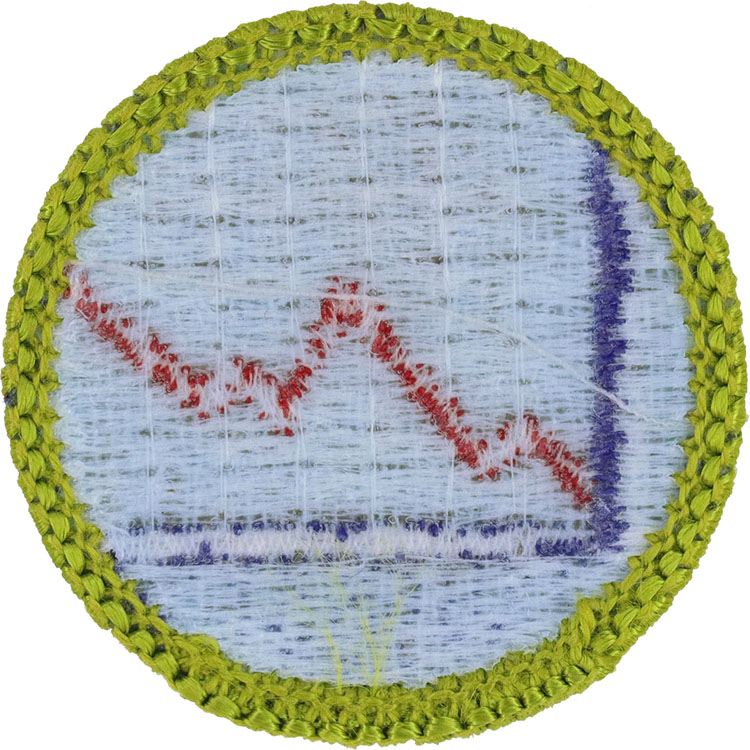
Fig. 2: AmeBus-H1-Reverse
- Back: Blue plastic with waffle pattern
Item Name: American Business 1972 - 1975
Item ID: AmeBus-H1
Collector Rating: 1
Pamphlets Used to Earn this Badge
Requirements June 1972 until July 1995
1. Do the following:
(a) Explain four features of the free enterprise system in America. Tell its benefits and responsibilities. Describe the difference between freedom and license. Tell how the Scout Oath and Law apply to business and free enterprise.
(b) Describe the industrial revolution. Tell about the major developments that marked the start of the modern industrial era in the United States. Tell about five people who had a great influence on business or industry in the United States. Tell what each did.
2. Do the following:
(a) Visit a bank. Talk with one of the officers or staff. Chart the organization of the bank. Show its relationship with other banks, business, and industry.
(b) Explain how changes in interest rates, taxes, and government spending change the flow of money into or out of business and industry.
(c) Explain how a proprietorship or partnership gets its capital. Discuss and explain four ways a corporation gets its capital.
(d) Explain the place of profit in business.
(e) Name five kinds of insurance useful to business. Describe their purpose.
3. Do the following:
(a) Pick two or more stocks from the financial pages of a newspaper. Pretend you have bought $1,000 worth of these stocks. Explain how you “bought” the stocks. Tell why you decided to “buy” them. Keep a weekly record for 3 months of your stock’s market value. Show any dividends declared.
(b) Write to one company whose stock you “bought.” Ask for a copy of its annual report. Explain it.
4. Do the following:
(a) Draw an organizational chart of a typical central labor council.
(b) Describe automation, union shop, open shop, collective-bargaining agreements, shop steward, business agent, union counselor.
(c) Explain the part played by four different Federal or State agencies in labor relations.
5. Run a small business involving a product or service for at least 3 months. First find out the need for it. For example: a newspaper route, lawn mowing, sales of things you have made or grown. Keep records showing the costs, income, and profit.*
Report:
(a) How service, friendliness, hard work, and salesmanship helped build your business.
(b) The benefits you and others received because you were in business.
*Comparable 4-H, FFA, or Junior Achievement projects may be used for No. 5.