-
Merit Badges
- Legend to identify Merit Badges
- 1910 British Merit Badges
- Square 1911 - 33
- Wide Crimped 1934 & 35
-
Narrow Tan Crimped 1936 - 42
- Tan Heavyweight Cloth with Silk Embroidery and Printed Back 1936 - 37
- Tan Heavyweight Cloth with Silk Embroidery and Plain Back 1937 - 38
- Tan Lightweight Cloth with Silk Embroidery and Plain Back 1938 - 39
- Tan Lightweight Cloth with Cotton Continuous Loop Embroidery and Plain Back 1939 - 42
- Tan Lightweight Cloth with Cotton Lockstitch Embroidery and Plain Back 1939 - 42
- Blue Background 1942 - 46
- Wartime 1942 - 46
- Khaki Narrow Crimped 1946 - 59
- Green Twill Gauze Back 1960 - 68
- Fully Embroidered Merrowed Edge 1960 - 72
- Unprinted Plastic Back 1972 - 01
- Printed Plastic Back 2002 - Current
-
Merit Badge Paper
- Merit Badge Applications
- Merit Badge Cards
-
Merit Badge Pamphlets
- Type 1 White Cover - Rectangle Drawing On Cover
- Type 2 White Cover 5-375" x 8" Title at Top
- Type 3A Tan Cover - 200 Fifth Avenue
- Type 3B Tan Cover - 2 line address New York City
- Type 3C Tan Cover - 2 line address New York N.Y.
- Type 3D Tan Cover - 1 line address New York N.Y.
- Type 4 Standing Scout Cover
- Type 5A War Cover
- Type 5B Red and White
- Type 6 Photo-Red Cover
- Type 7 Full Photo Cover or Bulls-eye Cover
- Type 8 Full Photo - Green Stripe Cover
- Type 9 Full Photo - Red Stripe Cover
- Type 10A Blue Stripe - Logo above bottom blue stripe - FDL centered
- Type 10B - Blue Stripe in bottom of photo area. FDL to left of text
- Special Covers
- Boy Craft Helps
- Merit Badge Counselor's Guides
-
Youth Position
- Junior Assistant Scoutmaster
- Senior Patrol Leader
- Assistant Senior Patrol Leader
- Patrol Leader
- Assistant Patrol Leader
- Troop Guide
- Scribe
- Quartermaster
- Instructor
- Chaplain Aide
- Den Chief
- Librarian
- Musician
- Webmaster
- Bugler
- Troop Historian
- Troop Representative
- Unit Representative
- Leadership Corps
- Honor Guard
- Leave No Trace Trainer
- Outdoor Ethics Guide
-
Patrol Medallions
- Patrol Medallions Introduction
- Legend to identify Patrol Medallions
- Patrol Shoulder Knot-Ribbons
- Felt Handmade Patrol Medallions
- Square Felt Patrol Medallions
- Round Broadcloth Patrol Medallions
- Red Twill Patrol Medallions
- Multi-Color Cloth Patrol Medallions
- Tan Cloth Patrol Medallions
- Patrol Medallion Back Patches
- Woodbadge Patrol Medallion
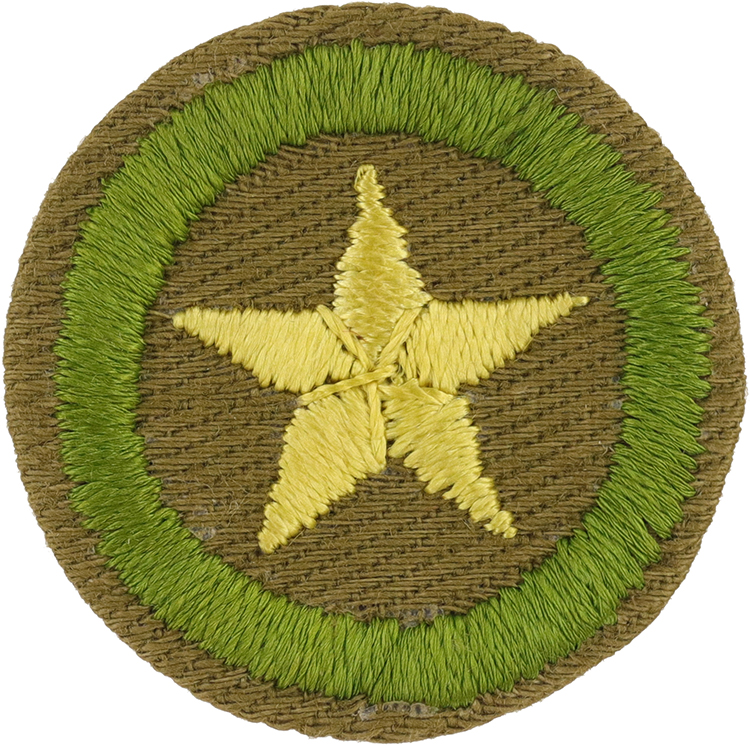
Fig. 1: Astron-C4-Front
- Cloth: Lightweight tan right twill
- Embroidery: Cotton loop continuous
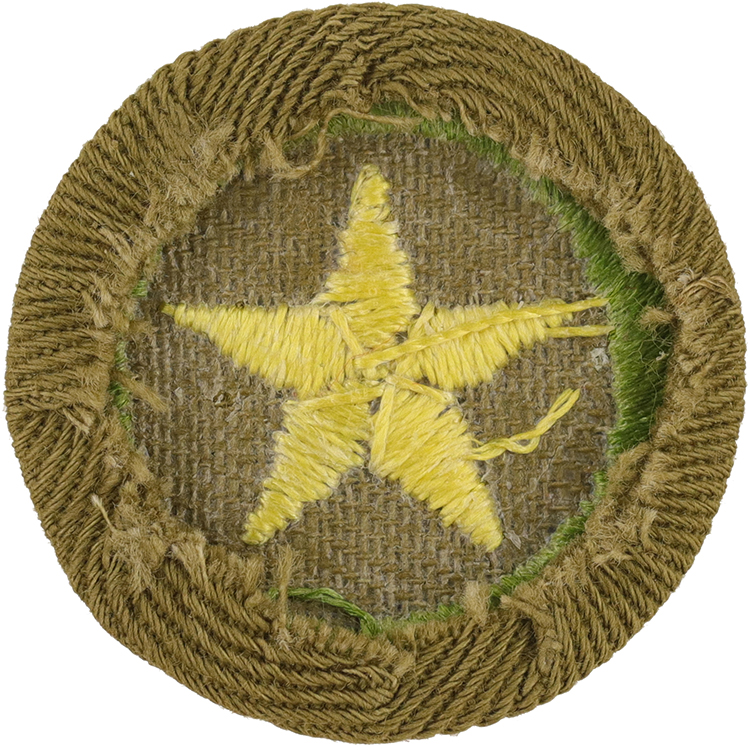
Fig. 2: Astron-C4-Reverse
- Back: Plain NO imprint with starch
Item Name: Astronomy 1939 - 1943
Item ID: Astron-C4
Collector Rating: 1
Pamphlets Used to Earn this Badge


Requirements October 1914 until October 1939
1. Have a general knowledge of nature and movements of the stars and planets.
2. Point out and name twelve principle constellations; find the north by means of other stars than the Pole-star, in case of that star’s being obscured by clouds.
3. Have a general knowledge of the positions and movements of the earth, sun, and moon, and of the tides, eclipses, meteors, comets, and planets.
4. Plot on at least two nights per month for at six months the positions of all naked-eye planets visible between sundown and one hour thereafter. The plot of each planet shall contain at least three fixed stars, with their names or designations colors of planets and stars to be recorded as observed by him.
Requirements October 1939 until December 1943
1. Describe the characteristics and differences of the celestial bodies including sun, moon, planets, comets, meteors, stars, nebulae, and galaxies.
2. Show that he has a clear understanding of the structure of the universe by describing: (a) the relative position of the earth in the solar system: (b) the relation of the solar system to the Milky Way galaxy; (c) the relation of the galaxy to other systems in the universe.
3. Explain the actual and apparent movements of the earth, moon, sun, and other planets
4. Explain the causes of: (a) phases of the moon; (b) tides; (c) solar and lunar eclipses; (d) the seasons; (e) leap year.
5. Know the differences between the following kinds of time: (a) sidereal (star time); (b) solar; (c) apparent; (d) mean; (e) local; and (f) standard.
6. Identify in the sky: (a) at least the 8 first magnitude stars; (b) 15 principle constellation, including at least 4 in the Zodiac. Be able to find the North by means of other stars than Polaris.
7. Explain the difference between a planet and a star. Explain the motions and characteristics by which each of the 5 naked-eye planets can be positively identified at any time its visible.
8. Make from personal observation, a carefully drawn map (at least 8 1/2” X 8 1/2”) of the north circum-polar region of the sky. Show the principle stars in at least five constellations.
9. Construct at least one of the following : (a) sundial; (b) star clock; (c) plainisphere; (d) simple refracting telescope; (e) four-inch telescope mirror; (f) simple telescope mounting.