-
Merit Badges
- Legend to identify Merit Badges
- 1910 British Merit Badges
- Square 1911 - 33
- Wide Crimped 1934 & 35
-
Narrow Tan Crimped 1936 - 42
- Tan Heavyweight Cloth with Silk Embroidery and Printed Back 1936 - 37
- Tan Heavyweight Cloth with Silk Embroidery and Plain Back 1937 - 38
- Tan Lightweight Cloth with Silk Embroidery and Plain Back 1938 - 39
- Tan Lightweight Cloth with Cotton Continuous Loop Embroidery and Plain Back 1939 - 42
- Tan Lightweight Cloth with Cotton Lockstitch Embroidery and Plain Back 1939 - 42
- Blue Background 1942 - 46
- Wartime 1942 - 46
- Khaki Narrow Crimped 1946 - 59
- Green Twill Gauze Back 1960 - 68
- Fully Embroidered Merrowed Edge 1960 - 72
- Unprinted Plastic Back 1972 - 01
- Printed Plastic Back 2002 - Current
-
Merit Badge Paper
- Merit Badge Applications
- Merit Badge Cards
-
Merit Badge Pamphlets
- Type 1 White Cover - Rectangle Drawing On Cover
- Type 2 White Cover 5-375" x 8" Title at Top
- Type 3A Tan Cover - 200 Fifth Avenue
- Type 3B Tan Cover - 2 line address New York City
- Type 3C Tan Cover - 2 line address New York N.Y.
- Type 3D Tan Cover - 1 line address New York N.Y.
- Type 4 Standing Scout Cover
- Type 5A War Cover
- Type 5B Red and White
- Type 6 Photo-Red Cover
- Type 7 Full Photo Cover or Bulls-eye Cover
- Type 8 Full Photo - Green Stripe Cover
- Type 9 Full Photo - Red Stripe Cover
- Type 10A Blue Stripe - Logo above bottom blue stripe - FDL centered
- Type 10B - Blue Stripe in bottom of photo area. FDL to left of text
- Special Covers
- Boy Craft Helps
- Merit Badge Counselor's Guides
-
Youth Position
- Junior Assistant Scoutmaster
- Senior Patrol Leader
- Assistant Senior Patrol Leader
- Patrol Leader
- Assistant Patrol Leader
- Troop Guide
- Scribe
- Quartermaster
- Instructor
- Chaplain Aide
- Den Chief
- Librarian
- Musician
- Webmaster
- Bugler
- Troop Historian
- Troop Representative
- Unit Representative
- Leadership Corps
- Honor Guard
- Leave No Trace Trainer
- Outdoor Ethics Guide
-
Patrol Medallions
- Patrol Medallions Introduction
- Legend to identify Patrol Medallions
- Patrol Shoulder Knot-Ribbons
- Felt Handmade Patrol Medallions
- Square Felt Patrol Medallions
- Round Broadcloth Patrol Medallions
- Red Twill Patrol Medallions
- Multi-Color Cloth Patrol Medallions
- Tan Cloth Patrol Medallions
- Patrol Medallion Back Patches
- Woodbadge Patrol Medallion

Fig. 1: Astron-H5-Front
- Embroidery: Rayon thread
- Border: Merrowed
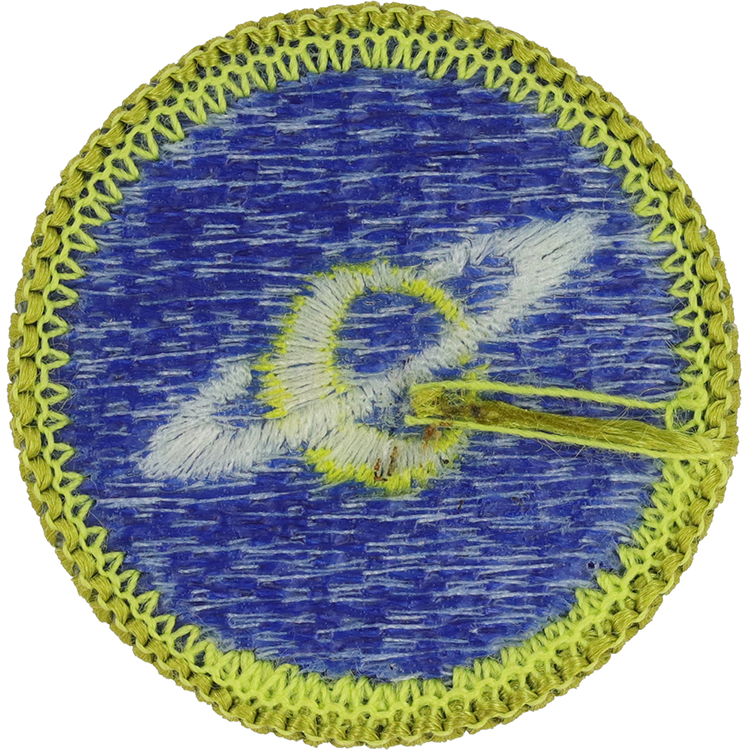
Fig. 2: Astron-H5-Reverse
- Back: Molded plastic
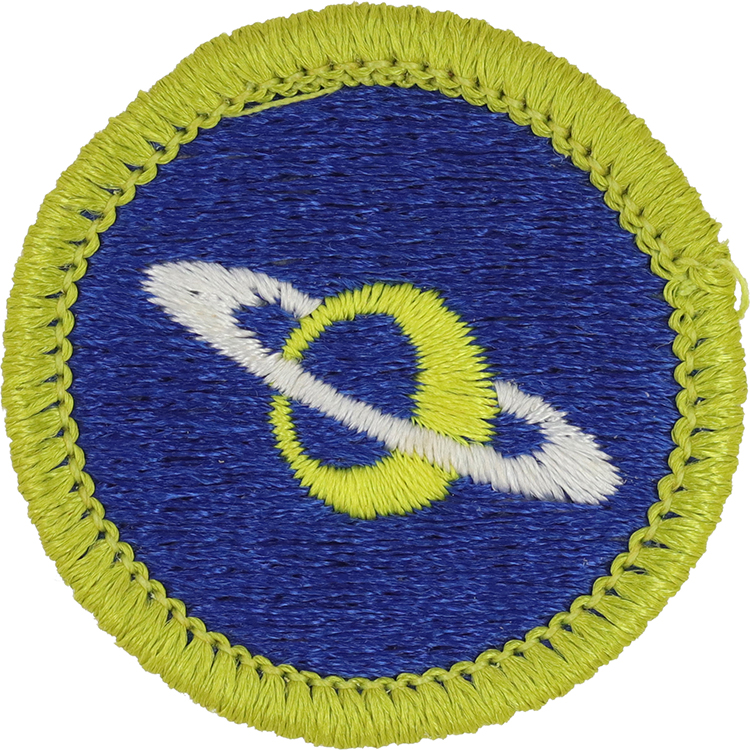
Fig. 3: Astron-H5-mve1-front
- Minor variation: Yellow border
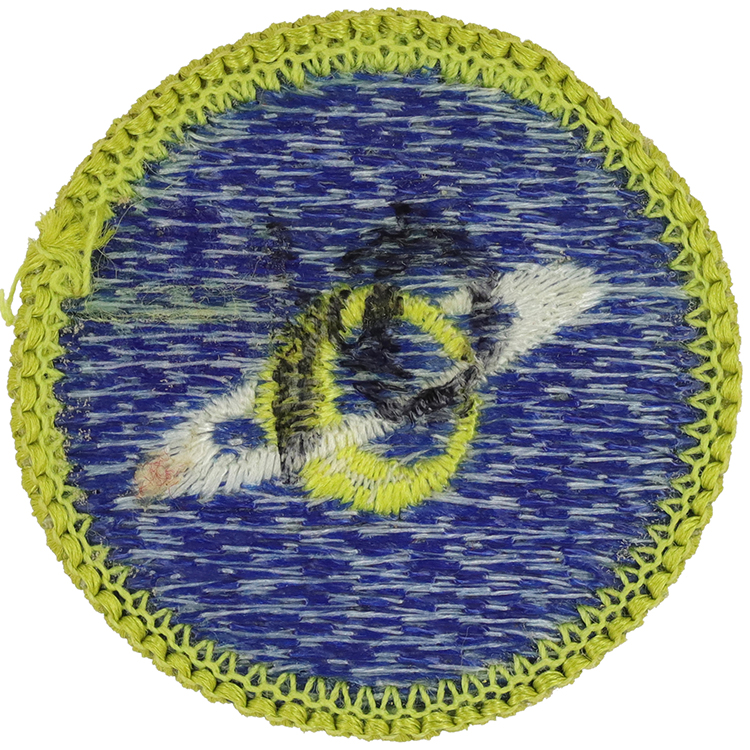
Fig. 4: Astron-H5-mve1-reverse
- Back: Molded plastic
Item Name: Astronomy 1990 - 2002
Item ID: Astron-H5
Collector Rating: 1
Pamphlets Used to Earn this Badge
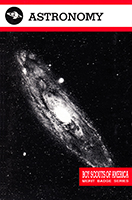
Requirements June 1972 until January 2005
1. Do the following:
(a) Sketch the face of the moon, indicating on it the locations of at least five seas and five craters.
(b) Within a single week sketch the position of the moon in the sky at the same hour on three different evenings. Explain the changes observed.
(c) Tell what factors keep the moon in orbit around the earth.
2. Do ONE of the following:
(a) Photograph or locate on a map of the sky a planet at approximately weekly intervals at the same time of night for at least 4 weeks. Explain any changes noticed on the photographs or map.
(b) Find out when each of the five visible planets will be observable in the evening sky during the next 12 months and compile this information in the form of a chart or table.
3. Do ONE of the following:
(a) In a sketch show the position of Venus, Mars, or Jupiter in the sky at approximately weekly intervals at the same time for at least 4 weeks.
(b) Using a compass, record the direction to the sun at sunset at approximately weekly intervals for at least 4 weeks in spring or fall (for 6 to 8 weeks in summer or winter) and relate this information to the seasons of the earth.
(c) With the aid of diagrams explain the relative positions of sun, earth, and moon at the times of lunar and solar eclipses and at the times of New, First Quarter, Full and Last Quarter phases of the moon.
4. Using the shadow of a vertical pole in sunshine, lay out a true north-south line (a meridian). Then, using the line and the pole on another day, measure the altitude of the noontime sun and determine your latitude.
5. Identify in the sky at least 10 constellations, four of which are in the Zodiac. Identify at least eight conspicuous stars, five of which are of first magnitude. Then do the following:
(a) Show in a sketch the position of the Big Dipper and its relation to the North Star and the horizon early some evening and again 6 hours later the same night. Record the date and time of making each sketch.
(b) Explain what we see when we look at the Milky Way.
6. With the aid of diagrams (or real telescopes if available) explain the difference between reflecting and refracting telescopes. Describe the basic purpose of a telescope, and list at least three other instruments used with telescopes.
7. Do the following:
(a) Visit a planetarium or observatory and submit a report to your counselor both on the activities occurring there and on the exhibits of instruments and other astronomical objects you observed.
(b) Spend at least 3 hours observing celestial objects through a telescope or field glass, and write a report for your counselor on what you observed.
9. Name different career opportunities in astronomy. Explain how to prepare for one of them. List the high school courses most useful in beginning such preparation.