-
Merit Badges
- Legend to identify Merit Badges
- 1910 British Merit Badges
- Square 1911 - 33
- Wide Crimped 1934 & 35
-
Narrow Tan Crimped 1936 - 42
- Tan Heavyweight Cloth with Silk Embroidery and Printed Back 1936 - 37
- Tan Heavyweight Cloth with Silk Embroidery and Plain Back 1937 - 38
- Tan Lightweight Cloth with Silk Embroidery and Plain Back 1938 - 39
- Tan Lightweight Cloth with Cotton Continuous Loop Embroidery and Plain Back 1939 - 42
- Tan Lightweight Cloth with Cotton Lockstitch Embroidery and Plain Back 1939 - 42
- Blue Background 1942 - 46
- Wartime 1942 - 46
- Khaki Narrow Crimped 1946 - 59
- Green Twill Gauze Back 1960 - 68
- Fully Embroidered Merrowed Edge 1960 - 72
- Unprinted Plastic Back 1972 - 01
- Printed Plastic Back 2002 - Current
-
Merit Badge Paper
- Merit Badge Applications
- Merit Badge Cards
-
Merit Badge Pamphlets
- Type 1 White Cover - Rectangle Drawing On Cover
- Type 2 White Cover 5-375" x 8" Title at Top
- Type 3A Tan Cover - 200 Fifth Avenue
- Type 3B Tan Cover - 2 line address New York City
- Type 3C Tan Cover - 2 line address New York N.Y.
- Type 3D Tan Cover - 1 line address New York N.Y.
- Type 4 Standing Scout Cover
- Type 5A War Cover
- Type 5B Red and White
- Type 6 Photo-Red Cover
- Type 7 Full Photo Cover or Bulls-eye Cover
- Type 8 Full Photo - Green Stripe Cover
- Type 9 Full Photo - Red Stripe Cover
- Type 10A Blue Stripe - Logo above bottom blue stripe - FDL centered
- Type 10B - Blue Stripe in bottom of photo area. FDL to left of text
- Special Covers
- Boy Craft Helps
- Merit Badge Counselor's Guides
-
Youth Position
- Junior Assistant Scoutmaster
- Senior Patrol Leader
- Assistant Senior Patrol Leader
- Patrol Leader
- Assistant Patrol Leader
- Troop Guide
- Scribe
- Quartermaster
- Instructor
- Chaplain Aide
- Den Chief
- Librarian
- Musician
- Webmaster
- Bugler
- Troop Historian
- Troop Representative
- Unit Representative
- Leadership Corps
- Honor Guard
- Leave No Trace Trainer
- Outdoor Ethics Guide
-
Patrol Medallions
- Patrol Medallions Introduction
- Legend to identify Patrol Medallions
- Patrol Shoulder Knot-Ribbons
- Felt Handmade Patrol Medallions
- Square Felt Patrol Medallions
- Round Broadcloth Patrol Medallions
- Red Twill Patrol Medallions
- Multi-Color Cloth Patrol Medallions
- Tan Cloth Patrol Medallions
- Patrol Medallion Back Patches
- Woodbadge Patrol Medallion
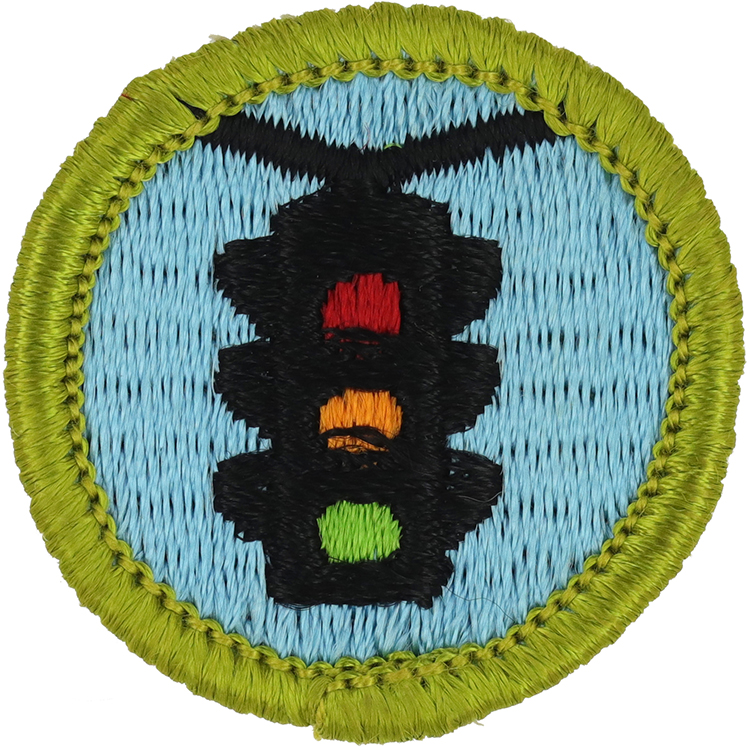
Fig. 1: AutSaf-G-Front
- Embroidery: Cotton thread
- Border: Merrowed
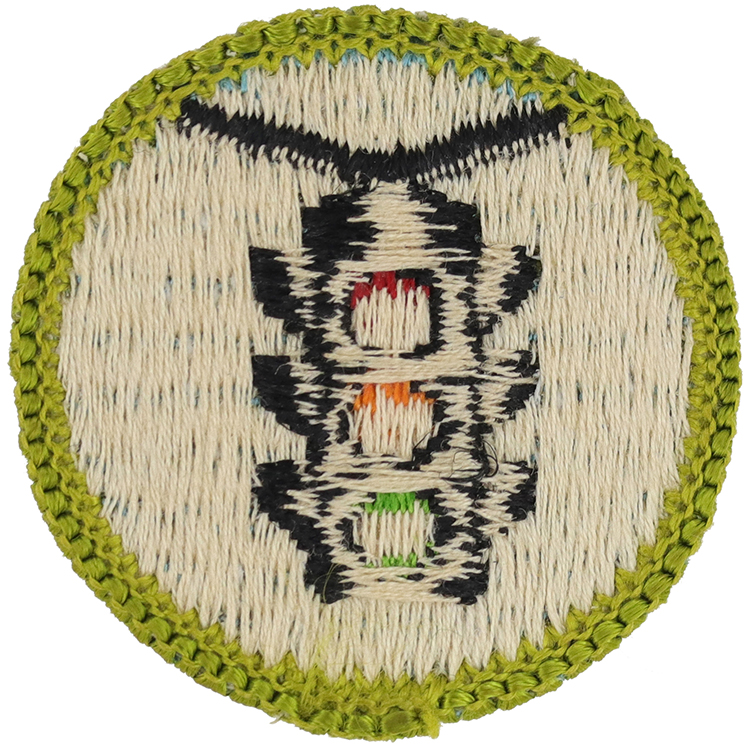
Fig. 2: AutSaf-G-Reverse
- Back: Starched cloth
Item Name: Automotive Safety 1969 - 1972
Item ID: AutSaf-G
Collector Rating: 1
Pamphlets Used to Earn this Badge
Requirements November 1969 until June 1972
1. On a car preferably one owned by your family, point out:
(a) At least ten items of supplemental safety equipment which are - or should be - present for accident prevention.
(b) At least three items of safety equipment or features are or should be present to reduce the chance of death or injury in case of an accident.
Explain the value, proper use, and maintenance of each.
2. Do the following to demonstrate your knowledge of car care for safety maintenance:
(a) Check operation of all exterior lights (high and low beam, front and rear directional signals, stop lights, license-plate light, taillights).
(b) Check operation of all interior lights (direction signal indicators, high-beam light, instrument panel lights, and others).
(c) Locate and change a fuse on the light or horn circuit.
(d) Check a windshield wiper blade by smear-and-clear test. Replace the blade and retest.
(e) Adjust rearview mirrors to obtain maximum vision when seated at the wheel, eliminating “blind” area to left rear at a distance of 20 feet from the rear of the car.
(f) With car stopped, check brake pedal with full pressure to determine whether the distance pedal travels is less than halfway. Then, hold full pressure for 30 seconds or more to make sure that no further pedal movement occurs.
3. At a service station, inspect tires for inside or outside defects. Examine the tires on a car (preferably the family car), including the spare, for safe condition. Check pressure with a gauge. Check once a week for a month and submit record. Explain conditions found, their meaning and corrections when required.
4. With stakes, mark out the distance necessary to stop a car traveling 60 miles per hour on dry pavement. Discuss additional allowances that bad weather and road conditions would require.
5. Be prepared to explain or answer questions about the seriousness and the size of the traffic accident problem in the United States, your state, and your community. Visit your police department, sheriff’s office, of state highway patrol and get information on at least two serious accident cases. From the evidence, tell what driving and safety rules were violated and how these accidents might have been prevented.
6. Do the following:
(a) Demonstrate six ways in which a passenger can contribute to the safe operation of a car in which he is riding and explain what you will do when you find yourself in a car being driven in a reckless manner.
(b) Using a bicycle, demonstrate four safe practices common to bicycle and automobile driving.
(c) Obtain the driver’s manual of your state. Point out to your merit badge counselor the requirements you must meet to obtain a driver’s license.
(d) Draw the shapes of the six basic traffic signs and explain the meaning of each.
7. Do ONE of the following three projects:
(a) Observe, study, and prepare a report on one important community activity for traffic safety.
(b) Report on a traffic safety project in which you participated with your troop or post.
(c) Report on an individual project that you carried out in promoting traffic safety.