-
Merit Badges
- Legend to identify Merit Badges
- 1910 British Merit Badges
- Square 1911 - 33
- Wide Crimped 1934 & 35
-
Narrow Tan Crimped 1936 - 42
- Tan Heavyweight Cloth with Silk Embroidery and Printed Back 1936 - 37
- Tan Heavyweight Cloth with Silk Embroidery and Plain Back 1937 - 38
- Tan Lightweight Cloth with Silk Embroidery and Plain Back 1938 - 39
- Tan Lightweight Cloth with Cotton Continuous Loop Embroidery and Plain Back 1939 - 42
- Tan Lightweight Cloth with Cotton Lockstitch Embroidery and Plain Back 1939 - 42
- Blue Background 1942 - 46
- Wartime 1942 - 46
- Khaki Narrow Crimped 1946 - 59
- Green Twill Gauze Back 1960 - 68
- Fully Embroidered Merrowed Edge 1960 - 72
- Unprinted Plastic Back 1972 - 01
- Printed Plastic Back 2002 - Current
-
Merit Badge Paper
- Merit Badge Applications
- Merit Badge Cards
-
Merit Badge Pamphlets
- Type 1 White Cover - Rectangle Drawing On Cover
- Type 2 White Cover 5-375" x 8" Title at Top
- Type 3A Tan Cover - 200 Fifth Avenue
- Type 3B Tan Cover - 2 line address New York City
- Type 3C Tan Cover - 2 line address New York N.Y.
- Type 3D Tan Cover - 1 line address New York N.Y.
- Type 4 Standing Scout Cover
- Type 5A War Cover
- Type 5B Red and White
- Type 6 Photo-Red Cover
- Type 7 Full Photo Cover or Bulls-eye Cover
- Type 8 Full Photo - Green Stripe Cover
- Type 9 Full Photo - Red Stripe Cover
- Type 10A Blue Stripe - Logo above bottom blue stripe - FDL centered
- Type 10B - Blue Stripe in bottom of photo area. FDL to left of text
- Special Covers
- Boy Craft Helps
- Merit Badge Counselor's Guides
-
Youth Position
- Junior Assistant Scoutmaster
- Senior Patrol Leader
- Assistant Senior Patrol Leader
- Patrol Leader
- Assistant Patrol Leader
- Troop Guide
- Scribe
- Quartermaster
- Instructor
- Chaplain Aide
- Den Chief
- Librarian
- Musician
- Webmaster
- Bugler
- Troop Historian
- Troop Representative
- Unit Representative
- Leadership Corps
- Honor Guard
- Leave No Trace Trainer
- Outdoor Ethics Guide
-
Patrol Medallions
- Patrol Medallions Introduction
- Legend to identify Patrol Medallions
- Patrol Shoulder Knot-Ribbons
- Felt Handmade Patrol Medallions
- Square Felt Patrol Medallions
- Round Broadcloth Patrol Medallions
- Red Twill Patrol Medallions
- Multi-Color Cloth Patrol Medallions
- Tan Cloth Patrol Medallions
- Patrol Medallion Back Patches
- Woodbadge Patrol Medallion
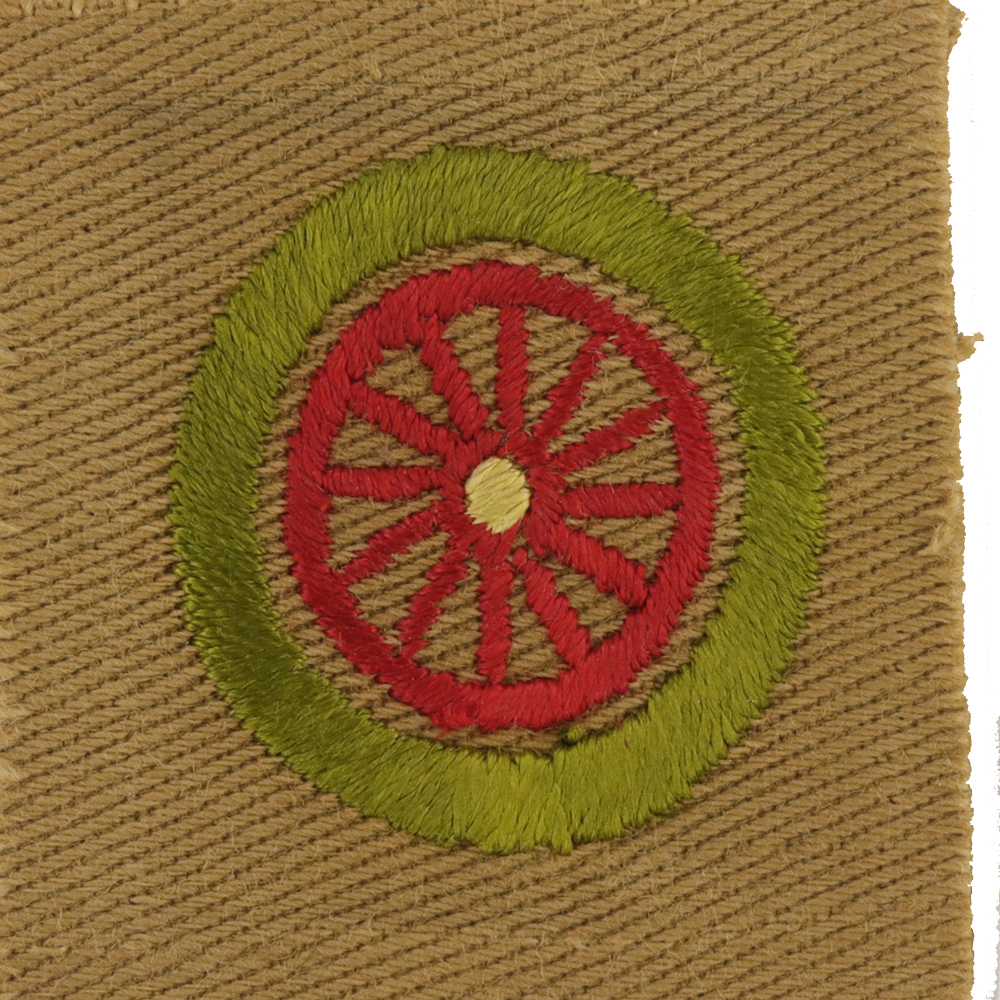
Fig. 1: Automo-AH09-Front
- Cloth: Heavyweight tan right twill
- Embroidery: Silk continuous
- Border: Clockwise, round & dense
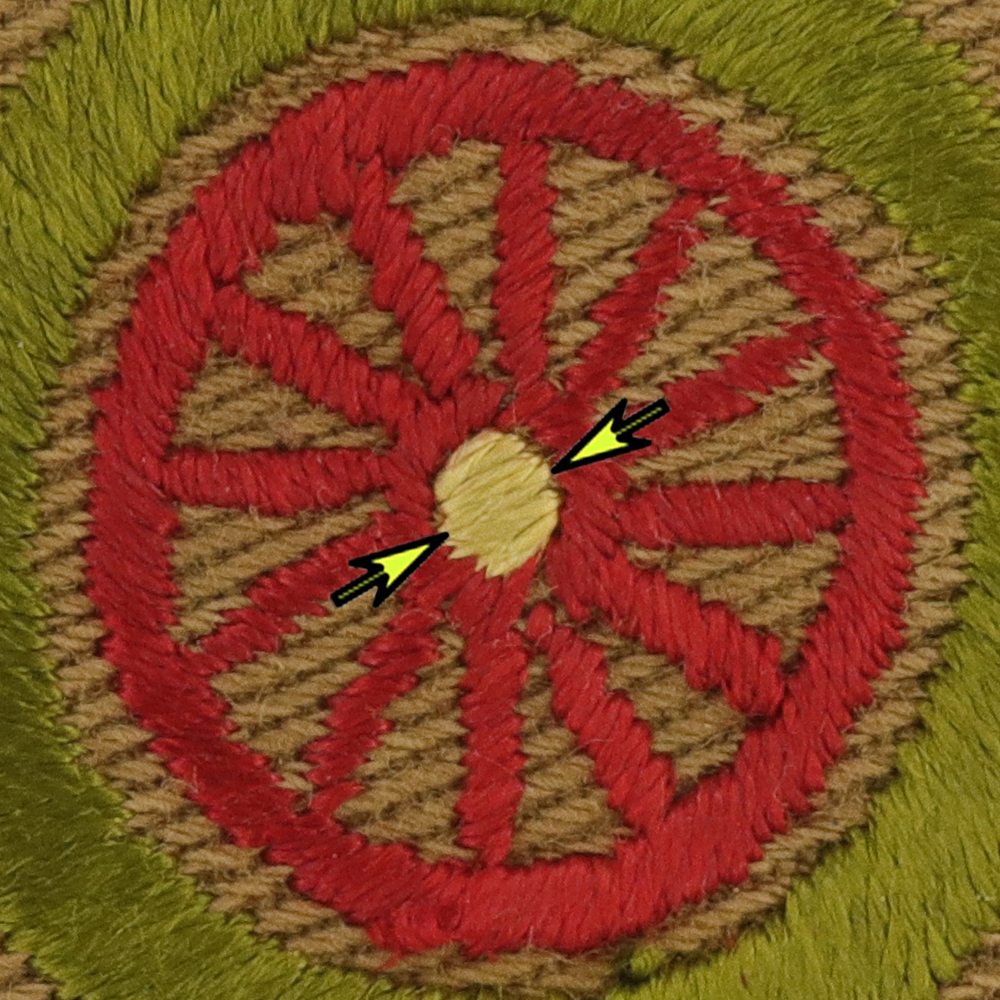
Fig. 2: Automo-AH09-Magnified
- Design: 12 spokes, NO valve, yellow 45 degree stitched center
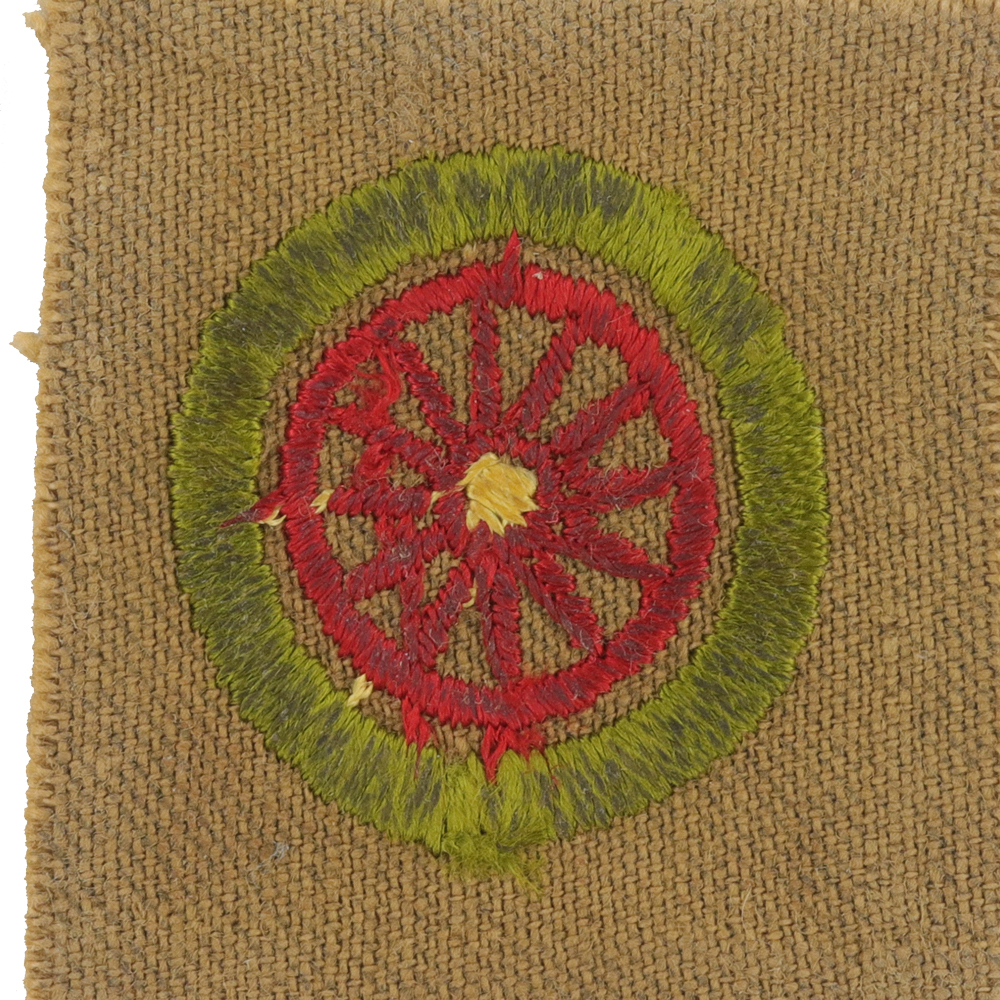
Fig. 3: Automo-AH09-Reverse
- Back: Brown imprint
Item Name: Automobiling 1913 - 1921
Item ID: Automo-AH09
Collector Rating: 1
Pamphlets Used to Earn this Badge
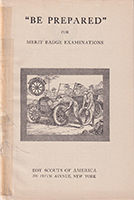
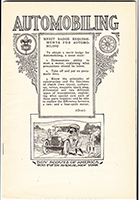
Requirements August 1911 until October 1914
1. Demonstrate how to start a motor, explaining what precautions should be taken.
2. Take off and put on pneumatic tires.
3. Know the function of a clutch, carburetor, valves, magneto, spark plug, differential cam shaft, and different speed gears, and be able to explain the difference between a two and four-cycle motor.
4. Know how to put out burning gasoline or oil.
5. Have satisfactorily passed the requirements to receive a license to operate an automobile in the community in which he lives.
Requirements October 1914 until December 1917
1. Demonstrate ability to start a motor, explaining what precautions should be taken.
2. Take off and put on pneumatic tires.
3. Know the principle of construction and the functions of clutch (two types), carburetor, valves, magneto, spark plug, differential, and two different types of transmission, explaining what special care each of these parts requires; and be able to explain three differences between a two- and a four-cycle motor.
4. Know how to put out burning gasoline or oil.
5. Be able to pass an examination equivalent to that required for a license to operate an automobile in the community in which he lives.
Requirements December 1918 until January 1921
1. Demonstrate ability to start a motor, explaining when precautions should be taken.
2. Take off and put on pneumatic tires.
3. Know the principles of construction and the functions of clutch (two types), carburetor, valves, magneto, spark plug, differential, and two different types of transmission, explaining what special care each of these parts requires; and be able to explain three differences between a two- and a four-cycle motor.
4. Know how to put out burning gasoline or oil.
5. Be able to pass an examination equivalent to that required for a license to operate an automobile in the community in which he lives.