-
Merit Badges
- Legend to identify Merit Badges
- 1910 British Merit Badges
- Square 1911 - 33
- Wide Crimped 1934 & 35
-
Narrow Tan Crimped 1936 - 42
- Tan Heavyweight Cloth with Silk Embroidery and Printed Back 1936 - 37
- Tan Heavyweight Cloth with Silk Embroidery and Plain Back 1937 - 38
- Tan Lightweight Cloth with Silk Embroidery and Plain Back 1938 - 39
- Tan Lightweight Cloth with Cotton Continuous Loop Embroidery and Plain Back 1939 - 42
- Tan Lightweight Cloth with Cotton Lockstitch Embroidery and Plain Back 1939 - 42
- Blue Background 1942 - 46
- Wartime 1942 - 46
- Khaki Narrow Crimped 1946 - 59
- Green Twill Gauze Back 1960 - 68
- Fully Embroidered Merrowed Edge 1960 - 72
- Unprinted Plastic Back 1972 - 01
- Printed Plastic Back 2002 - Current
-
Merit Badge Paper
- Merit Badge Applications
- Merit Badge Cards
-
Merit Badge Pamphlets
- Type 1 White Cover - Rectangle Drawing On Cover
- Type 2 White Cover 5-375" x 8" Title at Top
- Type 3A Tan Cover - 200 Fifth Avenue
- Type 3B Tan Cover - 2 line address New York City
- Type 3C Tan Cover - 2 line address New York N.Y.
- Type 3D Tan Cover - 1 line address New York N.Y.
- Type 4 Standing Scout Cover
- Type 5A War Cover
- Type 5B Red and White
- Type 6 Photo-Red Cover
- Type 7 Full Photo Cover or Bulls-eye Cover
- Type 8 Full Photo - Green Stripe Cover
- Type 9 Full Photo - Red Stripe Cover
- Type 10A Blue Stripe - Logo above bottom blue stripe - FDL centered
- Type 10B - Blue Stripe in bottom of photo area. FDL to left of text
- Special Covers
- Boy Craft Helps
- Merit Badge Counselor's Guides
-
Youth Position
- Junior Assistant Scoutmaster
- Senior Patrol Leader
- Assistant Senior Patrol Leader
- Patrol Leader
- Assistant Patrol Leader
- Troop Guide
- Scribe
- Quartermaster
- Instructor
- Chaplain Aide
- Den Chief
- Librarian
- Musician
- Webmaster
- Bugler
- Troop Historian
- Troop Representative
- Unit Representative
- Leadership Corps
- Honor Guard
- Leave No Trace Trainer
- Outdoor Ethics Guide
-
Patrol Medallions
- Patrol Medallions Introduction
- Legend to identify Patrol Medallions
- Patrol Shoulder Knot-Ribbons
- Felt Handmade Patrol Medallions
- Square Felt Patrol Medallions
- Round Broadcloth Patrol Medallions
- Red Twill Patrol Medallions
- Multi-Color Cloth Patrol Medallions
- Tan Cloth Patrol Medallions
- Patrol Medallion Back Patches
- Woodbadge Patrol Medallion
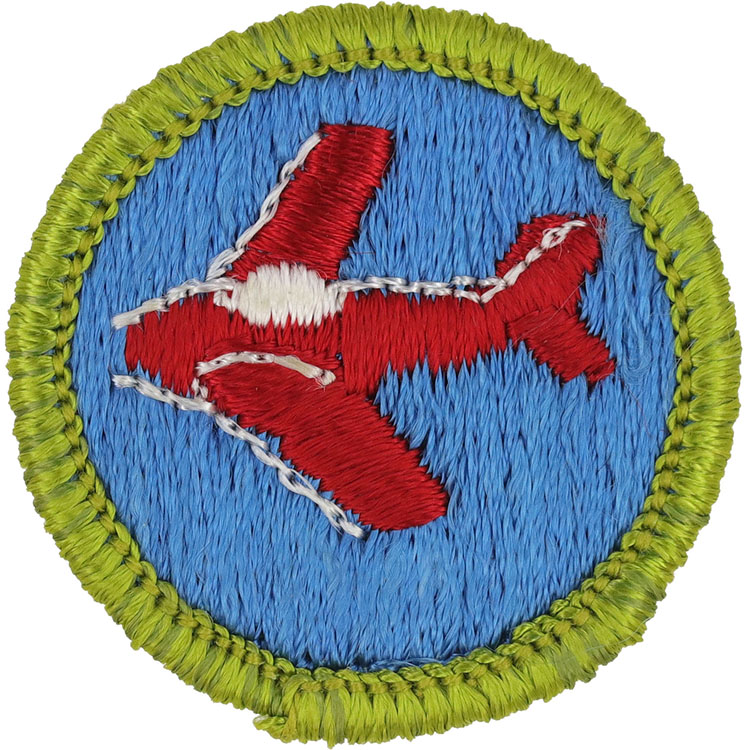
Fig. 1: Aviati-H1-Front
- Embroidery: Cotton thread
- Border: Merrowed
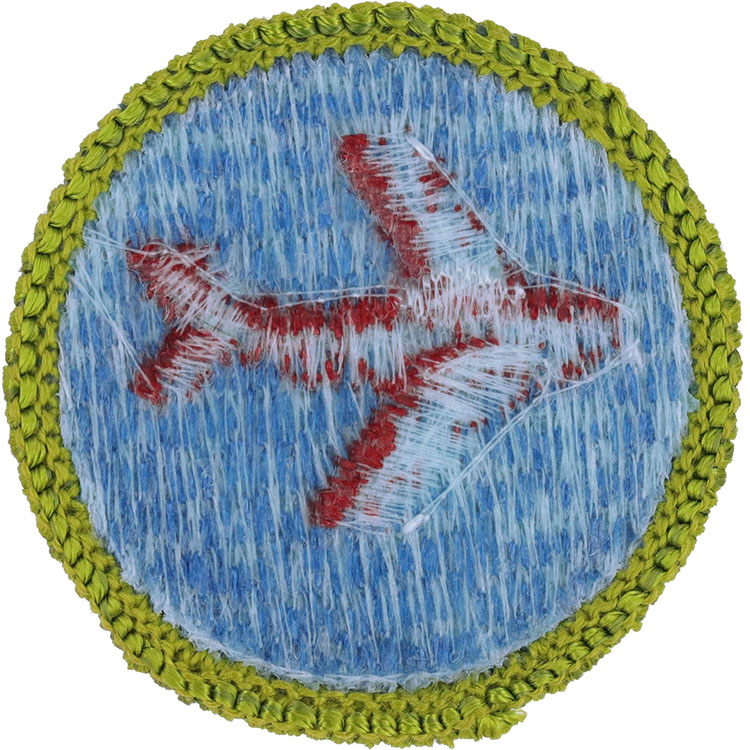
Fig. 2: Aviati-H1-Reverse
- Back: Blue plastic with waffle pattern
Item Name: Aviation 1972 - 1975
Item ID: Aviati-H1
Collector Rating: 1
Pamphlets Used to Earn this Badge
Requirements June 1972 until September 1987
1. Do the following:
(a) Describe how aviation has affected our world.
(b) Define “aircraft.” Describe some kinds of aircraft in use today.
(c) List at least 10 uses of aircraft.
2. Do the following:
(a) Point out on a model plane the forces which act on an airplane in flight.
(b) Show one other principle basic to flight.
(c) Build a model airfoil wing section. Show with it the principle of lift; or build demonstration airfoils to compare the drag of streamlined and nonstreamlined surfaces.
3. Show how the control surfaces of an airplane are used for takeoff, straight climb, level turn, climbing turn, descending turn, straight descent and landing.
4. Identify the following aircraft instruments. Explain the purposes of each: altimeter, airspeed indicator, compass, turn and bank indicator, tachometer, and oil-pressure and temperature gauges.
5. Show you know the International Phonetic Alphabet.
6. Explain the differences in the operation of piston, turboprop, pure jet, and rocket types of engines.
7. Tell six rules of safety to follow around airplanes and airports. Describe safety rules for building and flying model airplanes. Tell safety rules for use of glue, paint, dope, and plastics.
8. Build and fly a rise-off-ground model airplane (you may use a kit but must carve the propeller yourself); or build two solid scale model planes (kits may be used).
9. Do any TWO of the following:
(a) Take a flight in an aircraft. Record the date, place, type of aircraft, duration of flight, and your impressions of the flight.
(b) On a map mark a route for an imaginary air trip of at least 3,000 miles. Start from the commercial airport nearest your home. Travel over three or more different airlines. From timetables decide when you will get to and leave all connecting points. List places of interest and geographical features to see on the trip.
(c) Visit a modern airport. After the visit tell how the facilities were used.
(d) Make a checklist for a routine preflight inspection of a light plane.
(e) Learn how to read an aeronautical chart. Measure a true course on the chart. Correct it for magnetic variation, compass deviation, and wind drift. Arrive at a compass heading.
(f) Build a gasoline-powered rise-off-ground model plane that will take off and land; or fly a radio-controlled model plane (a kit may be used).
(g) Take part in a model air meet recognized by the Academy of Model Aeronautics.
(h) Find out what job opportunities there are in aviation. Describe the qualifications and working conditions of one job in which you are interested. Tell what it offers for reaching your goal in life.