-
Merit Badges
- Legend to identify Merit Badges
- 1910 British Merit Badges
- Square 1911 - 33
- Wide Crimped 1934 & 35
-
Narrow Tan Crimped 1936 - 42
- Tan Heavyweight Cloth with Silk Embroidery and Printed Back 1936 - 37
- Tan Heavyweight Cloth with Silk Embroidery and Plain Back 1937 - 38
- Tan Lightweight Cloth with Silk Embroidery and Plain Back 1938 - 39
- Tan Lightweight Cloth with Cotton Continuous Loop Embroidery and Plain Back 1939 - 42
- Tan Lightweight Cloth with Cotton Lockstitch Embroidery and Plain Back 1939 - 42
- Blue Background 1942 - 46
- Wartime 1942 - 46
- Khaki Narrow Crimped 1946 - 59
- Green Twill Gauze Back 1960 - 68
- Fully Embroidered Merrowed Edge 1960 - 72
- Unprinted Plastic Back 1972 - 01
- Printed Plastic Back 2002 - Current
-
Merit Badge Paper
- Merit Badge Applications
- Merit Badge Cards
-
Merit Badge Pamphlets
- Type 1 White Cover - Rectangle Drawing On Cover
- Type 2 White Cover 5-375" x 8" Title at Top
- Type 3A Tan Cover - 200 Fifth Avenue
- Type 3B Tan Cover - 2 line address New York City
- Type 3C Tan Cover - 2 line address New York N.Y.
- Type 3D Tan Cover - 1 line address New York N.Y.
- Type 4 Standing Scout Cover
- Type 5A War Cover
- Type 5B Red and White
- Type 6 Photo-Red Cover
- Type 7 Full Photo Cover or Bulls-eye Cover
- Type 8 Full Photo - Green Stripe Cover
- Type 9 Full Photo - Red Stripe Cover
- Type 10A Blue Stripe - Logo above bottom blue stripe - FDL centered
- Type 10B - Blue Stripe in bottom of photo area. FDL to left of text
- Special Covers
- Boy Craft Helps
- Merit Badge Counselor's Guides
-
Youth Position
- Junior Assistant Scoutmaster
- Senior Patrol Leader
- Assistant Senior Patrol Leader
- Patrol Leader
- Assistant Patrol Leader
- Troop Guide
- Scribe
- Quartermaster
- Instructor
- Chaplain Aide
- Den Chief
- Librarian
- Musician
- Webmaster
- Bugler
- Troop Historian
- Troop Representative
- Unit Representative
- Leadership Corps
- Honor Guard
- Leave No Trace Trainer
- Outdoor Ethics Guide
-
Patrol Medallions
- Patrol Medallions Introduction
- Legend to identify Patrol Medallions
- Patrol Shoulder Knot-Ribbons
- Felt Handmade Patrol Medallions
- Square Felt Patrol Medallions
- Round Broadcloth Patrol Medallions
- Red Twill Patrol Medallions
- Multi-Color Cloth Patrol Medallions
- Tan Cloth Patrol Medallions
- Patrol Medallion Back Patches
- Woodbadge Patrol Medallion

Fig. 1: BeeKee-AT2-Front
- Cloth: Heavyweight tan right twill
- Embroidery: Silk continuous
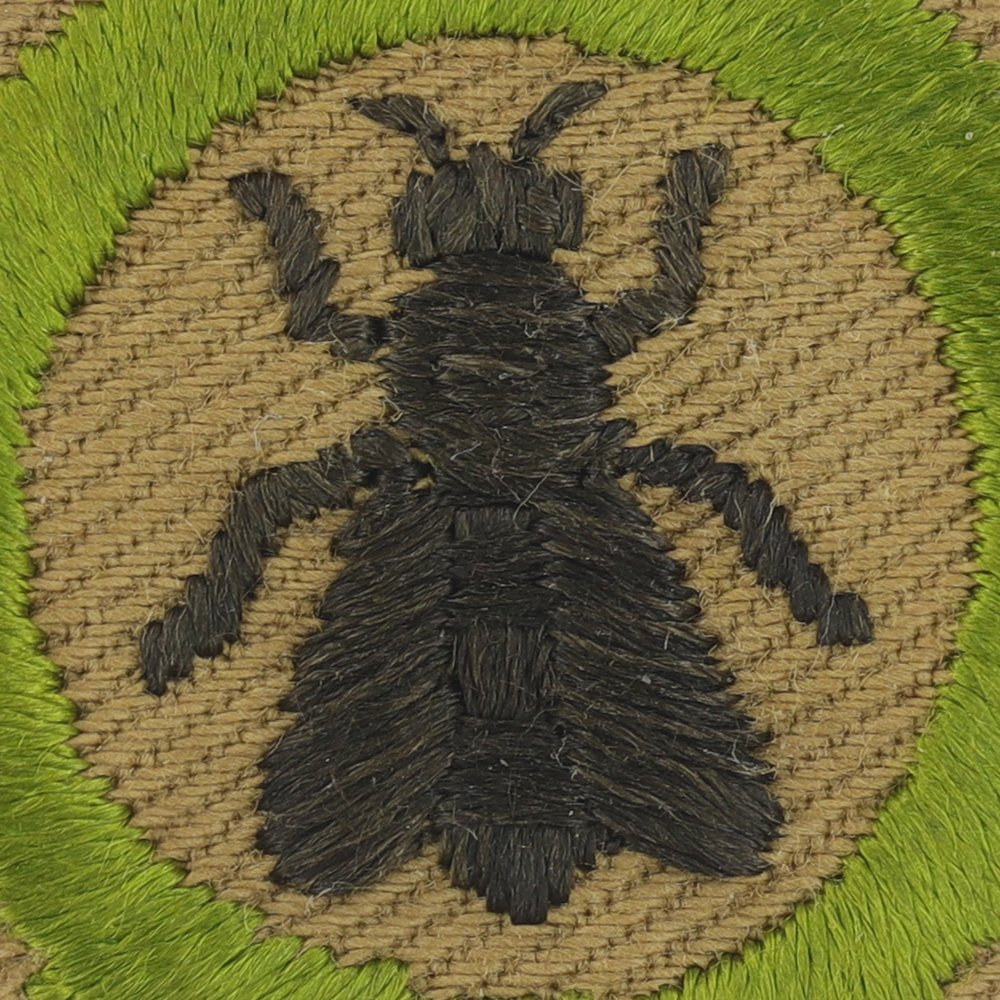
Fig. 2: BeeKee-AT2-Magnified
- Design: Left and right wing over abdomen
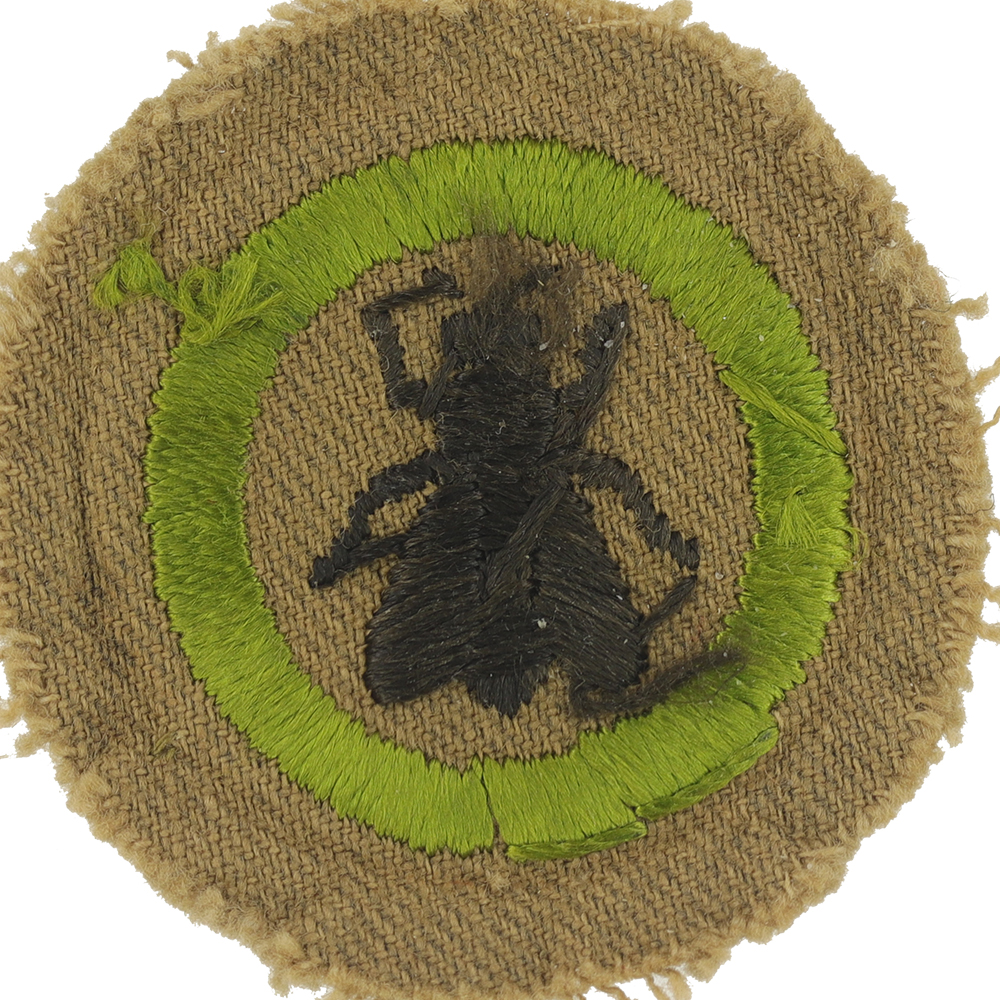
Fig. 3: BeeKee-AT2-Reverse
- Back: Black imprint

Fig. 4: BeeKee-AT1-error3-front
- Manufacturing error: Type 3 error; twill back

Fig. 5: BeeKee-AT1-error3-reverse
- Back: Black imprint
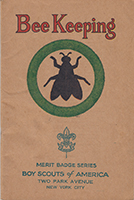
Item Name: Bee Keeping 1920 - 1933
Item ID: BeeKee-AT2
Collector Rating: 1
Pamphlets Used to Earn this Badge
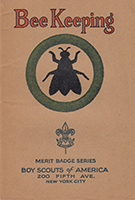
Requirements March 1915 until August 1922
1. Know how to examine a colony of bees, remove the combs, find the queen, and determine the amount of the brood, number of queen cells, and the amount of honey in the hive.
2. Distinguish between the drones, workers, eggs, larvae, pupae, honey, wax, pollen, and propolis; tell how the bees make the honey, and where the wax comes from; and explain the part played in the life of the colony by the queen, the drones, and the workers.
3. Have had experience in hiving at least one swarm. Explain the construction of the modern hive, especially in regard to the “Bee Spaces.”
4. Put foundations in sections and fill supers with sections; and also remove filled supers from the hive and prepare the honey for market.
5. Write an acceptable article of not more than two hundred words on the differences in honeys according to the flowers from which the nectar is obtained.
Requirements August 1922 until April 1923
1. Demonstrate how to examine a colony of bees, remove the combs, find the queen, and determine the amount of the brood, number of queen cells, and the amount of honey in the hive.
2. Distinguish between the drones, workers, eggs, larvae, pupae, honey, wax, pollen, and propolis; tell how the bees make the honey, and where the wax comes from; and explain the part played in the life of the colony by the queen, the drones, and the workers.
3. Have had experience in hiving at least one swarm. Explain the construction of the modern hive, especially in regard to the “Bee Spaces.”
4. Put foundations in sections and fill supers with sections; and also remove filled supers from the hive and prepare the honey for market.
5. Write an acceptable article of not more than two hundred words on the differences in honeys according to the flowers from which the nectar is obtained.
Requirements April 1923 until May 1925
1. Demonstrate how to examine a colony of bees, remove the combs, find the queen, and determine the amount of the brood, number of queen cells, and the amount of honey in the hive.
2. Distinguish between the drones, workers, eggs, larvae, pupae, honey, wax, pollen, and propolis; tell how the bees make the honey, and where the wax comes from; and explain the part played in the life of the colony by the queen, the drones, and the workers.
3. Have had experience in hiving or artificially dividing at least one swarm. Explain the construction of the modern hive, especially in regard to the “Bee Spaces.”
4. Put foundations in sections and fill supers with sections; and also remove filled supers from the hive and prepare the honey for market.
5. Write an acceptable article of not more than two hundred words on the differences in honeys according to the flowers from which the nectar is obtained.
Requirements May 1925 until November 1927
1. Examine a colony of bees, remove the combs, find the queen, and determine the amount of the brood, number of queen cells, and the amount of honey in the hive.
2. Distinguish between the drones, workers, eggs, larvae, pupae, honey, wax, pollen, and propolis; tell how the bees make the honey, and where the wax comes from; and explain the part played in the life of the colony by the queen, the drones, and the workers.
3. Have had experience in hiving or artificially dividing at least one swarm. Explain the construction of the modern hive, especially in regard to the “Bee Spaces.”
4. Put foundations in sections and fill supers with sections; and also remove filled supers from the hive and prepare the honey for market.
5. Write an acceptable article of not more than two hundred words on the differences in honeys according to the flowers from which the nectar is obtained.
Requirements January 1928 until June 1948
1. Examine a colony of bees, remove the combs, find the queen, and determine the amount of the brood, number of queen cells, and the amount of honey in the hive.
2. Distinguish between the drones, workers, eggs, larvae, pupae, honey, wax, pollen, and propolis; tell how the bees make the honey, and where the wax comes from; and explain the part played in the life of the colony by the queen, the drones, and the workers.
3. Have had experience in hiving or artificially dividing at least one swarm. Explain the construction of the modern hive, especially in regard to the “Bee Spaces.”
4. Put foundations in sections and fill supers with sections; and also remove filled supers from the hive and prepare the honey for market.
5. Write an acceptable article of not more than two hundred words on the differences in honeys according to the flowers from which the nectar is obtained.
OR
Comply with the 4H Club or home Project Requirements in Bee Keeping as follows:
1. Own a hive of bees.
2. Do all work in care and management of the hive of bees.
3. Keep accurate cost account record of Bee Keeping during the season or year.
4. Exhibit honey samples as required by leaders in charge of 4H Club work.
5. Make complete report at the end of season or year as required by leaders showing profit or loss.