-
Merit Badges
- Legend to identify Merit Badges
- 1910 British Merit Badges
- Square 1911 - 33
- Wide Crimped 1934 & 35
-
Narrow Tan Crimped 1936 - 42
- Tan Heavyweight Cloth with Silk Embroidery and Printed Back 1936 - 37
- Tan Heavyweight Cloth with Silk Embroidery and Plain Back 1937 - 38
- Tan Lightweight Cloth with Silk Embroidery and Plain Back 1938 - 39
- Tan Lightweight Cloth with Cotton Continuous Loop Embroidery and Plain Back 1939 - 42
- Tan Lightweight Cloth with Cotton Lockstitch Embroidery and Plain Back 1939 - 42
- Blue Background 1942 - 46
- Wartime 1942 - 46
- Khaki Narrow Crimped 1946 - 59
- Green Twill Gauze Back 1960 - 68
- Fully Embroidered Merrowed Edge 1960 - 72
- Unprinted Plastic Back 1972 - 01
- Printed Plastic Back 2002 - Current
-
Merit Badge Paper
- Merit Badge Applications
- Merit Badge Cards
-
Merit Badge Pamphlets
- Type 1 White Cover - Rectangle Drawing On Cover
- Type 2 White Cover 5-375" x 8" Title at Top
- Type 3A Tan Cover - 200 Fifth Avenue
- Type 3B Tan Cover - 2 line address New York City
- Type 3C Tan Cover - 2 line address New York N.Y.
- Type 3D Tan Cover - 1 line address New York N.Y.
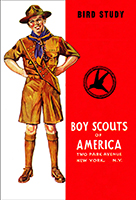
- Type 4 Standing Scout Cover
- Type 5A War Cover
- Type 5B Red and White
- Type 6 Photo-Red Cover
- Type 7 Full Photo Cover or Bulls-eye Cover
- Type 8 Full Photo - Green Stripe Cover
- Type 9 Full Photo - Red Stripe Cover
- Type 10A Blue Stripe - Logo above bottom blue stripe - FDL centered
- Type 10B - Blue Stripe in bottom of photo area. FDL to left of text
- Special Covers
- Boy Craft Helps
- Merit Badge Counselor's Guides
-
Youth Position
- Junior Assistant Scoutmaster
- Senior Patrol Leader
- Assistant Senior Patrol Leader
- Patrol Leader
- Assistant Patrol Leader
- Troop Guide
- Scribe
- Quartermaster
- Instructor
- Chaplain Aide
- Den Chief
- Librarian
- Musician
- Webmaster
- Bugler
- Troop Historian
- Troop Representative
- Unit Representative
- Leadership Corps
- Honor Guard
- Leave No Trace Trainer
- Outdoor Ethics Guide
-
Patrol Medallions
- Patrol Medallions Introduction
- Legend to identify Patrol Medallions
- Patrol Shoulder Knot-Ribbons
- Felt Handmade Patrol Medallions
- Square Felt Patrol Medallions
- Round Broadcloth Patrol Medallions
- Red Twill Patrol Medallions
- Multi-Color Cloth Patrol Medallions
- Tan Cloth Patrol Medallions
- Patrol Medallion Back Patches
- Woodbadge Patrol Medallion
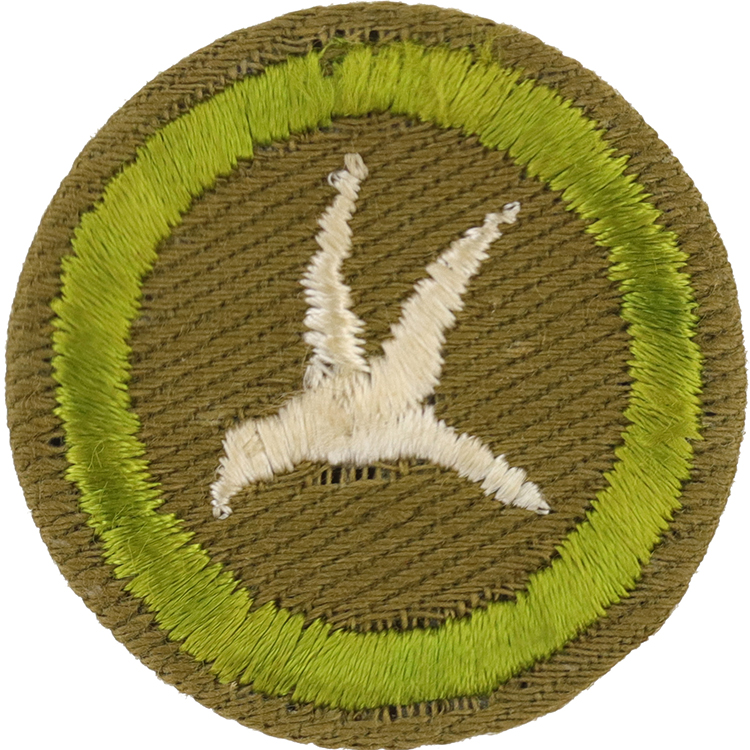
Fig. 1: BirStu-C5-Front
- Cloth: Lightweight tan right twill
- Embroidery: Cotton lock stitch
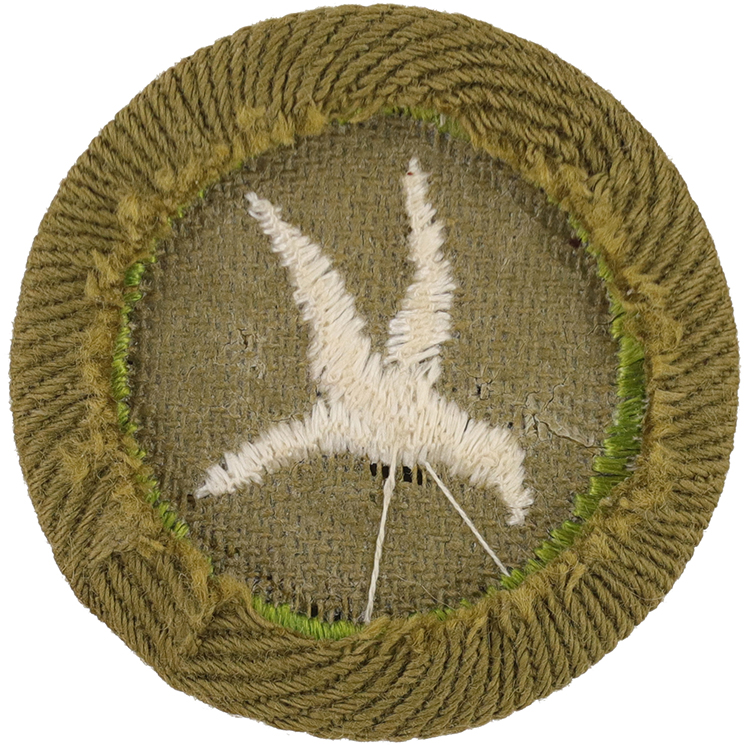
Fig. 2: BirStu-C5-Reverse
- Back: Plain NO imprint with starch
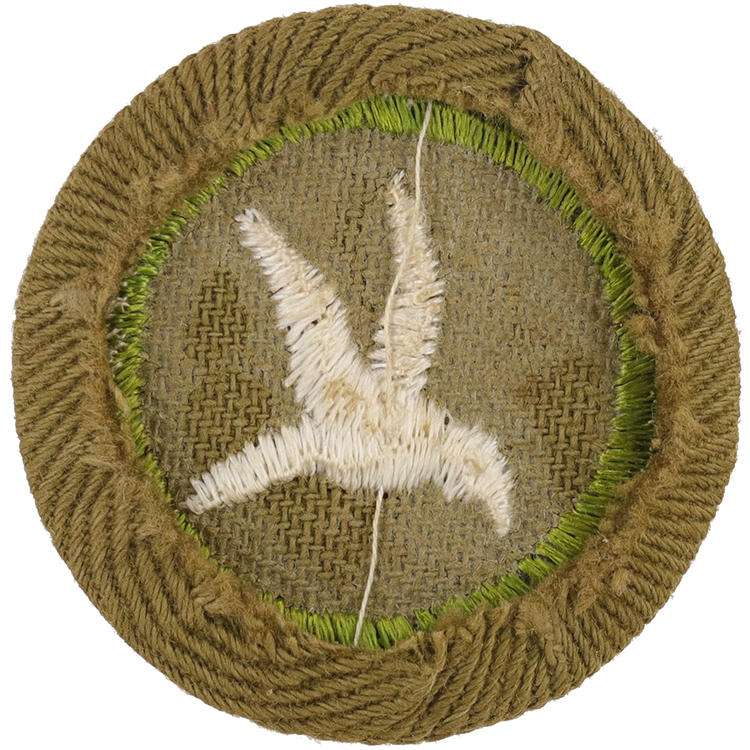
Fig. 3: BirStu-C5-mve1-reverse
- Minor variation: Body size, eye differences
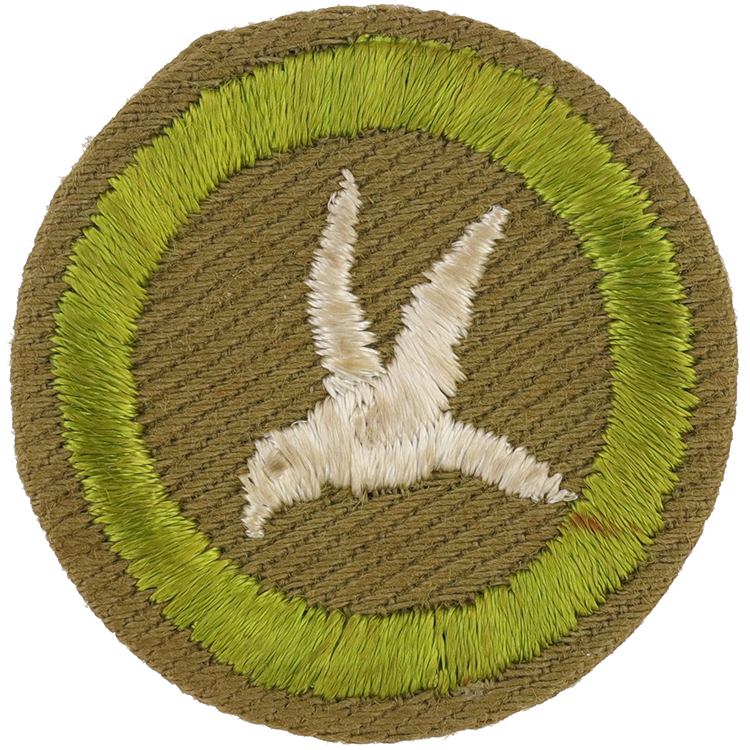
Fig. 4: BirStu-C5-mve1-front
- Back: Plain NO imprint with starch
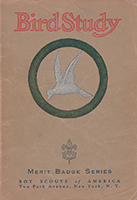
Item Name: Bird Study 1939 - 1943
Item ID: BirStu-C5
Collector Rating: 1
Pamphlets Used to Earn this Badge
Requirements January 1 1938 until December 1943. Between September 7 1937 and January 1 1938 these requirements were optional
1. Produce a list of forty species of wild birds which have been personally observed and positively identified in the field and tell how to differentiate each from those other species with which it might be confused.
2. Produce a list showing the greatest number of species that he has seen in the field in one week.
3. Produce a list derived form personal reading of:
a. Twenty species of birds particularly noted for their value to agriculture in the destruction of insects and weed seeds.
b. Ten birds of prey particularly useful in the destruction of rats and mice.
c. Ten species of fish-eating birds, and tell why they are not inimical to man's interests.
4. Describe at least two bird boxes and two food tables that have been erected by him, the species of birds that have been attracted by them, and how many of the birds have nested in these boxes.
5. From personal observation name and describe the birds he has seen in three different habitats (open fields, woodlands, farmland, marsh, etc.) and tell why all birds do not choose the same habitat. Make at least three visits to each type of countryside.
or
Make a census of the bird-life of a 25-acre tract by systematically covering the ground on three separate days and listing the species and number of individuals of each observed.
6. State what he did to protect birds from slaughter; and to promote the creation of bird preserves and sanctuaries.
(BIRD STUDY IN HAWAII)
Since it is impossible for Scouts on the Hawaiian Islands to meet the requirements in Bird Study, as the required number of birds is not to be found on the Islands, these requirements are official for use in the Hawaiian Islands only, but in no other section.
1. Ascertain the approximate number of species of wild birds that occur in the Hawaiian group, and name and describe not less than seven species that have been personally observed by him, giving the English and Hawaiian name of each, and tell something of the home life (or habits) of each species of the seven.
2. Produce a list of all introduced species of birds found in the Islands and tell something of interest about each.
3. Name all species common to the Island where the Scout resides that are beneficial or detrimental to agriculture, giving reasons in each case.
4. Produce a list, from general reading, of ten birds of prey, from any country, that feed on rats and mice; ten that feed largely on fish; ten that feed on both animal and plant food.
5. State what is done by the Territory in the way of bird protection, and tell about the location, extent and purpose of the Hawaiian Island Bird Reservation.
6. State the reason for not building bird boxes in Hawaii. Tell why Scouts on mainland are encouraged to build bird boxes, food tables, etc., for the use of birds.
7. Name and briefly describe several birds from reading or from a visit to the museum, that are very rare or extinct. How many birds in the Hawaiian group are found in no other locality in the world; how many extinct species are known to have lived in Oahu?