-
Merit Badges
- Legend to identify Merit Badges
- 1910 British Merit Badges
- Square 1911 - 33
- Wide Crimped 1934 & 35
-
Narrow Tan Crimped 1936 - 42
- Tan Heavyweight Cloth with Silk Embroidery and Printed Back 1936 - 37
- Tan Heavyweight Cloth with Silk Embroidery and Plain Back 1937 - 38
- Tan Lightweight Cloth with Silk Embroidery and Plain Back 1938 - 39
- Tan Lightweight Cloth with Cotton Continuous Loop Embroidery and Plain Back 1939 - 42
- Tan Lightweight Cloth with Cotton Lockstitch Embroidery and Plain Back 1939 - 42
- Blue Background 1942 - 46
- Wartime 1942 - 46
- Khaki Narrow Crimped 1946 - 59
- Green Twill Gauze Back 1960 - 68
- Fully Embroidered Merrowed Edge 1960 - 72
- Unprinted Plastic Back 1972 - 01
- Printed Plastic Back 2002 - Current
-
Merit Badge Paper
- Merit Badge Applications
- Merit Badge Cards
-
Merit Badge Pamphlets
- Type 1 White Cover - Rectangle Drawing On Cover
- Type 2 White Cover 5-375" x 8" Title at Top
- Type 3A Tan Cover - 200 Fifth Avenue
- Type 3B Tan Cover - 2 line address New York City
- Type 3C Tan Cover - 2 line address New York N.Y.
- Type 3D Tan Cover - 1 line address New York N.Y.
- Type 4 Standing Scout Cover
- Type 5A War Cover
- Type 5B Red and White
- Type 6 Photo-Red Cover
- Type 7 Full Photo Cover or Bulls-eye Cover
- Type 8 Full Photo - Green Stripe Cover
- Type 9 Full Photo - Red Stripe Cover
- Type 10A Blue Stripe - Logo above bottom blue stripe - FDL centered
- Type 10B - Blue Stripe in bottom of photo area. FDL to left of text
- Special Covers
- Boy Craft Helps
- Merit Badge Counselor's Guides
-
Youth Position
- Junior Assistant Scoutmaster
- Senior Patrol Leader
- Assistant Senior Patrol Leader
- Patrol Leader
- Assistant Patrol Leader
- Troop Guide
- Scribe
- Quartermaster
- Instructor
- Chaplain Aide
- Den Chief
- Librarian
- Musician
- Webmaster
- Bugler
- Troop Historian
- Troop Representative
- Unit Representative
- Leadership Corps
- Honor Guard
- Leave No Trace Trainer
- Outdoor Ethics Guide
-
Patrol Medallions
- Patrol Medallions Introduction
- Legend to identify Patrol Medallions
- Patrol Shoulder Knot-Ribbons
- Felt Handmade Patrol Medallions
- Square Felt Patrol Medallions
- Round Broadcloth Patrol Medallions
- Red Twill Patrol Medallions
- Multi-Color Cloth Patrol Medallions
- Tan Cloth Patrol Medallions
- Patrol Medallion Back Patches
- Woodbadge Patrol Medallion
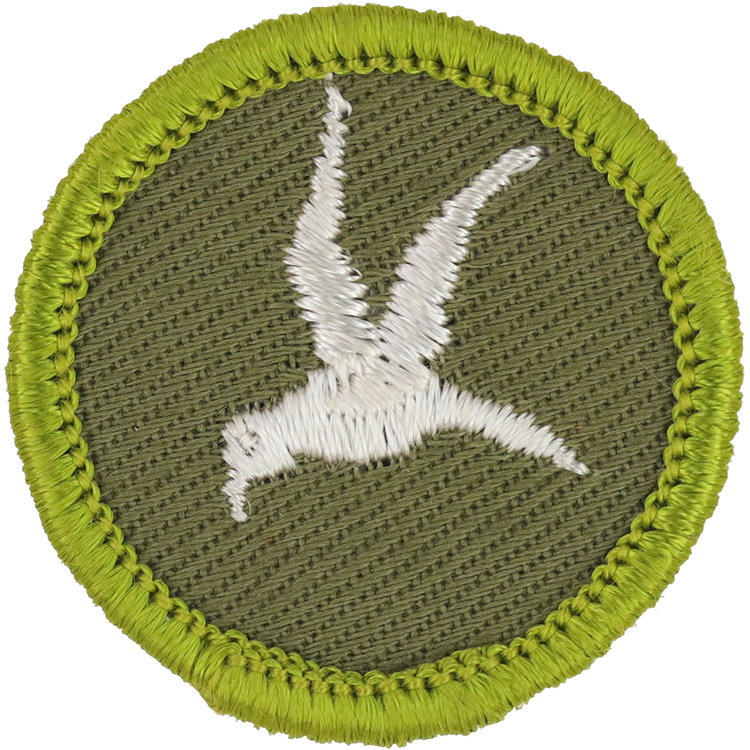
Fig. 1: BirStu-F-Front
- Cloth: Green right twill
- Border: Merrowed
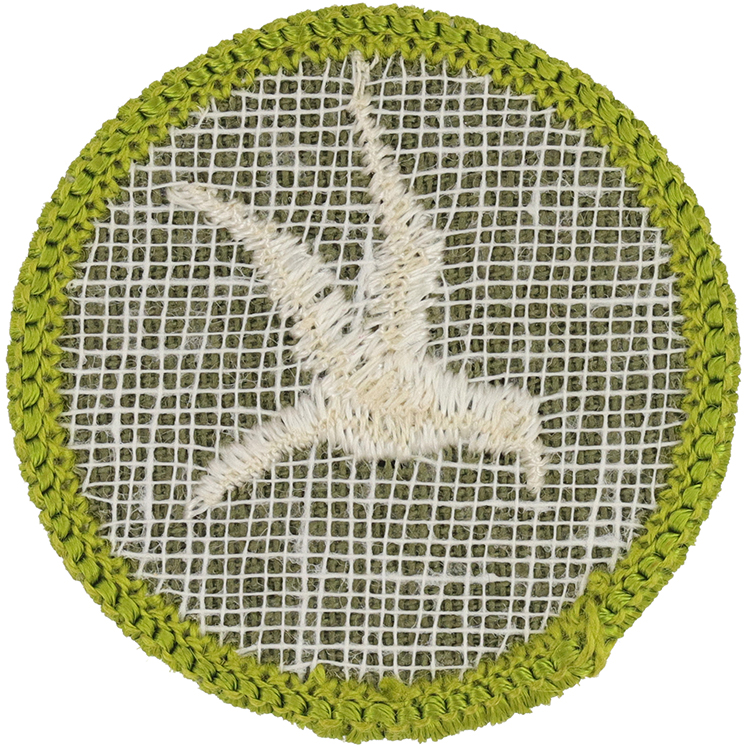
Fig. 2: BirStu-F-Reverse
- Back: Gauze reinforced starched
Item Name: Bird Study 1961 - 1968
Item ID: BirStu-F
Collector Rating: 1
Pamphlets Used to Earn this Badge
Requirements 1948 until January 1965
1. Produce a list of forty species of wild birds which have been personally observed and positively identified in the field and tell how to differentiate each from those other species with which it might be confused.
2. Produce a list showing the greatest number of species that he has seen in the field in one week.
3. Produce a list derived from personal reading of:
a. Twenty species of birds particularly noted for their value to agriculture in the destruction of insects and weed seeds.
b. Ten birds of prey particularly useful in the destruction of rats and mice.
c. Ten species of fish-eating birds, and tell why they are not inimical to man's interests.
4. Describe at least two bird boxes or a bird bath, and two feeding stations that have been constructed and erected by him.
5. (a) From personal observation name and describe the birds he has seen in three different habitats (open fields, woodlands, farmland, marsh, etc.) and tell why all birds do not choose the same habitat. Make at least three visits to each type of countryside; OR (b) make a census of the bird-life of a 25-acre tract by systematically covering the ground on three separate days and listing the species and number of individuals of each observed.
6. State what he did to protect birds from slaughter; and to promote the creation of bird preserves and sanctuaries.
Requirements January 1965 until January 1969
1. Spend at least 3 hours in each of two different kinds of natural habitats at different elevations (field or prairie, forest, marsh, etc.) and make a list of the different bird species and individual numbers which you identified by yourself. Tell why all birds do not live in the same kind of habitat.
2. Spend 3 hours on each of 5 days on at least a 25-acre area, and make a list of bird species and numbers which you identified by sound or sight.
3. Recognize by sound alone 10 birds found in your locality.
4. Make as complete a list as possible from reading and talks with your counselor of the different bird families found in the course of a year in your locality, and identify in the field at least one bird from each family usually found in your locality at any one season of the year.
5. From personal observation and reading, write a life history story of five hundred words on one bird other than a game bird that nests in your locality.
6. Do one:
(a) Keep accurate records of birds observed on at least eight field trips during one season (3 months).
(b) Watch a bird nest for an hour a day for 10 days and describe what you saw.
(c) Go on a Christmas census of at least 8 hours with a bird club and present a list of birds observed.
(d) Go on a May big day* of at least 8 hours with an expert and present a list of birds observed.
(e) Visit a federal, state or private bird refuge and describe its purpose and management techniques.
(f) Write a five hundred word life history of a game bird that nests in your locality.
7. Do one:
(a) Develop a backyard sanctuary of at least a tenth of an acre (planting trees and shrubs for food and cover) and describe what birds you expect to attract and why.
(b) Build three bird feeders of different kinds, and set them out. Keep them stocked with food for 3 months in winter, and describe what birds used them and what kinds of food these birds preferred.
(c) Build three nest boxes for different birds and set them out in appropriate places. Describe the birds that used them and tell how many young birds were raised in these boxes.
(d) Take 12 clear, sharp, recognizable photographs of 12 species of birds.
(e) Build a watering device for birds and keep it filled with water for 3 months. Tell what kind of birds used it, and describe any interesting things you saw.
8. Do one:
(a) Select on species of bird (hawk, owl, heron, kingfisher, etc.) that eats other animals, and talk for 3 to 5 minutes on its place in the world of nature. Tell on what birds your state pays a bounty, if any, and give your opinion on whether this is a logical idea.
(b) Make a migration map (flyway map) of the U.S. Name some of the birds that use each flyway, where they nest and where they winter. Describe bird banding-the technique used to develop the flyway idea.
(c) Make a list of the extinct or declining birds of the U.S. and describe the chief causes as far as are known for the extinction of these species.