-
Merit Badges
- Legend to identify Merit Badges
- 1910 British Merit Badges
- Square 1911 - 33
- Wide Crimped 1934 & 35
-
Narrow Tan Crimped 1936 - 42
- Tan Heavyweight Cloth with Silk Embroidery and Printed Back 1936 - 37
- Tan Heavyweight Cloth with Silk Embroidery and Plain Back 1937 - 38
- Tan Lightweight Cloth with Silk Embroidery and Plain Back 1938 - 39
- Tan Lightweight Cloth with Cotton Continuous Loop Embroidery and Plain Back 1939 - 42
- Tan Lightweight Cloth with Cotton Lockstitch Embroidery and Plain Back 1939 - 42
- Blue Background 1942 - 46
- Wartime 1942 - 46
- Khaki Narrow Crimped 1946 - 59
- Green Twill Gauze Back 1960 - 68
- Fully Embroidered Merrowed Edge 1960 - 72
- Unprinted Plastic Back 1972 - 01
- Printed Plastic Back 2002 - Current
-
Merit Badge Paper
- Merit Badge Applications
- Merit Badge Cards
-
Merit Badge Pamphlets
- Type 1 White Cover - Rectangle Drawing On Cover
- Type 2 White Cover 5-375" x 8" Title at Top
- Type 3A Tan Cover - 200 Fifth Avenue
- Type 3B Tan Cover - 2 line address New York City
- Type 3C Tan Cover - 2 line address New York N.Y.
- Type 3D Tan Cover - 1 line address New York N.Y.
- Type 4 Standing Scout Cover
- Type 5A War Cover
- Type 5B Red and White
- Type 6 Photo-Red Cover
- Type 7 Full Photo Cover or Bulls-eye Cover
- Type 8 Full Photo - Green Stripe Cover
- Type 9 Full Photo - Red Stripe Cover
- Type 10A Blue Stripe - Logo above bottom blue stripe - FDL centered
- Type 10B - Blue Stripe in bottom of photo area. FDL to left of text
- Special Covers
- Boy Craft Helps
- Merit Badge Counselor's Guides
-
Youth Position
- Junior Assistant Scoutmaster
- Senior Patrol Leader
- Assistant Senior Patrol Leader
- Patrol Leader
- Assistant Patrol Leader
- Troop Guide
- Scribe
- Quartermaster
- Instructor
- Chaplain Aide
- Den Chief
- Librarian
- Musician
- Webmaster
- Bugler
- Troop Historian
- Troop Representative
- Unit Representative
- Leadership Corps
- Honor Guard
- Leave No Trace Trainer
- Outdoor Ethics Guide
-
Patrol Medallions
- Patrol Medallions Introduction
- Legend to identify Patrol Medallions
- Patrol Shoulder Knot-Ribbons
- Felt Handmade Patrol Medallions
- Square Felt Patrol Medallions
- Round Broadcloth Patrol Medallions
- Red Twill Patrol Medallions
- Multi-Color Cloth Patrol Medallions
- Tan Cloth Patrol Medallions
- Patrol Medallion Back Patches
- Woodbadge Patrol Medallion
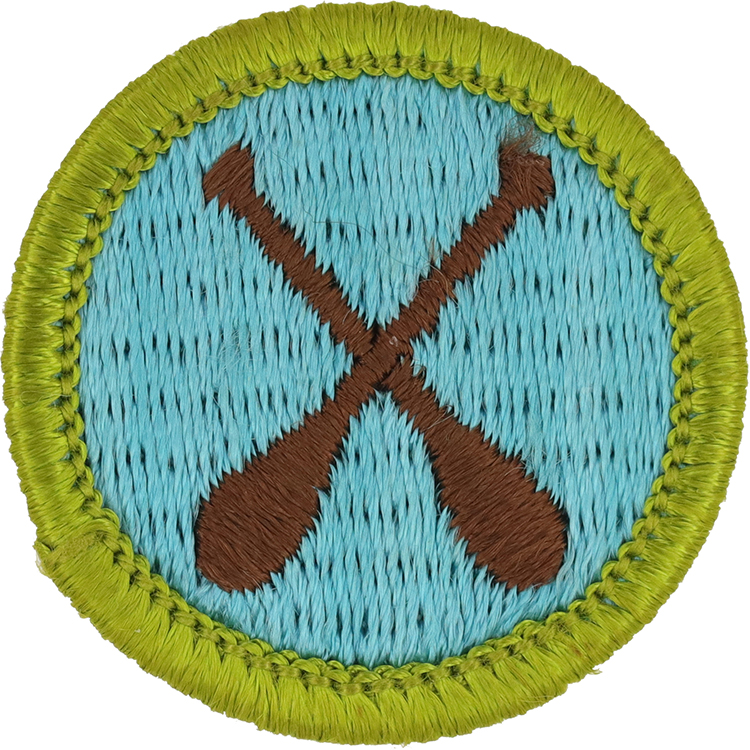
Fig. 1: Canoei-H2-Front
- Embroidery: Cotton thread
- Border: Merrowed
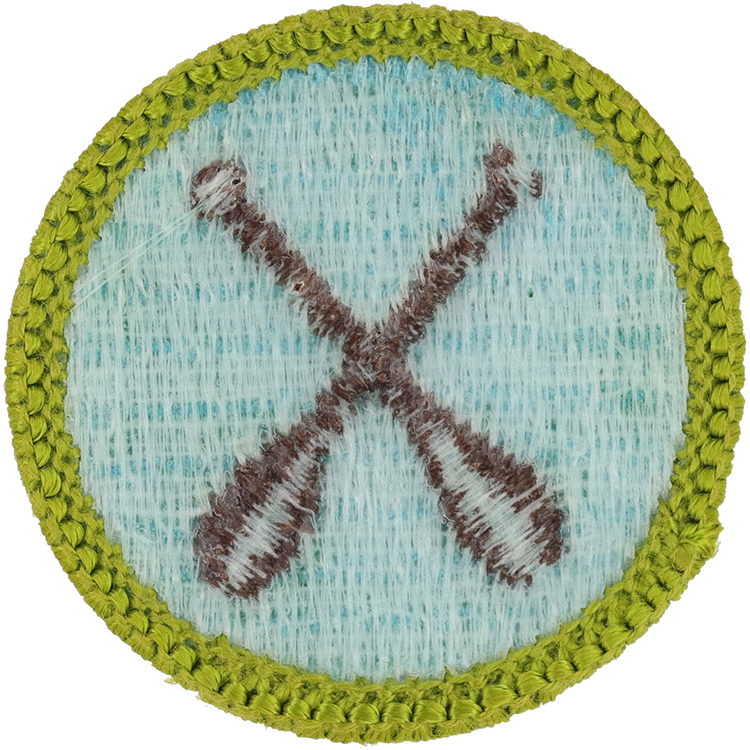
Fig. 2: Canoei-H2-Reverse
- Back: Clear plastic with waffle pattern
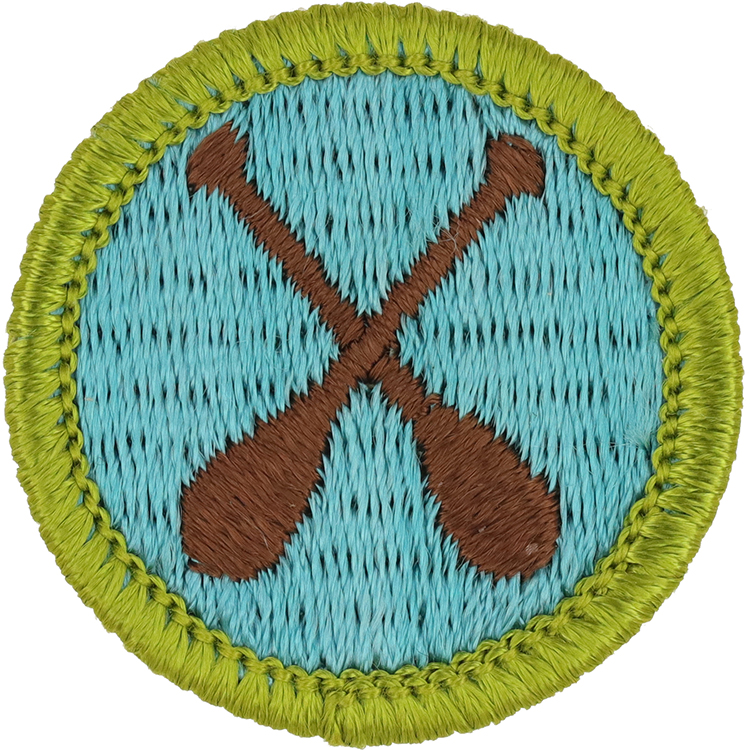
Fig. 3: Canoei-H2-mve1-front
- Embroidery: Cotton thread
- Border: Merrowed
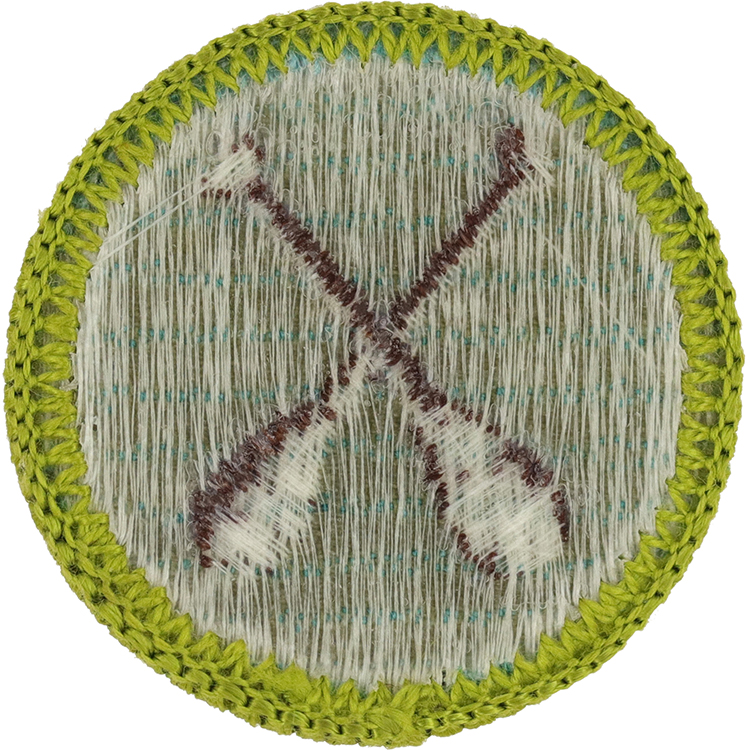
Fig. 4: Canoei-H2-mve1-reverse
- Back: Dark base cloth, clear plastic with waffle pattern
Item Name: Canoeing 1972 - 1975
Item ID: Canoei-H2
Collector Rating: 1
Pamphlets Used to Earn this Badge
Requirements June 1972 until December 1977
1. Before doing other requirements, swim 100 yards as follows: 75 yards with any strokes. Then 25 yards on your back using an easy resting stroke. Then rest by floating as still as you can for 1 minute.
2. Point out and name each part of the canoe and paddles you are using.
3. With a partner about your size, and using a properly equipped canoe:
(a) Launch and get in the bow of the canoe properly from dock or shore (both, if possible). Give directions to your partner.
(b) Paddle on one side only 100 yards using a single-blade paddle while kneeling on one or both knees. Turn and paddle back. Show proper form in the following strokes: bow, diagonal draw, pushover, backwater, reverse sweep, quarter sweep, stop.
(c) Change paddle to other side and repeat No. 3b.
(d) Change places with your partner while your canoe is afloat. On one or both knees, in the stern, paddle 100 yards and return. Keep the canoe on a straight course.
(e) Make a proper landing at dock or shore.
4. While alone in a canoe:
(a) Show eight single-blade strokes: (1) J, (2) draw, (3) stop, (4) pushover, (5) sweep, (6) reverse, (7) scull, (8) outside pivot.
(b) Go five times around a short, irregular marked course. Paddle on one side only. Use the right strokes at the right time.
(c) Use a single-blade or double-blade paddle. Paddle over a 100-yard straight course. Return using the right strokes.
5. While fully dressed and alone in a canoe, do the following:*
(a) Jump into the water feet first, keeping hold of the canoe with one hand. Climb back in without shipping water.
(b) Tip the canoe over in deep water about 50 feet from the landing place.
(c) Turn it right side up. Stow paddle and kneeling pad. Get in the filled canoe. Paddle with hands or paddle for 25 yards.
(d) Go overboard.. Hold on with one hand. Swim and tow or push the canoe to shore.
(e) Empty the canoe. Store it properly with help if needed.
6. Get in the bow with a partner in the stern. Help two persons who have tipped their canoe over and are hanging on to it. Empty the filled canoe over your own canoe. Steady it while they climb in.
7. Discuss:
(a) Canoe trip preparations and safety.
(b) How to repair a hole or break in a canvas-covered canoe, an aluminum canoe, and a fiber-glass canoe.
(c) Other uses of the canoe such as racing and sailing.
(d) Explain lining and poling. Tell the differences between lake and river canoeing.
* Wear clothing used when canoeing where you live at that time of year.