-
Merit Badges
- Legend to identify Merit Badges
- 1910 British Merit Badges
- Square 1911 - 33
- Wide Crimped 1934 & 35
-
Narrow Tan Crimped 1936 - 42
- Tan Heavyweight Cloth with Silk Embroidery and Printed Back 1936 - 37
- Tan Heavyweight Cloth with Silk Embroidery and Plain Back 1937 - 38
- Tan Lightweight Cloth with Silk Embroidery and Plain Back 1938 - 39
- Tan Lightweight Cloth with Cotton Continuous Loop Embroidery and Plain Back 1939 - 42
- Tan Lightweight Cloth with Cotton Lockstitch Embroidery and Plain Back 1939 - 42
- Blue Background 1942 - 46
- Wartime 1942 - 46
- Khaki Narrow Crimped 1946 - 59
- Green Twill Gauze Back 1960 - 68
- Fully Embroidered Merrowed Edge 1960 - 72
- Unprinted Plastic Back 1972 - 01
- Printed Plastic Back 2002 - Current
-
Merit Badge Paper
- Merit Badge Applications
- Merit Badge Cards
-
Merit Badge Pamphlets
- Type 1 White Cover - Rectangle Drawing On Cover
- Type 2 White Cover 5-375" x 8" Title at Top
- Type 3A Tan Cover - 200 Fifth Avenue
- Type 3B Tan Cover - 2 line address New York City
- Type 3C Tan Cover - 2 line address New York N.Y.
- Type 3D Tan Cover - 1 line address New York N.Y.
- Type 4 Standing Scout Cover
- Type 5A War Cover
- Type 5B Red and White
- Type 6 Photo-Red Cover
- Type 7 Full Photo Cover or Bulls-eye Cover
- Type 8 Full Photo - Green Stripe Cover
- Type 9 Full Photo - Red Stripe Cover
- Type 10A Blue Stripe - Logo above bottom blue stripe - FDL centered
- Type 10B - Blue Stripe in bottom of photo area. FDL to left of text
- Special Covers
- Boy Craft Helps
- Merit Badge Counselor's Guides
-
Youth Position
- Junior Assistant Scoutmaster
- Senior Patrol Leader
- Assistant Senior Patrol Leader
- Patrol Leader
- Assistant Patrol Leader
- Troop Guide
- Scribe
- Quartermaster
- Instructor
- Chaplain Aide
- Den Chief
- Librarian
- Musician
- Webmaster
- Bugler
- Troop Historian
- Troop Representative
- Unit Representative
- Leadership Corps
- Honor Guard
- Leave No Trace Trainer
- Outdoor Ethics Guide
-
Patrol Medallions
- Patrol Medallions Introduction
- Legend to identify Patrol Medallions
- Patrol Shoulder Knot-Ribbons
- Felt Handmade Patrol Medallions
- Square Felt Patrol Medallions
- Round Broadcloth Patrol Medallions
- Red Twill Patrol Medallions
- Multi-Color Cloth Patrol Medallions
- Tan Cloth Patrol Medallions
- Patrol Medallion Back Patches
- Woodbadge Patrol Medallion
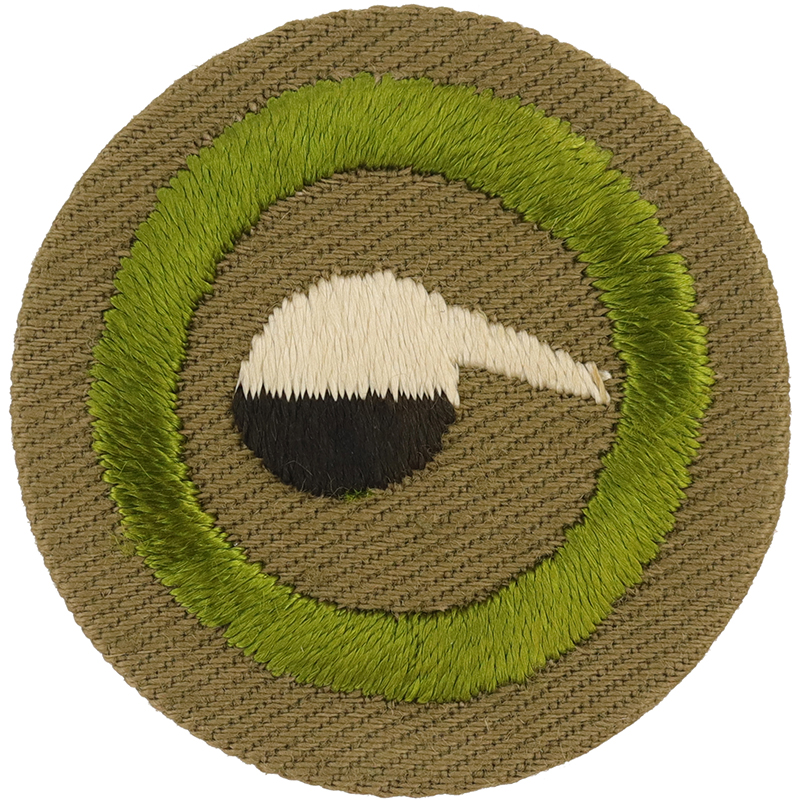
Fig. 1: Chemis-B2-Front
- Cloth: Heavyweight tan right twill
- Embroidery: Continuous loop silk
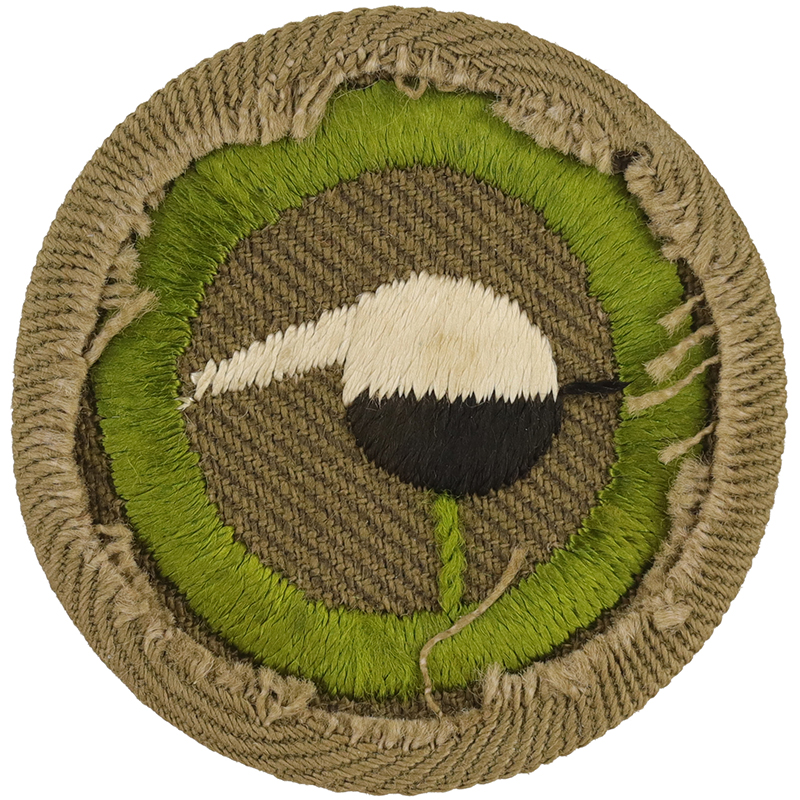
Fig. 2: Chemis-B2-Reverse
- Back: Black imprint
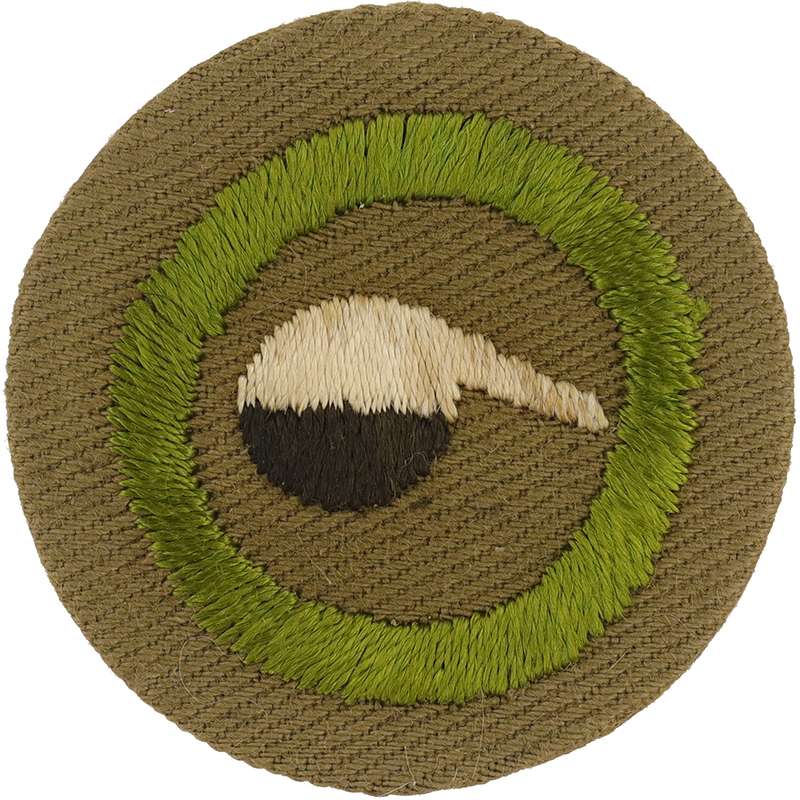
Fig. 3: Chemis-B2-mve1-front
- Minor variation: Flask difference
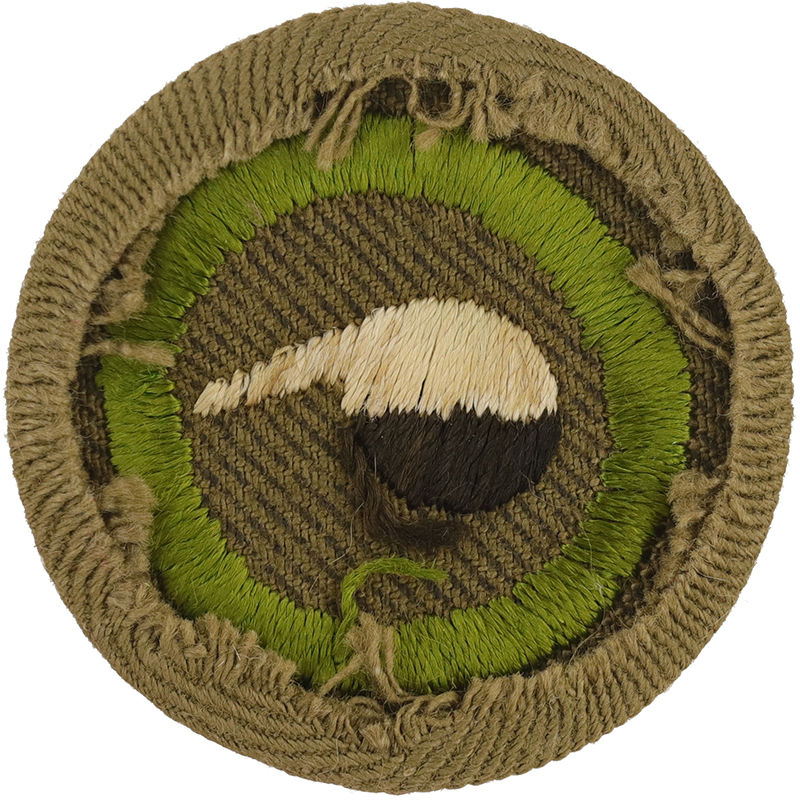
Fig. 4: Chemis-B2-mve1-reverse
- Back: Black imprint
Item Name: Chemistry 1934 - 1935
Item ID: Chemis-B2
Collector Rating: 1
Pamphlets Used to Earn this Badge
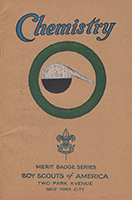
Requirements January 1930 until June 1953
Submit evidence of study and experimentation in Chemistry and demonstrate his ability to apply the knowledge gained in discussing points outlined in Part I, and carry out the experiments suggested in Part II.
PART I
1. In building a fire, one whittles or breaks sticks into small splints, starts the fire with a match, flint and steel, friction, or burning glass, and aids it with gentle fanning. Gentle fanning will aid, but violent fanning will extinguish a small flame. Very dry wood gives a hot fire; green or moderately wet wood will burn but give out little heat, while very wet wood will not burn. Discuss each point.
2. Suppose one has three very large bell jars or bottles inverted over a trough of lime water, thus enclosing air and sealing so that air can neither escape nor enter. Suppose one puts a boy into one, a lighted candle the size of the boy into the second, and a piece of phosphorus the size of the boy in the third. Soon the water will begin to rise in each. When the water has replaced 11% of the air in the first, the boy will collapse; when 6% of the air in the second is replaced, the candle will cease to burn; and when 21% of the air is replaced in the third, no more change will take place. Fully interpret and explain.
3. Give (a) a list of the sources of water
(b) a list of the uses of water
(c) a list of the impurities found in water
(d) a classification, with respect to injurious nature, of the impurities.
(e) the special problems confronted in obtaining, treating and storing water for drinking purposes.
4. A good Scout keeps his knife, axe and iron cooking utensils clean and dry, and as far as possible equips himself with aluminum canteens, etc. Explain.
5. Every boy uses salt in seasoning his food. Assume he has a salt mine and the whole world is dependent upon his mine and upon his knowledge of what might be done with it. Give a full discussion of what he might produce, provided all other chemicals and our present-day chemical machinery were available.
PART II
6. Prepare and collect two of the following gases:
Oxygen, hydrogen, chlorine and ammonia.
7. Find out which, if any, of five substances given him are carbonates, sulfides or chlorides.
8. Find out which, if any, of several liquids or solutions given him are acids or bases.
9. Extract metallic copper from its black oxide.
10. Give two experimental demonstrations that some substances catalyze certain reactions.