-
Merit Badges
- Legend to identify Merit Badges
- 1910 British Merit Badges
- Square 1911 - 33
- Wide Crimped 1934 & 35
-
Narrow Tan Crimped 1936 - 42
- Tan Heavyweight Cloth with Silk Embroidery and Printed Back 1936 - 37
- Tan Heavyweight Cloth with Silk Embroidery and Plain Back 1937 - 38
- Tan Lightweight Cloth with Silk Embroidery and Plain Back 1938 - 39
- Tan Lightweight Cloth with Cotton Continuous Loop Embroidery and Plain Back 1939 - 42
- Tan Lightweight Cloth with Cotton Lockstitch Embroidery and Plain Back 1939 - 42
- Blue Background 1942 - 46
- Wartime 1942 - 46
- Khaki Narrow Crimped 1946 - 59
- Green Twill Gauze Back 1960 - 68
- Fully Embroidered Merrowed Edge 1960 - 72
- Unprinted Plastic Back 1972 - 01
- Printed Plastic Back 2002 - Current
-
Merit Badge Paper
- Merit Badge Applications
- Merit Badge Cards
-
Merit Badge Pamphlets
- Type 1 White Cover - Rectangle Drawing On Cover
- Type 2 White Cover 5-375" x 8" Title at Top
- Type 3A Tan Cover - 200 Fifth Avenue
- Type 3B Tan Cover - 2 line address New York City
- Type 3C Tan Cover - 2 line address New York N.Y.
- Type 3D Tan Cover - 1 line address New York N.Y.
- Type 4 Standing Scout Cover
- Type 5A War Cover
- Type 5B Red and White
- Type 6 Photo-Red Cover
- Type 7 Full Photo Cover or Bulls-eye Cover
- Type 8 Full Photo - Green Stripe Cover
- Type 9 Full Photo - Red Stripe Cover
- Type 10A Blue Stripe - Logo above bottom blue stripe - FDL centered
- Type 10B - Blue Stripe in bottom of photo area. FDL to left of text
- Special Covers
- Boy Craft Helps
- Merit Badge Counselor's Guides
-
Youth Position
- Junior Assistant Scoutmaster
- Senior Patrol Leader
- Assistant Senior Patrol Leader
- Patrol Leader
- Assistant Patrol Leader
- Troop Guide
- Scribe
- Quartermaster
- Instructor
- Chaplain Aide
- Den Chief
- Librarian
- Musician
- Webmaster
- Bugler
- Troop Historian
- Troop Representative
- Unit Representative
- Leadership Corps
- Honor Guard
- Leave No Trace Trainer
- Outdoor Ethics Guide
-
Patrol Medallions
- Patrol Medallions Introduction
- Legend to identify Patrol Medallions
- Patrol Shoulder Knot-Ribbons
- Felt Handmade Patrol Medallions
- Square Felt Patrol Medallions
- Round Broadcloth Patrol Medallions
- Red Twill Patrol Medallions
- Multi-Color Cloth Patrol Medallions
- Tan Cloth Patrol Medallions
- Patrol Medallion Back Patches
- Woodbadge Patrol Medallion
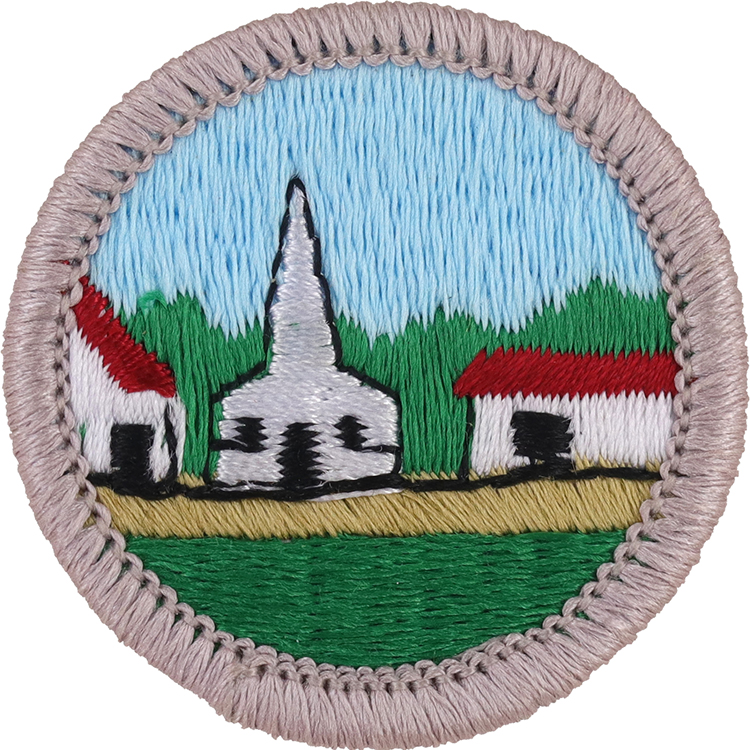
Fig. 1: CitCom-J2-Front
- Embroidery: Rayon thread
- Border: Merrowed
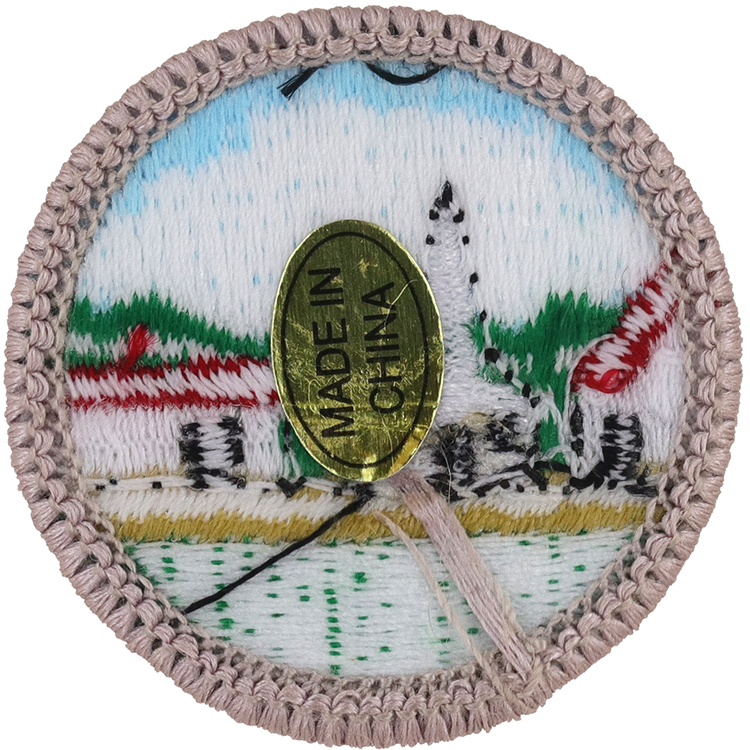
Fig. 2: CitCom-J2-Reverse
- Back: Smooth clear NO Scout Stuff imprint Bisphenol A (BPA) free plastic
Item Name: Citizenship in the Community 2009 - 2010
Item ID: CitCom-J2
Collector Rating: 1
Pamphlets Used to Earn this Badge

Requirements January 2005 until January 2013
1. Discuss with your counselor what citizenship in the community means and what it takes to be a good citizen in your community. Discuss the rights, duties, and obligations of citizenship, and explain how you can demonstrate good citizenship in your community, Scouting unit, place of worship, or school.
2. Do the following:
(a) On a map of your community, locate and point out the following:
(1) Chief government buildings such as your city hall, county courthouse, and public works/services facility
(2) Fire station, police station, and hospital nearest your home
(3) Historical or other interesting points
(b) Chart the organization of your local or state government. Show the top offices and tell whether they are elected or appointed.
3. Do the following:
(a) Attend a city or town council or school board meeting, or a municipal, county, or state court session.
(b) Choose one of the issues discussed at the meeting where a difference of opinions was expressed, and explain to your counselor why you agree with one opinion more that you do another one
4. Choose an issue that is important to the citizens of your community; then do the following:
(a) Find out which branch of local government is responsible for this issue.
(b) With your counselor’s and a parent’s approval, interview one person from the branch of government you identified in requirement 4a. Ask what is being done about this issue and how young people can help.
(c) Share what you have learned with your counselor.
5. With the approval of your counselor and a parent, watch a movie that shows how the actions of one individual or group of individuals can have a positive effect on a community. Discuss with your counselor what you learned from the movie about what it means to be a valuable and concerned member of the community.
6. List dome of the services (such as the library, recreationcenter, public transportation, and public safety) your community provides that are funded by taxpayers. Tell your counselor why these services are important to your community.
7. Do the following:
(a) Choose a charitable organization outside of Scouting that interests you and brings people in your community together to work for the good of your community.
(b) Using a variety of resources (including newspapers, fliers and other literature, the Internet, volunteers, and employees of the organization), find out more about the organization.
(c) With your counselor’s and your parent’s approval, contact the organization and find out what young people can do to help. While working on this merit badge, volunteer at least eight hours of your time for the organization. After your volunteer experience is over, discuss what you have learned with your counselor.
8. Develop a public presentation (such as a video, slide show, speech, digital presentation, or photo exhibit) about important and unique aspects of your community. Include information about the history, culture, and ethnic groups of your community; its best features and popular places where people gather; and the challenges it faces. Stage your presentation in front of your merit badge counselor or a group, such as your patrol or class at school.