-
Merit Badges
- Legend to identify Merit Badges
- 1910 British Merit Badges
- Square 1911 - 33
- Wide Crimped 1934 & 35
-
Narrow Tan Crimped 1936 - 42
- Tan Heavyweight Cloth with Silk Embroidery and Printed Back 1936 - 37
- Tan Heavyweight Cloth with Silk Embroidery and Plain Back 1937 - 38
- Tan Lightweight Cloth with Silk Embroidery and Plain Back 1938 - 39
- Tan Lightweight Cloth with Cotton Continuous Loop Embroidery and Plain Back 1939 - 42
- Tan Lightweight Cloth with Cotton Lockstitch Embroidery and Plain Back 1939 - 42
- Blue Background 1942 - 46
- Wartime 1942 - 46
- Khaki Narrow Crimped 1946 - 59
- Green Twill Gauze Back 1960 - 68
- Fully Embroidered Merrowed Edge 1960 - 72
- Unprinted Plastic Back 1972 - 01
- Printed Plastic Back 2002 - Current
-
Merit Badge Paper
- Merit Badge Applications
- Merit Badge Cards
-
Merit Badge Pamphlets
- Type 1 White Cover - Rectangle Drawing On Cover
- Type 2 White Cover 5-375" x 8" Title at Top
- Type 3A Tan Cover - 200 Fifth Avenue
- Type 3B Tan Cover - 2 line address New York City
- Type 3C Tan Cover - 2 line address New York N.Y.
- Type 3D Tan Cover - 1 line address New York N.Y.
- Type 4 Standing Scout Cover
- Type 5A War Cover
- Type 5B Red and White
- Type 6 Photo-Red Cover
- Type 7 Full Photo Cover or Bulls-eye Cover
- Type 8 Full Photo - Green Stripe Cover
- Type 9 Full Photo - Red Stripe Cover
- Type 10A Blue Stripe - Logo above bottom blue stripe - FDL centered
- Type 10B - Blue Stripe in bottom of photo area. FDL to left of text
- Special Covers
- Boy Craft Helps
- Merit Badge Counselor's Guides
-
Youth Position
- Junior Assistant Scoutmaster
- Senior Patrol Leader
- Assistant Senior Patrol Leader
- Patrol Leader
- Assistant Patrol Leader
- Troop Guide
- Scribe
- Quartermaster
- Instructor
- Chaplain Aide
- Den Chief
- Librarian
- Musician
- Webmaster
- Bugler
- Troop Historian
- Troop Representative
- Unit Representative
- Leadership Corps
- Honor Guard
- Leave No Trace Trainer
- Outdoor Ethics Guide
-
Patrol Medallions
- Patrol Medallions Introduction
- Legend to identify Patrol Medallions
- Patrol Shoulder Knot-Ribbons
- Felt Handmade Patrol Medallions
- Square Felt Patrol Medallions
- Round Broadcloth Patrol Medallions
- Red Twill Patrol Medallions
- Multi-Color Cloth Patrol Medallions
- Tan Cloth Patrol Medallions
- Patrol Medallion Back Patches
- Woodbadge Patrol Medallion
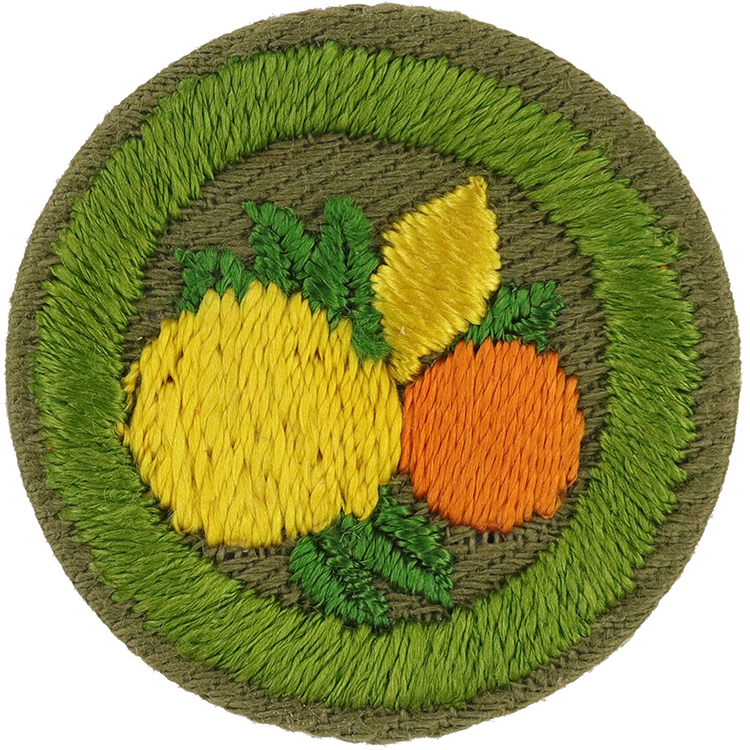
Fig. 1: CitCul-E1-Front
- Cloth: Khaki right twill
- Embroidery: Cotton continuous
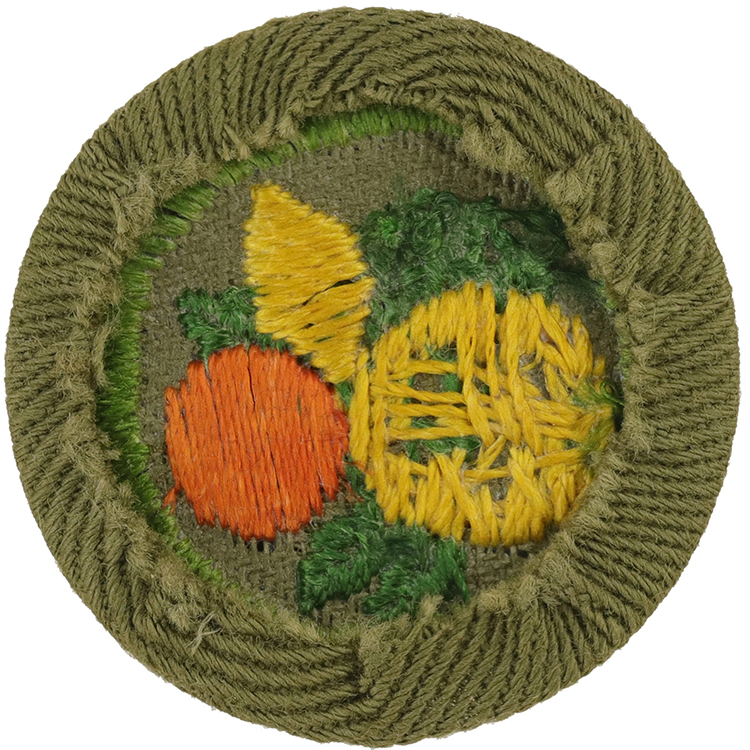
Fig. 2: CitCul-E1-Reverse
- Back: Plain NO imprint with starch
Item Name: Citrus Fruit Culture 1947 - 1952
Item ID: CitCul-E1
Collector Rating: 1
Pamphlets Used to Earn this Badge
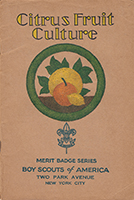
Requirements April 1932 until June 1948
1. Name three different kinds of citrus fruit, and two varieties of each kind.
2. Tell what points should be taken into account in selecting a site for a citrus orchard. Select a site favorable for each purpose; tell why it is suitable.
3. Name three diseases of citrus fruit, and give directions for the control of each.
4. Name the serious citrus insect pests in his region; give directions for their control.
5. Prune a citrus tree properly and give the reasons for each step.
6. Spend a half day in a citrus grove. Study the trees, their condition as to vigor, cultural practices and crop prospects, then write a report of his observations.
7. Tell the difference between a seedling tree and a budded tree; which is used in planting citrus orchards and why?
8. Tell what time of the year citrus trees are budded in the nursery; the different kinds of root stock that are used in propagating citrus trees; what one or ones are preferred for his section and why.
9. Bud a seedling stock; then demonstrate and describe briefly the details as he has performed them.
10. Describe in considerable detail the operation of picking and grading of fruit in a citrus orchard. Tell what points require special care.
11.a. Describe a packing house in which citrus fruit is prepared for shipping. Trace the course of the fruit from the time it enters the packing house until it is packed in the car for shipment.
b. Make a written report on some of the practices he has observed in a citrus orchard or in a packing house, which seem to him to be faulty; state how these practices could, in his judgment, be improved and the results which would follow the adoption of the changes he suggests.
12. On a map of the United States, block in the states or section of states in which various citrus fruits are now successfully grown such as grapefruit, oranges, limes and lemons.
OR
Comply with the 4H Club or Home Project requirements in the planting and management of citrus fruit trees as follows:
1. Own the number of trees required in the project.
2. Do all the work in the care and management of trees for one year.
3. Keep accurate record of costs, observations, results.
4. Exhibit products of citrus work as required by his county leader in charge.
5. Make a complete report at the end of season or year as required by leaders.
Requirements June 1948 until June 1953
1. Name three different kinds of citrus fruit, and two varieties of each kind.
2. Tell what points should be taken into account in selecting a site for a citrus orchard. Select a site favorable for each purpose; tell why it is suitable.
3. Name three diseases of citrus fruit, and give directions for the control of each.
4. Name the serious citrus insect pests in his region; give directions for their control.
5. Prune a citrus tree properly and give the reasons for each step.
6. Spend a half day in a citrus grove. Study the trees, their condition as to vigor, cultural practices and crop prospects, then write a report of his observations.
7. Tell the difference between a seedling tree and a budded tree; which is used in planting citrus orchards and why?
8. Tell what time of the year citrus trees are budded in the nursery; the different kinds of root stock that are used in propagating citrus trees; what one or ones are preferred for his section and why.
9. Bud a seedling stock; then demonstrate and describe briefly the details as he has performed them.
10. Describe in considerable detail the operation of picking and grading of fruit in a citrus orchard. Tell what points require special care.
11.a. Describe a packing house in which citrus fruit is prepared for shipping. Trace the course of the fruit from the time it enters the packing house until it is packed in the car for shipment.
b. Make a written report on some of the practices he has observed in a citrus orchard or in a packing house, which seem to him to be faulty; state how these practices could, in his judgment, be improved and the results which would follow the adoption of the changes he suggests.
12. On a map of the United States, block in the states or section of states in which various citrus fruits are now successfully grown such as grapefruit, oranges, limes and lemons.
OR
Comply with the 4H Club or Home Project requirements in the planting and management of citrus fruit trees.