-
Merit Badges
- Legend to identify Merit Badges
- 1910 British Merit Badges
- Square 1911 - 33
- Wide Crimped 1934 & 35
-
Narrow Tan Crimped 1936 - 42
- Tan Heavyweight Cloth with Silk Embroidery and Printed Back 1936 - 37
- Tan Heavyweight Cloth with Silk Embroidery and Plain Back 1937 - 38
- Tan Lightweight Cloth with Silk Embroidery and Plain Back 1938 - 39
- Tan Lightweight Cloth with Cotton Continuous Loop Embroidery and Plain Back 1939 - 42
- Tan Lightweight Cloth with Cotton Lockstitch Embroidery and Plain Back 1939 - 42
- Blue Background 1942 - 46
- Wartime 1942 - 46
- Khaki Narrow Crimped 1946 - 59
- Green Twill Gauze Back 1960 - 68
- Fully Embroidered Merrowed Edge 1960 - 72
- Unprinted Plastic Back 1972 - 01
- Printed Plastic Back 2002 - Current
-
Merit Badge Paper
- Merit Badge Applications
- Merit Badge Cards
-
Merit Badge Pamphlets
- Type 1 White Cover - Rectangle Drawing On Cover
- Type 2 White Cover 5-375" x 8" Title at Top
- Type 3A Tan Cover - 200 Fifth Avenue
- Type 3B Tan Cover - 2 line address New York City
- Type 3C Tan Cover - 2 line address New York N.Y.
- Type 3D Tan Cover - 1 line address New York N.Y.
- Type 4 Standing Scout Cover
- Type 5A War Cover
- Type 5B Red and White
- Type 6 Photo-Red Cover
- Type 7 Full Photo Cover or Bulls-eye Cover
- Type 8 Full Photo - Green Stripe Cover
- Type 9 Full Photo - Red Stripe Cover
- Type 10A Blue Stripe - Logo above bottom blue stripe - FDL centered
- Type 10B - Blue Stripe in bottom of photo area. FDL to left of text
- Special Covers
- Boy Craft Helps
- Merit Badge Counselor's Guides
-
Youth Position
- Junior Assistant Scoutmaster
- Senior Patrol Leader
- Assistant Senior Patrol Leader
- Patrol Leader
- Assistant Patrol Leader
- Troop Guide
- Scribe
- Quartermaster
- Instructor
- Chaplain Aide
- Den Chief
- Librarian
- Musician
- Webmaster
- Bugler
- Troop Historian
- Troop Representative
- Unit Representative
- Leadership Corps
- Honor Guard
- Leave No Trace Trainer
- Outdoor Ethics Guide
-
Patrol Medallions
- Patrol Medallions Introduction
- Legend to identify Patrol Medallions
- Patrol Shoulder Knot-Ribbons
- Felt Handmade Patrol Medallions
- Square Felt Patrol Medallions
- Round Broadcloth Patrol Medallions
- Red Twill Patrol Medallions
- Multi-Color Cloth Patrol Medallions
- Tan Cloth Patrol Medallions
- Patrol Medallion Back Patches
- Woodbadge Patrol Medallion
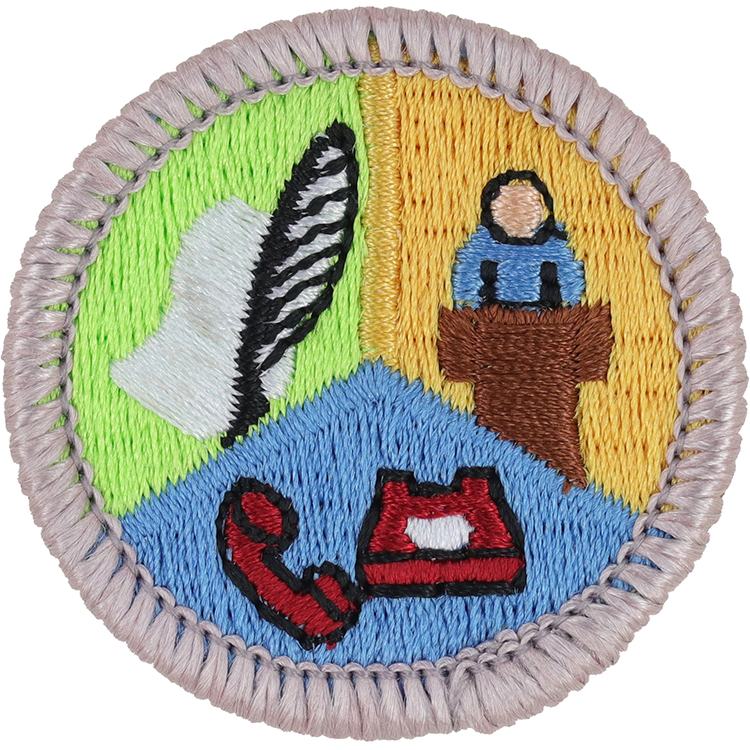
Fig. 1: Commun-K-Front
- Embroidery: Rayon thread
- Design: Blue-white-red background, horizontal background embroidery
- Border: /strong> Merrowed
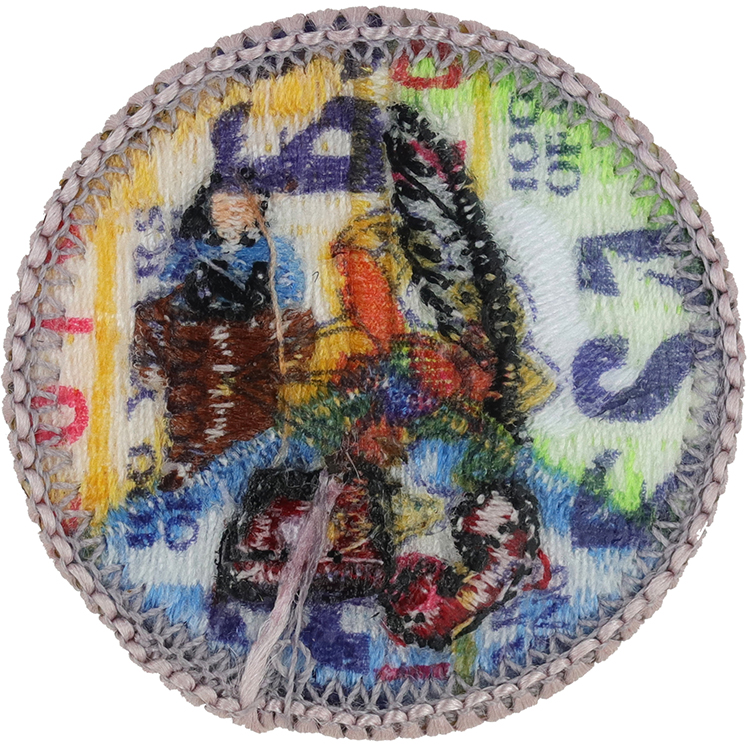
Fig. 2: Commun-K-Reverse
- Back: 100th Anniversary imprint
Item Name: Communications 2010 - 2013
Item ID: Commun-K
Collector Rating: 1
Pamphlets Used to Earn this Badge

Requirements January 2010 until January 2013
1. Do the following:
(a) For one day, keep a log in which you describe your communication activities. Keep track of the time and different ways you spend communicating, such as talking, person-to-person, listening to teachers or to the radio, watching television, reading books and other print media, and using any electronic communication device. Discuss with your counselor what your log reveals about the importance of communication in your life. Think of ways to improve your communication skills.
(b) For three days, keep a journal of your listening experiences. Identify one example of each of the following, and discuss with your counselor when you have listened to:
(1) Obtain information
(2) A persuasive argument
(3) Appreciate or enjoy something
(4) Understand someone’s feelings
(c) In a small-group setting, meet with other Scouts or with friends. Have them share personal stories about significant events in their lives that affected them in some way. Take note of how each Scout participates in the group discussion and how effectively he communicates his story. Report what you have learned to your counselor about the differences you observed in effective communication.
(d) List as many ways as you can think of to communicate with others (face-to-face, by telephone, letter, e-mail, text messages, and so on). For each type of communication, discuss with your counselor an instance when that method might not be appropriate or effective.
2. Do ONE of the following:
(a) Think of a creative way to describe yourself using, for example, college, short story or autobiography, drawing or series of photographs, or a song or skit. Using the aid you created, make a presentation to your counselor about yourself.
(b) Choose a concept, product, or service in which you have great confidence. Build a sales plan based on its good points. Try to persuade the counselor to agree with, use, or buy your concept, product, or service. After your sales talk, discuss with your counselor how persuasive you were.
3. Write a five-minute speech. Give it at a meeting of a group.
4. Interview someone you know fairly well, like, or respect because of his or her position, talent, career, or life experiences. Listen actively to learn as much as you can about the person. Then prepare and deliver to your counselor an introduction of the person as though this person were to be a guest speaker, and include reasons why the audience would want to hear this person speak. Show how you would call to invite this person to speak.
5. Attend a public meeting (city council, school board, debate) approved by your counselor where several points of view are given on a single issue. Practice active listening skills and take careful notes of each point of view. Present an objective report that includes all points of view that were expressed, and share this with your counselor.
6. With your counselor’s approval, develop a plan to teach a skill or inform someone about something. Prepare teaching aids for your plan. Carry out your plan. With your counselor, determine whether the person has learned what you intended.
7. Do ONE of the following:
(a) Write to the editor of a magazine or your local newspaper to express your opinion or share information on any subject you choose. Send your message by fax, e-mail, or regular mail.
(b) Create a Web page or blog of special interest to you (for instance, your troop or crew, school, a hobby, or a sport). Include at least three articles or entries and one photograph or illustration, and one link to some other Web page or blog that would be helpful to someone who visits the Web page or blog you have created. It is not necessary to post Web page or blog to the Internet, but if you decide to do so, you must first share it with your parents and counselor and get their permission.
(c) Use desktop publishing to produce a newsletter, brochure, flier, or other printed material for your Scout troop, class at school, or other group. Include at least one article and one photograph or illustration.
8. Plan a troop court of honor or campfire program. Have the patrol leader’s council approve it, then write the script and prepare the program. Serve as master of ceremonies.
9. Find out about three career opportunities in communication. Pick one and find out the education, training, and experience required for this profession. Discuss this with your counselor, and explain why this profession might interest you.
Requirements January 2013 until January 2014
1. Do the following:
(a) For one day, keep a log in which you describe your communication activities. Keep track of the time and different ways you spend communicating, such as talking person-to-person, listening to teachers or to the radio, watching television, using social media, reading books and other print media, and using any electronic communication device. Discuss with your counselor what your log reveals about the importance of communication in your life. Think of ways to improve your communication skills.
(b) For three days, keep a journal of your listening experiences. Identify one example of each of the following, and discuss with your counselor when you have listened to:
(1) Obtain information
(2) A persuasive argument
(3) Appreciate or enjoy something
(4) Understand someone’s feelings
(c) In a small-group setting, meet with other Scouts or with friends. Have them share personal stories about significant events in their lives that affected them in some way. Take note of how each Scout participates in the group discussion and how effectively he communicates his story. Report what you have learned to your counselor about the differences you observed in effective communication.
(d) List as many ways as you can think of to communicate with others (face-to-face, by telephone, letter, e-mail, text messages, and so on). For each type of communication, discuss with your counselor an instance when that method might not be appropriate or effective.
2. Do ONE of the following:
(a) Think of a creative way to describe yourself using, for example, college, short story or autobiography, drawing or series of photographs, or a song or skit. Using the aid you created, make a presentation to your counselor about yourself.
(b) Choose a concept, product, or service in which you have great confidence. Build a sales plan based on its good points. Try to persuade the counselor to agree with, use, or buy your concept, product, or service. After your sales talk, discuss with your counselor how persuasive you were.
3. Write a five-minute speech. Give it at a meeting of a group.
4. Interview someone you know fairly well, like, or respect because of his or her position, talent, career, or life experiences. Listen actively to learn as much as you can about the person. Then prepare and deliver to your counselor an introduction of the person as though this person were to be a guest speaker, and include reasons why the audience would want to hear this person speak. Show how you would call to invite this person to speak.
5. Attend a public meeting (city council, school board, debate) approved by your counselor where several points of view are given on a single issue. Practice active listening skills and take careful notes of each point of view. Present an objective report that includes all points of view that were expressed, and share this with your counselor.
6. With your counselor’s approval, develop a plan to teach a skill or inform someone about something. Prepare teaching aids for your plan. Carry out your plan. With your counselor, determine whether the person has learned what you intended.
7. Do ONE of the following:
(a) Write to the editor of a magazine or your local newspaper to express your opinion or share information on any subject you choose. Send your message by fax, e-mail, or regular mail.
(b) Create a Web page or blog of special interest to you (for instance, your troop or crew, school, a hobby, or a sport). Include at least three articles or entries and one photograph or illustration, and one link to some other Web page or blog that would be helpful to someone who visits the Web page or blog you have created. It is not necessary to post Web page or blog to the Internet, but if you decide to do so, you must first share it with your parents and counselor and get their permission.
(c) Use desktop publishing to produce a newsletter, brochure, flier, or other printed material for your Scout troop, class at school, or other group. Include at least one article and one photograph or illustration.
8. Plan a troop court of honor or campfire program. Have the patrol leader’s council approve it, then write the script and prepare the program. Serve as master of ceremonies.
9. Find out about three career opportunities in communication. Pick one and find out the education, training, and experience required for this profession. Discuss this with your counselor, and explain why this profession might interest you.