-
Merit Badges
- Legend to identify Merit Badges
- 1910 British Merit Badges
- Square 1911 - 33
- Wide Crimped 1934 & 35
-
Narrow Tan Crimped 1936 - 42
- Tan Heavyweight Cloth with Silk Embroidery and Printed Back 1936 - 37
- Tan Heavyweight Cloth with Silk Embroidery and Plain Back 1937 - 38
- Tan Lightweight Cloth with Silk Embroidery and Plain Back 1938 - 39
- Tan Lightweight Cloth with Cotton Continuous Loop Embroidery and Plain Back 1939 - 42
- Tan Lightweight Cloth with Cotton Lockstitch Embroidery and Plain Back 1939 - 42
- Blue Background 1942 - 46
- Wartime 1942 - 46
- Khaki Narrow Crimped 1946 - 59
- Green Twill Gauze Back 1960 - 68
- Fully Embroidered Merrowed Edge 1960 - 72
- Unprinted Plastic Back 1972 - 01
- Printed Plastic Back 2002 - Current
-
Merit Badge Paper
- Merit Badge Applications
- Merit Badge Cards
-
Merit Badge Pamphlets
- Type 1 White Cover - Rectangle Drawing On Cover
- Type 2 White Cover 5-375" x 8" Title at Top
- Type 3A Tan Cover - 200 Fifth Avenue
- Type 3B Tan Cover - 2 line address New York City
- Type 3C Tan Cover - 2 line address New York N.Y.
- Type 3D Tan Cover - 1 line address New York N.Y.
- Type 4 Standing Scout Cover
- Type 5A War Cover
- Type 5B Red and White
- Type 6 Photo-Red Cover
- Type 7 Full Photo Cover or Bulls-eye Cover
- Type 8 Full Photo - Green Stripe Cover
- Type 9 Full Photo - Red Stripe Cover
- Type 10A Blue Stripe - Logo above bottom blue stripe - FDL centered
- Type 10B - Blue Stripe in bottom of photo area. FDL to left of text
- Special Covers
- Boy Craft Helps
- Merit Badge Counselor's Guides
-
Youth Position
- Junior Assistant Scoutmaster
- Senior Patrol Leader
- Assistant Senior Patrol Leader
- Patrol Leader
- Assistant Patrol Leader
- Troop Guide
- Scribe
- Quartermaster
- Instructor
- Chaplain Aide
- Den Chief
- Librarian
- Musician
- Webmaster
- Bugler
- Troop Historian
- Troop Representative
- Unit Representative
- Leadership Corps
- Honor Guard
- Leave No Trace Trainer
- Outdoor Ethics Guide
-
Patrol Medallions
- Patrol Medallions Introduction
- Legend to identify Patrol Medallions
- Patrol Shoulder Knot-Ribbons
- Felt Handmade Patrol Medallions
- Square Felt Patrol Medallions
- Round Broadcloth Patrol Medallions
- Red Twill Patrol Medallions
- Multi-Color Cloth Patrol Medallions
- Tan Cloth Patrol Medallions
- Patrol Medallion Back Patches
- Woodbadge Patrol Medallion

Fig. 1: Comput-G-Front
- Embroidery: Cotton thread
- Border: Merrowed
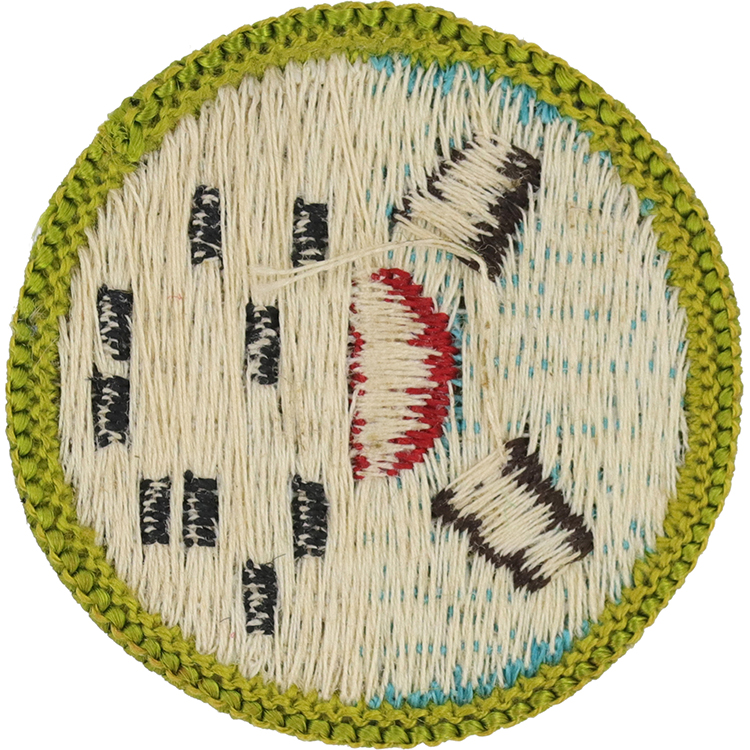
Fig. 2: Comput-G-Reverse
- Back: Starched cloth
Item Name: Computers 1967 - 1972
Item ID: Comput-G
Collector Rating: 1
Pamphlets Used to Earn this Badge

Requirements September 1967 until November 1969
1. Tell what computers are and briefly describe their history. Tell what data processing is and how it is used.
2. Name the four major components of a computer system and describe the function of one component in detail.
3. Build a simple model of one of the following that will help you to illustrate and explain its function in detail:
(a) Core storage
(b) Drum storage
(c) Disk storage
4. Do the following:
(a) Describe the differences and uses of analog and digital computers.
(b) Explain the Hollerith and Powers codes and their role in computers.
5. Obtain your local post office Zip code and convert to binary.
6. Using the flowchart-diagram method, show the steps necessary to set up a campsite.
7. Name four different uses of computers.
8. Convert your full name to each of the following codes"
(a) Hollerith
(b) Binary-coded decimal
(c) Eight channel standard code
9. Be able to tell your merit badge counselor in your own words the meaning of the following words or terms: functionsl units, storage, input/output devices, random-access, on-line system, central processing unit, magnetic ink character, information retrieval, solid-state components, nanosecond, stored program, console, optical reader, and register.
10. Do TWO of the following four projects:
(a) Arrange with your counselor to visit a local computer installation.
(b) Obtain and read two pieces of information about data processing other than manufacturers' literature. Summarize what you read for the counselor.
(c) Write a 500 work report on the various types of specialist occupations available in the computer field. Include educational requirements and average wage brackets when possible.
(d) Show your counselor five examples of data-processing output or the tape, cards, or report forms used.
11. Do the following:
(a) Construct an analog adder and explain its operation.
(b) Construct a card reader, demonstrate it to your merit badge counselor, and explain to him the difference between the Hollerith code and the internal machine code.
Requirements November 1969 until June 1972.
1. Tell what computers are and briefly describe their history. Tell what data processing is and how it is used.
2. Name the four major components of a computer system and describe the function of one component in detail.
3. Build a simple model of one of the following that will help you to illustrate and explain its function in detail:
(a) Core storage
(b) Drum storage
(c) Disk storage
4. Do the following:
(a) Describe the differences and uses of analog and digital computers.
(b) Explain the Hollerith code and its role in computers.
5. Obtain your local post office Zip code and convert to binary.
6. Using the flowchart-diagram method, show the steps necessary to set up a campsite.
7. Name four different uses of computers.
8. Convert your full name to each of the following codes"
(a) Hollerith
(b) Binary-coded decimal
(c) Eight channel standard code
9. Be able to tell your merit badge counselor in your own words the meaning of the following words or terms: functional units, storage, input/output devices, random-access, on-line system, central processing unit, magnetic ink character, information retrieval, solid-state components, nanosecond, stored program, console, optical reader, and register.
10. Do TWO of the following four projects:
(a) Arrange with your counselor to visit a local computer installation.
(b) Obtain and read two pieces of information about data processing other than manufacturers' literature. Summarize what you read for the counselor.
(c) Write a 500 work report on the various types of specialist occupations available in the computer field. Include educational requirements and average wage brackets when possible.
(d) Show your counselor five examples of data-processing output or the tape, cards, or report forms used.
11. Do the following:
(a) Construct an analog adder and explain its operation.
(b) Construct a card reader, demonstrate it to your merit badge counselor, and explain to him the difference between the Hollerith code and the internal machine code.