-
Merit Badges
- Legend to identify Merit Badges
- 1910 British Merit Badges
- Square 1911 - 33
- Wide Crimped 1934 & 35
-
Narrow Tan Crimped 1936 - 42
- Tan Heavyweight Cloth with Silk Embroidery and Printed Back 1936 - 37
- Tan Heavyweight Cloth with Silk Embroidery and Plain Back 1937 - 38
- Tan Lightweight Cloth with Silk Embroidery and Plain Back 1938 - 39
- Tan Lightweight Cloth with Cotton Continuous Loop Embroidery and Plain Back 1939 - 42
- Tan Lightweight Cloth with Cotton Lockstitch Embroidery and Plain Back 1939 - 42
- Blue Background 1942 - 46
- Wartime 1942 - 46
- Khaki Narrow Crimped 1946 - 59
- Green Twill Gauze Back 1960 - 68
- Fully Embroidered Merrowed Edge 1960 - 72
- Unprinted Plastic Back 1972 - 01
- Printed Plastic Back 2002 - Current
-
Merit Badge Paper
- Merit Badge Applications
- Merit Badge Cards
-
Merit Badge Pamphlets
- Type 1 White Cover - Rectangle Drawing On Cover
- Type 2 White Cover 5-375" x 8" Title at Top
- Type 3A Tan Cover - 200 Fifth Avenue
- Type 3B Tan Cover - 2 line address New York City
- Type 3C Tan Cover - 2 line address New York N.Y.
- Type 3D Tan Cover - 1 line address New York N.Y.
- Type 4 Standing Scout Cover
- Type 5A War Cover
- Type 5B Red and White
- Type 6 Photo-Red Cover
- Type 7 Full Photo Cover or Bulls-eye Cover
- Type 8 Full Photo - Green Stripe Cover
- Type 9 Full Photo - Red Stripe Cover
- Type 10A Blue Stripe - Logo above bottom blue stripe - FDL centered
- Type 10B - Blue Stripe in bottom of photo area. FDL to left of text
- Special Covers
- Boy Craft Helps
- Merit Badge Counselor's Guides
-
Youth Position
- Junior Assistant Scoutmaster
- Senior Patrol Leader
- Assistant Senior Patrol Leader
- Patrol Leader
- Assistant Patrol Leader
- Troop Guide
- Scribe
- Quartermaster
- Instructor
- Chaplain Aide
- Den Chief
- Librarian
- Musician
- Webmaster
- Bugler
- Troop Historian
- Troop Representative
- Unit Representative
- Leadership Corps
- Honor Guard
- Leave No Trace Trainer
- Outdoor Ethics Guide
-
Patrol Medallions
- Patrol Medallions Introduction
- Legend to identify Patrol Medallions
- Patrol Shoulder Knot-Ribbons
- Felt Handmade Patrol Medallions
- Square Felt Patrol Medallions
- Round Broadcloth Patrol Medallions
- Red Twill Patrol Medallions
- Multi-Color Cloth Patrol Medallions
- Tan Cloth Patrol Medallions
- Patrol Medallion Back Patches
- Woodbadge Patrol Medallion
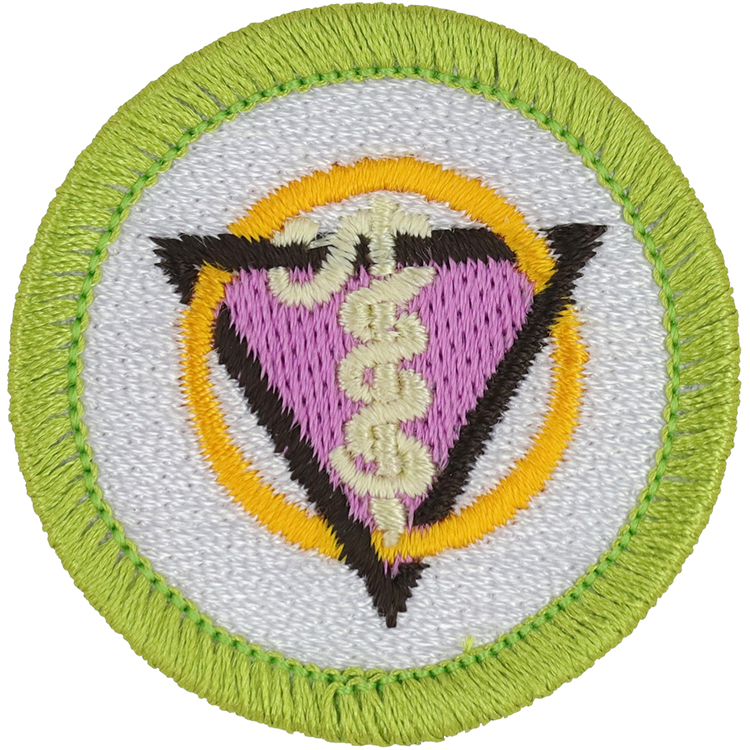
Fig. 1: Dentis-K-Front
- Embroidery: Rayon thread
- Border: Merrowed
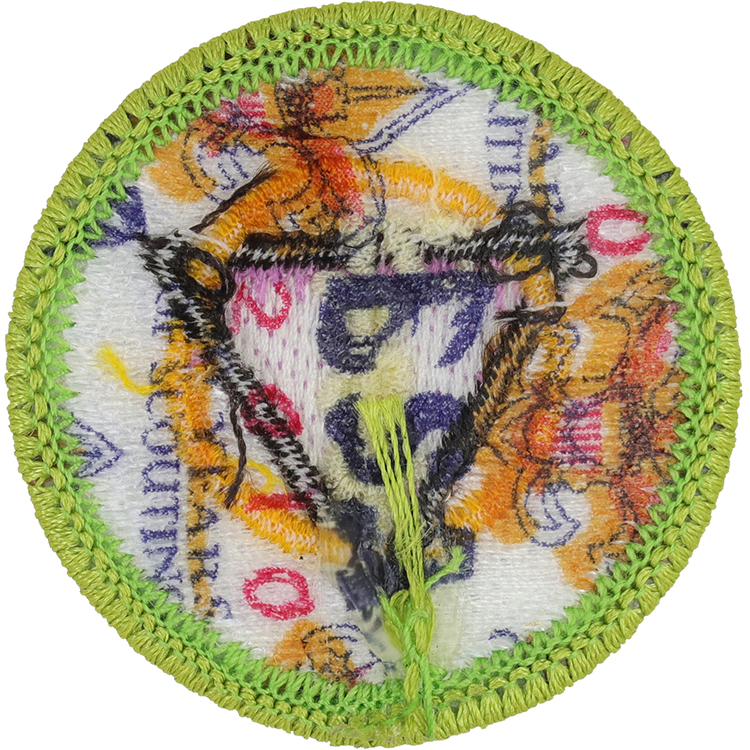
Fig. 2: Dentis-K-Reverse
- Back: 100th Anniversary imprint
Item Name: Dentistry 2010 - 2013
Item ID: Dentis-K
Collector Rating: 1
Pamphlets Used to Earn this Badge

Requirements January 2010 until January 2017
1. Using X-ray (radiographic) films and with your counselor’s guidance, study the tooth structure and look for decay. Then do the following:
(a) Use the radiographs as a guide to draw a lower molar. Label its parts and surfaces. Show surrounding structures such as bone and gum tissues.
(b) Show on your drawing where the nerves and blood vessels enter the tooth.
(c) Show on your drawing where bacterial plaque is most likely to be found.
2. Do the following:
(a) Tell or write about what causes dental decay and gum disease. Tell what each of the following does: bacterial plaque, sugars, and acid.
(b) Tell the possible causes for traumatic tooth loss, describe the types of mouth guards used to help prevent tooth trauma, and list the athletic activities during which a person should wear a mouth guard.
(c) Explain the first aid procedure for saving a tooth that has been knocked out.
(d) Discuss how the use of tobacco products can negatively affect your oral health.
3. Arrange for a visit with a dentist. Before going, ask if you can be given a dental examination and a plaque control demonstration. Afterward, ask questions about things you want to know. Tell your counselor what the dentist does during a checkup examination.
4. Do TWO of the following:
(a) Name at least five instruments in five pieces of equipment a dentist uses.
(b) With the help of a dentist, prepare a dental plaster cast using a vibrator, mixing bowl, water measure, plaster measure, model stone, and spatula.
(c) Keep a record of everything you eat for three days. Circle those that may provide the sugars needed for the bacterial plaque to make acid. List snacks that you should avoid to help maintain the best oral health.
5. Discuss with your merit badge counselor the following:
(a) How fluorides help prevent tooth decay in the ways fluorides can be provided to the teeth.
(b) How the mouth is related to the rest of the body. Topics might include chewing, saliva, enzymes, nutrition, and speech.
6. Do TWO of the following:
(a) Make a model tooth of soap, clay, papier-mache, or wax. Using a string and a large hand brush, show proper toothbrushing and flossing procedures.
(b) Make a poster on prevention of dental disease. Show the need for good oral health.
(c) Collect at least five advertisements for different toothpastes. List the claims that are made for each. Tell about the accuracy of the advertisements.
(d) Write a feature story for your school newspaper on proper care of teeth and gums.
(e) Make drawings and write about the progress of dental decay. Describe the types of dental fillings and treatments a dentist can use to repair dental decay problems.
7. Find out about three career opportunities in dentistry. Pick one and find out the education, training, and experience required for this profession. Discuss this with your counselor, and explain why this profession might interest you.