-
Merit Badges
- Legend to identify Merit Badges
- 1910 British Merit Badges
- Square 1911 - 33
- Wide Crimped 1934 & 35
-
Narrow Tan Crimped 1936 - 42
- Tan Heavyweight Cloth with Silk Embroidery and Printed Back 1936 - 37
- Tan Heavyweight Cloth with Silk Embroidery and Plain Back 1937 - 38
- Tan Lightweight Cloth with Silk Embroidery and Plain Back 1938 - 39
- Tan Lightweight Cloth with Cotton Continuous Loop Embroidery and Plain Back 1939 - 42
- Tan Lightweight Cloth with Cotton Lockstitch Embroidery and Plain Back 1939 - 42
- Blue Background 1942 - 46
- Wartime 1942 - 46
- Khaki Narrow Crimped 1946 - 59
- Green Twill Gauze Back 1960 - 68
- Fully Embroidered Merrowed Edge 1960 - 72
- Unprinted Plastic Back 1972 - 01
- Printed Plastic Back 2002 - Current
-
Merit Badge Paper
- Merit Badge Applications
- Merit Badge Cards
-
Merit Badge Pamphlets
- Type 1 White Cover - Rectangle Drawing On Cover
- Type 2 White Cover 5-375" x 8" Title at Top
- Type 3A Tan Cover - 200 Fifth Avenue
- Type 3B Tan Cover - 2 line address New York City
- Type 3C Tan Cover - 2 line address New York N.Y.
- Type 3D Tan Cover - 1 line address New York N.Y.
- Type 4 Standing Scout Cover
- Type 5A War Cover
- Type 5B Red and White
- Type 6 Photo-Red Cover
- Type 7 Full Photo Cover or Bulls-eye Cover
- Type 8 Full Photo - Green Stripe Cover
- Type 9 Full Photo - Red Stripe Cover
- Type 10A Blue Stripe - Logo above bottom blue stripe - FDL centered
- Type 10B - Blue Stripe in bottom of photo area. FDL to left of text
- Special Covers
- Boy Craft Helps
- Merit Badge Counselor's Guides
-
Youth Position
- Junior Assistant Scoutmaster
- Senior Patrol Leader
- Assistant Senior Patrol Leader
- Patrol Leader
- Assistant Patrol Leader
- Troop Guide
- Scribe
- Quartermaster
- Instructor
- Chaplain Aide
- Den Chief
- Librarian
- Musician
- Webmaster
- Bugler
- Troop Historian
- Troop Representative
- Unit Representative
- Leadership Corps
- Honor Guard
- Leave No Trace Trainer
- Outdoor Ethics Guide
-
Patrol Medallions
- Patrol Medallions Introduction
- Legend to identify Patrol Medallions
- Patrol Shoulder Knot-Ribbons
- Felt Handmade Patrol Medallions
- Square Felt Patrol Medallions
- Round Broadcloth Patrol Medallions
- Red Twill Patrol Medallions
- Multi-Color Cloth Patrol Medallions
- Tan Cloth Patrol Medallions
- Patrol Medallion Back Patches
- Woodbadge Patrol Medallion
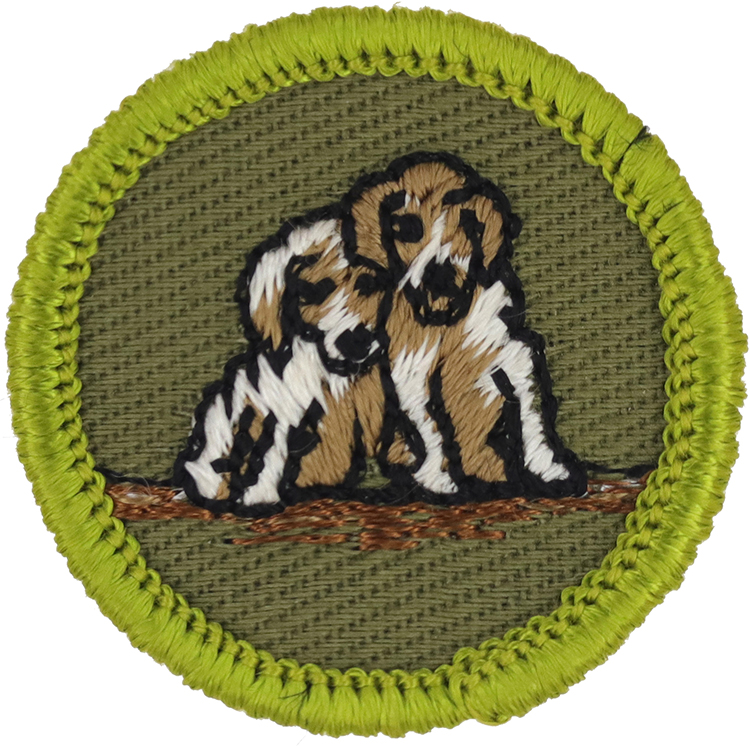
Fig. 1: DogCar-F-Front
- Cloth: Green right twill
- Border: Merrowed
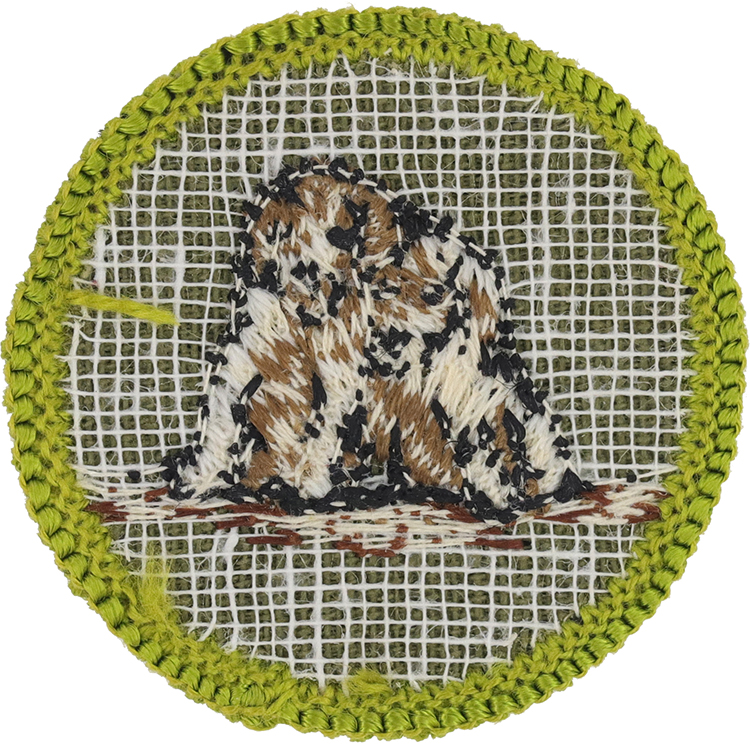
Fig. 2: DogCar-F-Reverse
- Back: Gauze reinforced starched
Item Name: Dog Care 1961 - 1968
Item ID: DogCar-F
Collector Rating: 1
Pamphlets Used to Earn this Badge

Requirements January 1952 until January 1969
1. Present a statement signed by a parent or guardian describing the care you have given your dog (or a dog under your supervision) during a period of at least two months. Include these items: feeding schedule, kinds of food used, housing, exercising, grooming, and bathing. State what has been done to keep the dog alert and healthy.
2. Present a written report showing the approximate cost of feeding and caring for your dog for a period of at least two months.
3. Point out on a dog (or on a sketch) at least ten parts, giving the correct name of each.
4. Describe from personal observation, or point out from pictures, some of the distinguishing characteristics of ten breeds of dogs. Or give a brief history of some one breed of dog, including the origin is possible.
5. Explain precautions to take in handling an injured dog; demonstrate how to apply an emergency safety muzzle. Explain how to treat wounds, including use of the tourniquet. Show how to apply simple dressing and bandage to the foot, body, or head. Explain what action to take when a dog is struck by an automobile.
6. Do at least two of the following: (a) Describe what should be done to remove fleas, ticks, and lice from your dog. (b) Describe the symptoms of the following and explain what you would do if your dog showed these symptoms; distemper, rabies, mange, ringworm. (c) Describe the proper treatment for: sore ear, sore eye, fits, removing an object swallowed by a dog, removing an object stuck in its throat. (d) Explain first aid treatment for a dog bite and list the items needed in every dog owner's first aid kit.
7. State the dangers of home treatment of a serious ailment when the services of a veterinarian are available and report on a visit to a veterinary hospital. Or report on a visit to a shelter of your local humane society or SPCA, if available.
8. Explain in general the proper method used in obedience training. Demonstrate, if possible, with your dog, at least three of these commands: "Come", "Sit", "Down" (lie down), "Heel" (walk closely at owner's left side), "Stay" (remain in position); "Take it", "Drop it", "Get it" as used in retrieving work.
9. Know the laws and ordinances involving dogs, including ownership, registration, control, and humane treatment, in force in your own community.