-
Merit Badges
- Legend to identify Merit Badges
- 1910 British Merit Badges
- Square 1911 - 33
- Wide Crimped 1934 & 35
-
Narrow Tan Crimped 1936 - 42
- Tan Heavyweight Cloth with Silk Embroidery and Printed Back 1936 - 37
- Tan Heavyweight Cloth with Silk Embroidery and Plain Back 1937 - 38
- Tan Lightweight Cloth with Silk Embroidery and Plain Back 1938 - 39
- Tan Lightweight Cloth with Cotton Continuous Loop Embroidery and Plain Back 1939 - 42
- Tan Lightweight Cloth with Cotton Lockstitch Embroidery and Plain Back 1939 - 42
- Blue Background 1942 - 46
- Wartime 1942 - 46
- Khaki Narrow Crimped 1946 - 59
- Green Twill Gauze Back 1960 - 68
- Fully Embroidered Merrowed Edge 1960 - 72
- Unprinted Plastic Back 1972 - 01
- Printed Plastic Back 2002 - Current
-
Merit Badge Paper
- Merit Badge Applications
- Merit Badge Cards
-
Merit Badge Pamphlets
- Type 1 White Cover - Rectangle Drawing On Cover
- Type 2 White Cover 5-375" x 8" Title at Top
- Type 3A Tan Cover - 200 Fifth Avenue
- Type 3B Tan Cover - 2 line address New York City
- Type 3C Tan Cover - 2 line address New York N.Y.
- Type 3D Tan Cover - 1 line address New York N.Y.
- Type 4 Standing Scout Cover
- Type 5A War Cover
- Type 5B Red and White
- Type 6 Photo-Red Cover
- Type 7 Full Photo Cover or Bulls-eye Cover
- Type 8 Full Photo - Green Stripe Cover
- Type 9 Full Photo - Red Stripe Cover
- Type 10A Blue Stripe - Logo above bottom blue stripe - FDL centered
- Type 10B - Blue Stripe in bottom of photo area. FDL to left of text
- Special Covers
- Boy Craft Helps
- Merit Badge Counselor's Guides
-
Youth Position
- Junior Assistant Scoutmaster
- Senior Patrol Leader
- Assistant Senior Patrol Leader
- Patrol Leader
- Assistant Patrol Leader
- Troop Guide
- Scribe
- Quartermaster
- Instructor
- Chaplain Aide
- Den Chief
- Librarian
- Musician
- Webmaster
- Bugler
- Troop Historian
- Troop Representative
- Unit Representative
- Leadership Corps
- Honor Guard
- Leave No Trace Trainer
- Outdoor Ethics Guide
-
Patrol Medallions
- Patrol Medallions Introduction
- Legend to identify Patrol Medallions
- Patrol Shoulder Knot-Ribbons
- Felt Handmade Patrol Medallions
- Square Felt Patrol Medallions
- Round Broadcloth Patrol Medallions
- Red Twill Patrol Medallions
- Multi-Color Cloth Patrol Medallions
- Tan Cloth Patrol Medallions
- Patrol Medallion Back Patches
- Woodbadge Patrol Medallion
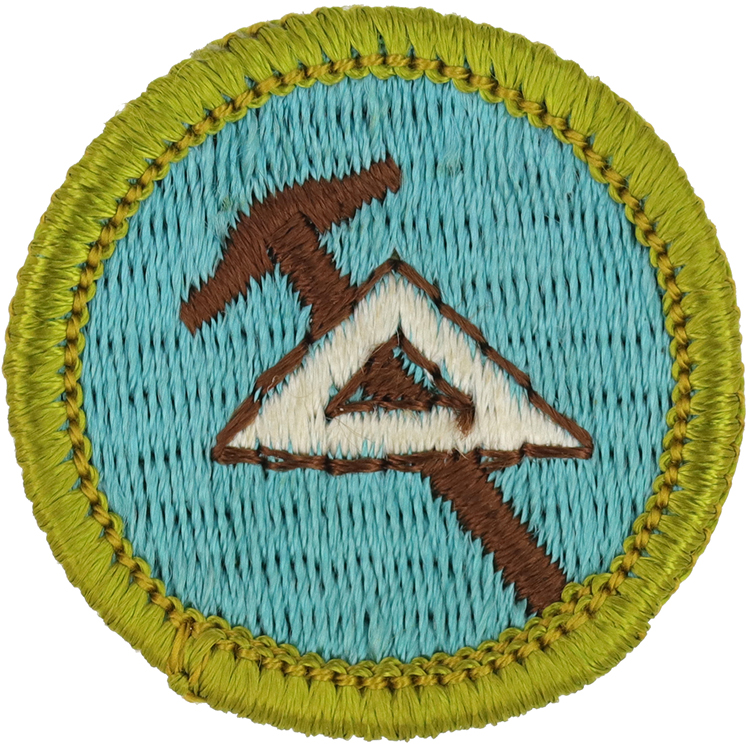
Fig. 1: Drafti-G-Front
- Embroidery: Cotton thread
- Border: Merrowed
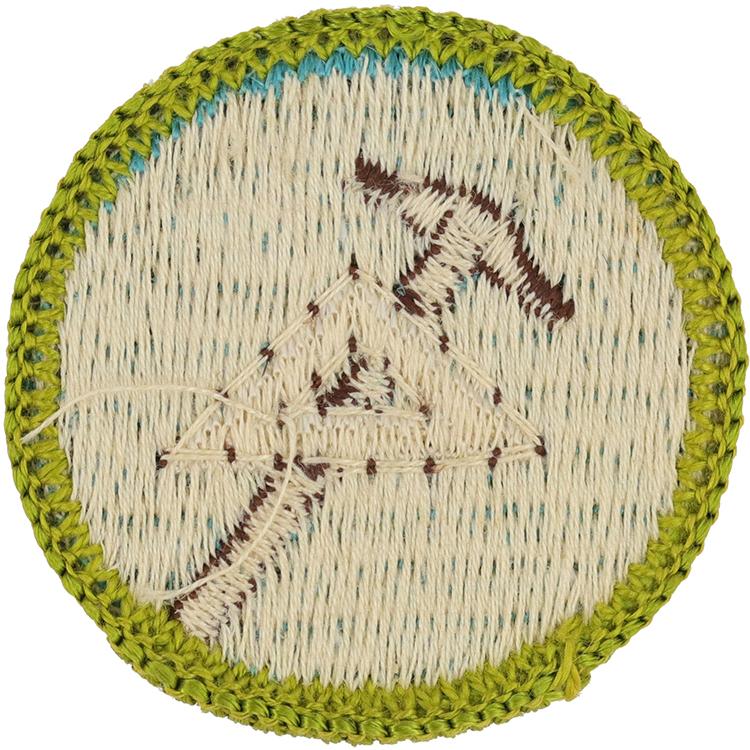
Fig. 2: Drafti-G-Reverse
- Back: Starched cloth
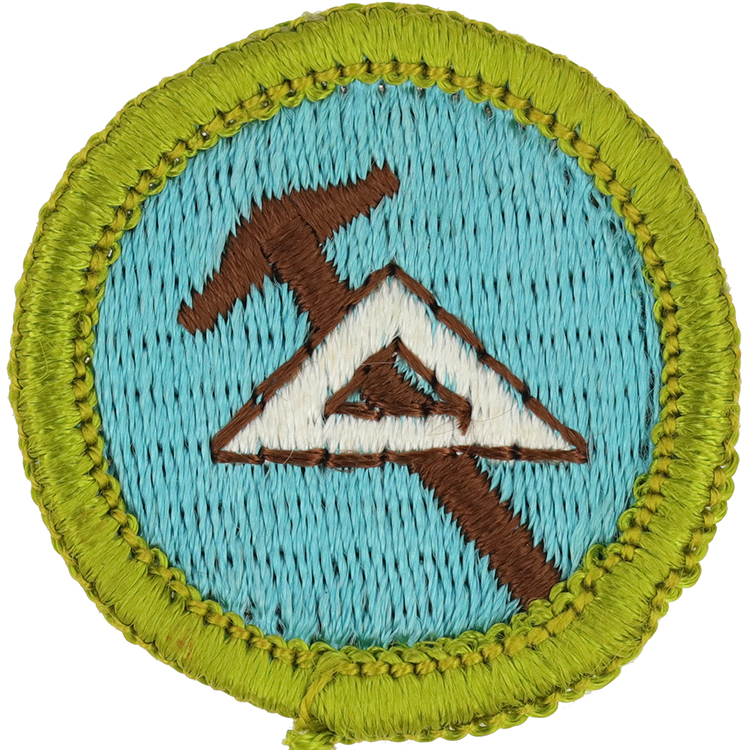
Fig. 3: Drafti-G-mve1-front
- Minor variation: Flat merrowed border
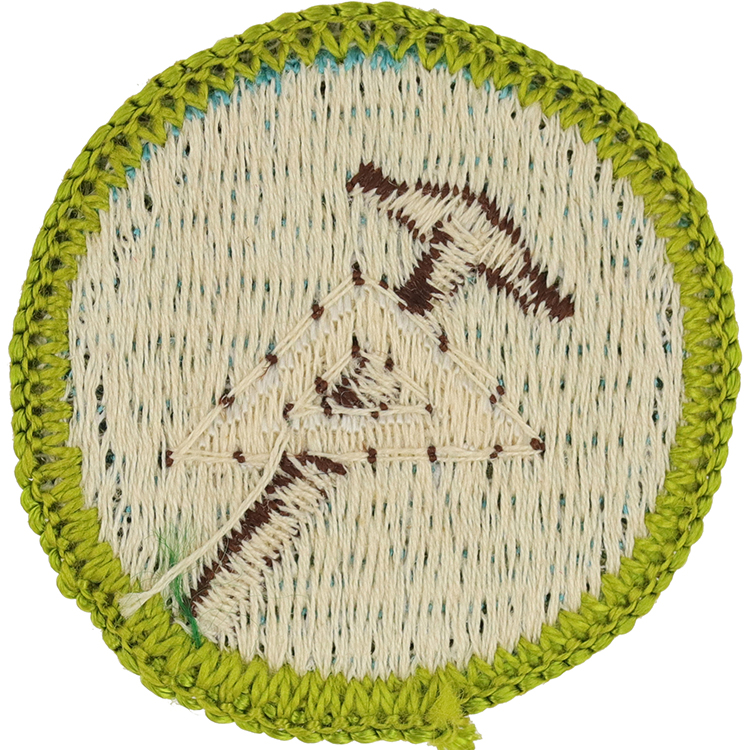
Fig. 4: Drafti-G-mve1-reverse
- Back: Starched cloth
Item Name: Drafting 1969 - 1972
Item ID: Drafti-G
Collector Rating: 1
Pamphlets Used to Earn this Badge
Requirements November 1965 until June 1972
1. Prepare the following pencil drawings on proper material for reproduction:
(a) Make a preliminary rough sketch drawn to approximate scale, and from it submit a finished accurate scale floor plan of your troop meeting room, or a room in your church building, school, or home. Such a drawing is to be properly titled. Indicate by accepted conventional symbols all openings, equipment, safety devices, etc. List drawing instrument used.
(b) Submit an accurate scale drawing of some piece of craftwork for use in your home, school, troop meeting place, or camp that is sufficiently clear and detailed to be used by someone else as a working basis for making the article. The drawing is to include a bill of material with an estimate of cost for this craft article.
(c) Reduce or enlarge the drawing you made for Requirement 1b, indicating the scale of enlargement or reduction used.
(d) Submit drawings made by yourself of orthographic projections, and an isometric drawing of an object other than those specified in Requirements 1a and 1b.
(e) Submit ONE of the following three drawings:
(1) A simple bar chart or graph showing your progress in scholarship, athletic achievement, physical fitness, or financial activity.
(2) A simple schematic drawing of a radio or electronic circuit other than the example shown.
(3) A perspective drawing of your own house, using proportion and showing shrubs and trees.
2. Using single-stroke vertical or slant Gothic lettering, describe in ink for reproduction the subject of your drawing in Requirement 1b in not less than 25 works. Lettering devices may be used.
3. Describe five processes that are used to reproduce drawings. With the assistance of your counselor, have copies made of one of your pencil drawings and ink lettering, using one of these processes.