-
Merit Badges
- Legend to identify Merit Badges
- 1910 British Merit Badges
- Square 1911 - 33
- Wide Crimped 1934 & 35
-
Narrow Tan Crimped 1936 - 42
- Tan Heavyweight Cloth with Silk Embroidery and Printed Back 1936 - 37
- Tan Heavyweight Cloth with Silk Embroidery and Plain Back 1937 - 38
- Tan Lightweight Cloth with Silk Embroidery and Plain Back 1938 - 39
- Tan Lightweight Cloth with Cotton Continuous Loop Embroidery and Plain Back 1939 - 42
- Tan Lightweight Cloth with Cotton Lockstitch Embroidery and Plain Back 1939 - 42
- Blue Background 1942 - 46
- Wartime 1942 - 46
- Khaki Narrow Crimped 1946 - 59
- Green Twill Gauze Back 1960 - 68
- Fully Embroidered Merrowed Edge 1960 - 72
- Unprinted Plastic Back 1972 - 01
- Printed Plastic Back 2002 - Current
-
Merit Badge Paper
- Merit Badge Applications
- Merit Badge Cards
-
Merit Badge Pamphlets
- Type 1 White Cover - Rectangle Drawing On Cover
- Type 2 White Cover 5-375" x 8" Title at Top
- Type 3A Tan Cover - 200 Fifth Avenue
- Type 3B Tan Cover - 2 line address New York City
- Type 3C Tan Cover - 2 line address New York N.Y.
- Type 3D Tan Cover - 1 line address New York N.Y.
- Type 4 Standing Scout Cover
- Type 5A War Cover
- Type 5B Red and White
- Type 6 Photo-Red Cover
- Type 7 Full Photo Cover or Bulls-eye Cover
- Type 8 Full Photo - Green Stripe Cover
- Type 9 Full Photo - Red Stripe Cover
- Type 10A Blue Stripe - Logo above bottom blue stripe - FDL centered
- Type 10B - Blue Stripe in bottom of photo area. FDL to left of text
- Special Covers
- Boy Craft Helps
- Merit Badge Counselor's Guides
-
Youth Position
- Junior Assistant Scoutmaster
- Senior Patrol Leader
- Assistant Senior Patrol Leader
- Patrol Leader
- Assistant Patrol Leader
- Troop Guide
- Scribe
- Quartermaster
- Instructor
- Chaplain Aide
- Den Chief
- Librarian
- Musician
- Webmaster
- Bugler
- Troop Historian
- Troop Representative
- Unit Representative
- Leadership Corps
- Honor Guard
- Leave No Trace Trainer
- Outdoor Ethics Guide
-
Patrol Medallions
- Patrol Medallions Introduction
- Legend to identify Patrol Medallions
- Patrol Shoulder Knot-Ribbons
- Felt Handmade Patrol Medallions
- Square Felt Patrol Medallions
- Round Broadcloth Patrol Medallions
- Red Twill Patrol Medallions
- Multi-Color Cloth Patrol Medallions
- Tan Cloth Patrol Medallions
- Patrol Medallion Back Patches
- Woodbadge Patrol Medallion
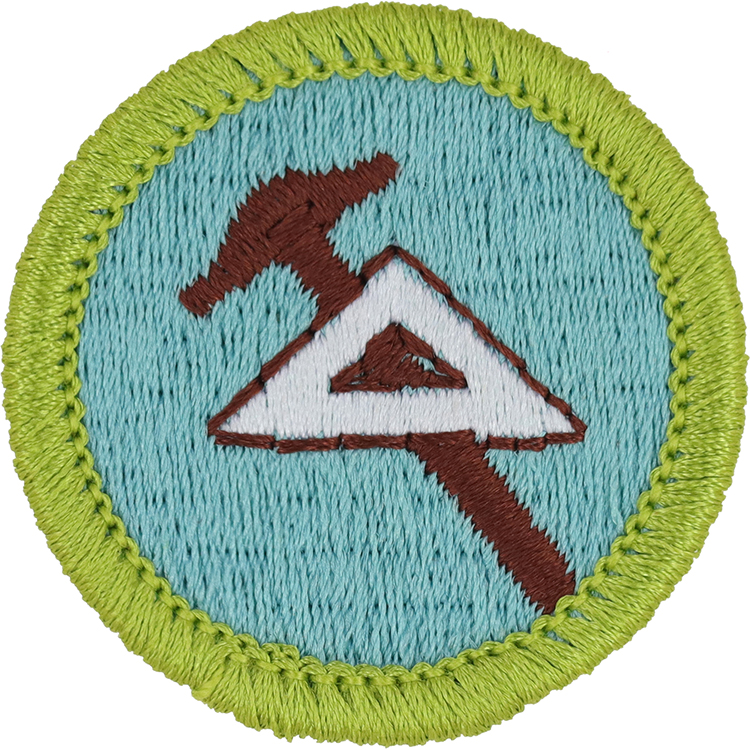
Fig. 1: Drafti-K-Front
- Embroidery: Rayon thread
- Border: Merrowed

Fig. 2: Drafti-K-Reverse
- Back: 100th Anniversary imprint
Item Name: Drafting 2010 - 2013
Item ID: Drafti-K
Collector Rating: 1
Pamphlets Used to Earn this Badge

Requirements January 2009 until January 2015
1. Format two sheets of drawing paper with proper borders and the blocks – one for your manual project (see requirement 2) and one for your lettering project (see requirement 5).
- Make a rough sketch for each of your project drawings to determine the correct size of paper to format.
- Using either single-stroke vertical or slant Gothic lettering, fill in all important information in the title block sections of the formatted paper.
2. Using the formatted sheet of paper you prepared for your manual project, produce a pencil drawing as if it would be used for manufacturing. Fill in all title block information. The manual drawing may be one of the following drawing types:
- Architectural: Make a scale drawing of an architectural project. The architectural drawing may be a floorplan; electrical, plumbing, mechanical service plan: elevation plan: or landscaping plan. Use the architect scale and show dimensions to communicate the actual size of features. Include any important notes and considerations necessary for construction.
- Mechanical: Make a scale drawing of some mechanical device or interesting object. The mechanical drawing may be of the orthographic or isometric style. Use an engineer scale and show dimensions to communicate the actual size of features. Include any important notes and manufacturing considerations.
- Electrical: Draw a simple schematic of a radio or electrical circuit. Properly print a bill of materials including all the major components used in the circuit. Use standard drawing symbols to represent the electric moments.
3. Produce a computer aided design (CAD) drawing as it would be used in manufacturing. Fill in all title block information. The CAD drawing may be any one of the following drawing types.
- Architectural: Make a scale drawing of an architectural project the architectural drawing may be a floorplan: electrical, plumbing, or mechanical service plan; elevation plan; or landscaping plan. Using architects scale and show dimensions to communicate the actual size of features. Include any important notes and considerations necessary for construction.
- Mechanical: Make a scale drawing of some mechanical device or interesting object. The mechanical drawing may be of the orthographic or isometric style. Use an engineer scale and show dimensions to communicate the actual size of features. Include any important notes and manufacturing considerations.
- Electrical: Draw a simple schematic of a radio or electronic circuit. Properly print a bill of materials including all the major electrical components used in the circuit. Use standard drawing symbols to represent the electronic components.
4. Discuss with your counselor how filling requirement 2 and 3 different from each other tell about the benefits derived from using CAD for requirement 3. Include in your discussion the software you used as well as other software options that are available.
5. Using single-stroke slant for vertical Gothic lettering (without the aid of a template for lettering guide), but a brief explanation of what you consider to be the most important benefit in using CAD in a particular industry (aerospace, electronics, manufacturing, architectural, or other). Use the experience gained in fulfilling requirements 2, 3, and 4 to support your opinion. Use the formatted sheet of paper you prepared in requirement 1 for your lettering project.
6. Do one of the following (a or b):
- Visit a facility or industry workplace word drafting is part of the business. Asked to see an example of the work that is done there, the different drafting facilities, and the tools used.
- Find out how much of the drafting there is manual and how much is done using CAD. If CAD is used, find out what software is used and how and why it was chosen.
- Ask about the drafting services provided. Haskell uses the designs produced in the drafting area and how those designs are used. Discuss how the professionals who performed drafting cooperate with other individuals in the drafting area and other areas of the business.
- Ask how important the role of drafting is to producing the end product or service that this business applies. Find out how drafting contributes to the companies in product or service
- Using resources you find on your own such as the library and on the Internet (with your parent’s permission), learn more about the drafting trade and discuss the following with your counselor.
- The drafting tools used in the past – why and how they were used. Explain which tools are still used today and held their uses changed with the advent of new tools. Discuss which tools are being made obsolete by newer tools in the industry.
- Tell what media types for use in the past and how drawings were used, stored, and reproduced. Tell how the advent of CAD has changed the media used, and discuss how these changes affect the storage or reproduction of drawings.
- Discuss whether the types of media have changed such that there are new uses for the drawings, or other outputs, produced by designers. Briefly discuss how the new media types are used in the industry today.
7. Find out about three career opportunities in drafting. Pick one and find out the education, training, and experience required for this profession. Discuss this with your counselor, and explain why this profession might interest you.