-
Merit Badges
- Legend to identify Merit Badges
- 1910 British Merit Badges
- Square 1911 - 33
- Wide Crimped 1934 & 35
-
Narrow Tan Crimped 1936 - 42
- Tan Heavyweight Cloth with Silk Embroidery and Printed Back 1936 - 37
- Tan Heavyweight Cloth with Silk Embroidery and Plain Back 1937 - 38
- Tan Lightweight Cloth with Silk Embroidery and Plain Back 1938 - 39
- Tan Lightweight Cloth with Cotton Continuous Loop Embroidery and Plain Back 1939 - 42
- Tan Lightweight Cloth with Cotton Lockstitch Embroidery and Plain Back 1939 - 42
- Blue Background 1942 - 46
- Wartime 1942 - 46
- Khaki Narrow Crimped 1946 - 59
- Green Twill Gauze Back 1960 - 68
- Fully Embroidered Merrowed Edge 1960 - 72
- Unprinted Plastic Back 1972 - 01
- Printed Plastic Back 2002 - Current
-
Merit Badge Paper
- Merit Badge Applications
- Merit Badge Cards
-
Merit Badge Pamphlets
- Type 1 White Cover - Rectangle Drawing On Cover
- Type 2 White Cover 5-375" x 8" Title at Top
- Type 3A Tan Cover - 200 Fifth Avenue
- Type 3B Tan Cover - 2 line address New York City
- Type 3C Tan Cover - 2 line address New York N.Y.
- Type 3D Tan Cover - 1 line address New York N.Y.
- Type 4 Standing Scout Cover
- Type 5A War Cover
- Type 5B Red and White
- Type 6 Photo-Red Cover
- Type 7 Full Photo Cover or Bulls-eye Cover
- Type 8 Full Photo - Green Stripe Cover
- Type 9 Full Photo - Red Stripe Cover
- Type 10A Blue Stripe - Logo above bottom blue stripe - FDL centered
- Type 10B - Blue Stripe in bottom of photo area. FDL to left of text
- Special Covers
- Boy Craft Helps
- Merit Badge Counselor's Guides
-
Youth Position
- Junior Assistant Scoutmaster
- Senior Patrol Leader
- Assistant Senior Patrol Leader
- Patrol Leader
- Assistant Patrol Leader
- Troop Guide
- Scribe
- Quartermaster
- Instructor
- Chaplain Aide
- Den Chief
- Librarian
- Musician
- Webmaster
- Bugler
- Troop Historian
- Troop Representative
- Unit Representative
- Leadership Corps
- Honor Guard
- Leave No Trace Trainer
- Outdoor Ethics Guide
-
Patrol Medallions
- Patrol Medallions Introduction
- Legend to identify Patrol Medallions
- Patrol Shoulder Knot-Ribbons
- Felt Handmade Patrol Medallions
- Square Felt Patrol Medallions
- Round Broadcloth Patrol Medallions
- Red Twill Patrol Medallions
- Multi-Color Cloth Patrol Medallions
- Tan Cloth Patrol Medallions
- Patrol Medallion Back Patches
- Woodbadge Patrol Medallion
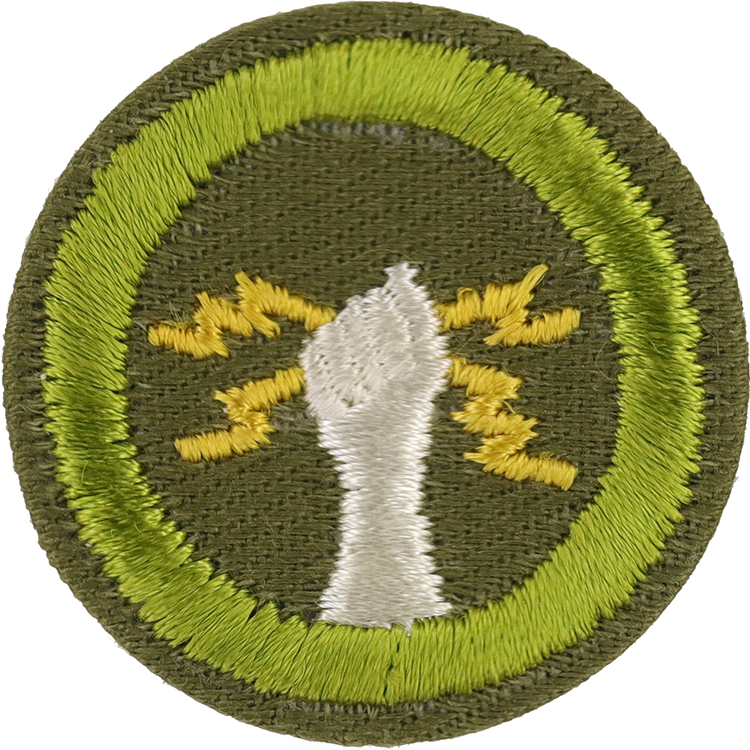
Fig. 1: Electr-E2-Front
- Cloth: Khaki right twill
- Embroidery: Cotton lock stitch
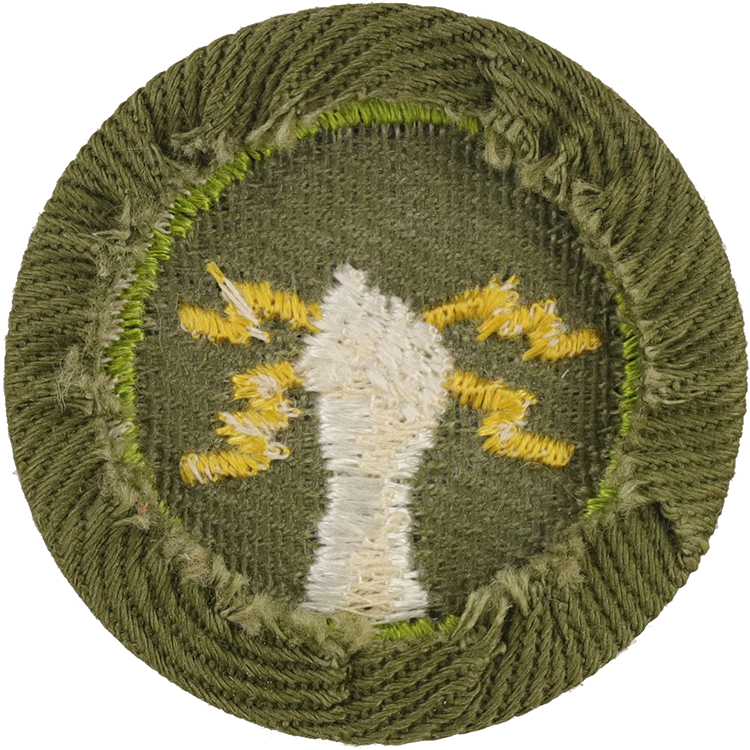
Fig. 2: Electr-E2-Reverse
- Back: Plain NO imprint with starch
Item Name: Electricity 1947 - 1960
Item ID: Electr-E2
Collector Rating: 1
Pamphlets Used to Earn this Badge
Requirements March 1927 until January 1957
1. Illustrate the experiment by which the laws of electrical attraction and repulsion are shown.
2. Understand the difference between a direct and an alternating current, and show uses to which each is adapted. Give a method of determining which kind flows in a given circuit.
3. Make a simple electro-magnet.
4. Have an elementary knowledge of the construction of simple battery cells, and of the working of electric bells and telephones.
5. Be able to replace fuses and to properly slice, solder, and tape rubber-covered wires
6. Demonstrate how to rescue a person in contact with a live electrical wire, and have a knowledge of the method of resuscitation of a person insensible from shock.
7. Diagram a typical electric lighting and wiring system of an automobile.
8. Make and submit a diagram or sketch, showing the lights, switches and convenience outlets which are controlled by each fuse in his dwelling house or a dwelling house.
9. Read correctly an electric meter and compute a residence bill.
Requirements January 1957 until June 1972.
1. Do an experiment showing the law of electrical attraction and repulsion; make and operate a simple electromagnet.
2. Explain the difference between a direct and an alternating current and the common uses of each. Give one method of identifying the currents.
3. Make pencil sketches showing the construction and operation of a battery cell and an electric bell.
4. Explain why a fuse blows out and how to detect a blown fuse in your own home. Demonstrate how to safely replace it.
5. Explain the meaning of overloading a household electrical circuit. Tell what you have done to make sure that this unsafe condition does not exist in your home.
6. Properly splice and tape two pieces of insulated wire. OR Repair a frayed electrical cord where it enters and appliance or wall plug.
7. Demonstrate how to rescue a person in contact with a live wire in the home and show proper first aid treatment if the patient is unconscious from electrical shock.
8. Sketch the floor plan of a room in your home, showing light sockets, switches, and convenience outlets. Find out which fuses protect these.
9. Read correctly a watt-hour meter and compute a residence bill.
10. Explain ten electrical terms in common use, such as volt, ampere, watt, ohm, resistance, induction, circuit breaker, fuse transformer, main switch, insulation, cycle, rectifier, magnetic field, etc.
11. Do any two of the items listed: (a) Mount and connect a buzzer, bell, or light with a battery; have a key or switch in the line. (b) Make and operate a simple electric motor, not from a kit. (c) Construct a simple rheostat; show how it works. (d) Construct a single-pole double-throw switch; show that it works. (e) Make a proper connection of electric train equipment to a standard house circuit and show how it operates.