-
Merit Badges
- Legend to identify Merit Badges
- 1910 British Merit Badges
- Square 1911 - 33
- Wide Crimped 1934 & 35
-
Narrow Tan Crimped 1936 - 42
- Tan Heavyweight Cloth with Silk Embroidery and Printed Back 1936 - 37
- Tan Heavyweight Cloth with Silk Embroidery and Plain Back 1937 - 38
- Tan Lightweight Cloth with Silk Embroidery and Plain Back 1938 - 39
- Tan Lightweight Cloth with Cotton Continuous Loop Embroidery and Plain Back 1939 - 42
- Tan Lightweight Cloth with Cotton Lockstitch Embroidery and Plain Back 1939 - 42
- Blue Background 1942 - 46
- Wartime 1942 - 46
- Khaki Narrow Crimped 1946 - 59
- Green Twill Gauze Back 1960 - 68
- Fully Embroidered Merrowed Edge 1960 - 72
- Unprinted Plastic Back 1972 - 01
- Printed Plastic Back 2002 - Current
-
Merit Badge Paper
- Merit Badge Applications
- Merit Badge Cards
-
Merit Badge Pamphlets
- Type 1 White Cover - Rectangle Drawing On Cover
- Type 2 White Cover 5-375" x 8" Title at Top
- Type 3A Tan Cover - 200 Fifth Avenue
- Type 3B Tan Cover - 2 line address New York City
- Type 3C Tan Cover - 2 line address New York N.Y.
- Type 3D Tan Cover - 1 line address New York N.Y.
- Type 4 Standing Scout Cover
- Type 5A War Cover
- Type 5B Red and White
- Type 6 Photo-Red Cover
- Type 7 Full Photo Cover or Bulls-eye Cover
- Type 8 Full Photo - Green Stripe Cover
- Type 9 Full Photo - Red Stripe Cover
- Type 10A Blue Stripe - Logo above bottom blue stripe - FDL centered
- Type 10B - Blue Stripe in bottom of photo area. FDL to left of text
- Special Covers
- Boy Craft Helps
- Merit Badge Counselor's Guides
-
Youth Position
- Junior Assistant Scoutmaster
- Senior Patrol Leader
- Assistant Senior Patrol Leader
- Patrol Leader
- Assistant Patrol Leader
- Troop Guide
- Scribe
- Quartermaster
- Instructor
- Chaplain Aide
- Den Chief
- Librarian
- Musician
- Webmaster
- Bugler
- Troop Historian
- Troop Representative
- Unit Representative
- Leadership Corps
- Honor Guard
- Leave No Trace Trainer
- Outdoor Ethics Guide
-
Patrol Medallions
- Patrol Medallions Introduction
- Legend to identify Patrol Medallions
- Patrol Shoulder Knot-Ribbons
- Felt Handmade Patrol Medallions
- Square Felt Patrol Medallions
- Round Broadcloth Patrol Medallions
- Red Twill Patrol Medallions
- Multi-Color Cloth Patrol Medallions
- Tan Cloth Patrol Medallions
- Patrol Medallion Back Patches
- Woodbadge Patrol Medallion
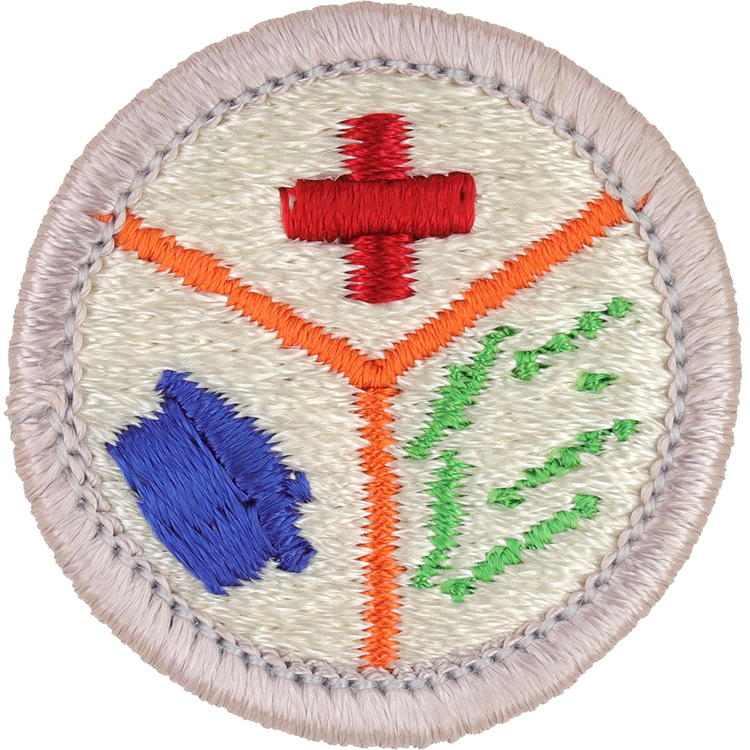
Fig. 1: EmePre-H3a-Front
- Embroidery: Cotton thread, dull sheen
- Border: Dk green merrowed
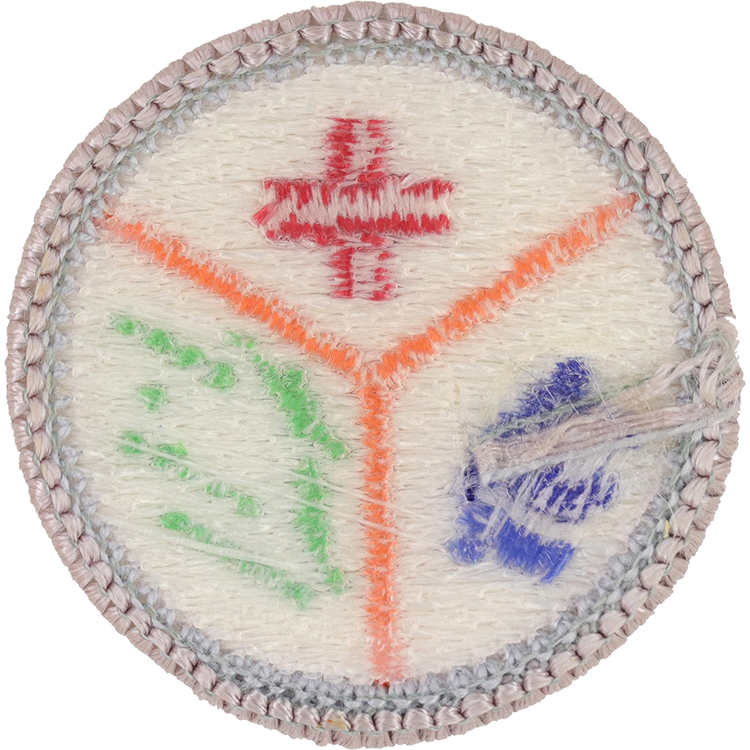
Fig. 2: EmePre-H3a-Reverse
- Embroidery: Cotton thread, dull sheen
- Design: Red cross
- Border: Silver merrowed
Item Name: Emergency Preparedness 1976 - 1978
Item ID: EmePre-H3a
Collector Rating: 1
Pamphlets Used to Earn this Badge
Requirements June 1972 until Setember 1995
1. Earn First Aid merit badge.
2. Do the following:
(a) Tell what you would do to prevent injury and possible loss of life to yourself and others in each of the following emergencies:
Fire or explosion at home and in a public building
Car stalled in blizzard or desert
Motor vehicle accident
Mountain accident
Food poisoning
Boat in accident
Search for lost person
Lost or marooned group
Gas leak
Earthquake
Flood
Tornado or hurricane
Atomic emergency
Avalanche (snow or rock)
(b) Show that you know what to do in at least TWO of the above.
3. Show how you could safely save a person from the following:
(a) Touching a live electric wire
(b) From a room with carbon monoxide or other fumes or smoke
(c) With clothes on fire
(d) From drowning using non-swimming rescues (including ice accidents).
4. Tell the things a group of Scouts should be prepared to do, the training needed, and the safety precautions to be taken for the following emergency service:
(a) Crowd and traffic control
(b) Messenger service and communication
(c) Collection and distribution services
(d) Group feeding, shelter, and sanitation.
5. Take part in an emergency service project, either real or a practice drill.
6. Show three ways of attracting and communicating with rescue planes.
7. With another person, show a good way to move an injured person out of a remote and rugged area, conserving the energy of the rescuers.
8. Do the following:
(a) Prepare a written plan for mobilizing your troop when needed to do emergency services. If there is a plan, explain it. Tell your part in making it work.
(b) Take part in at least one troop mobilization. Describe your part.
(c) Show the personal "emergency pack" which you have prepared to be ready for a mobilization call. Show a family kit (suitcase or box) for use by your family in case an emergency evacuation is needed. Explain the need.
9. Show proper use of ropes and lines for rescue work by doing the following:
(a) Tie knots for joining lines. Tie knots for shortening or adjusting lines. Tie knots for lashings.
(b) Lower a person from a height sufficient to show how.
(c) Coil and accurately throw light and heavy 50-foot heaving lines.