-
Merit Badges
- Legend to identify Merit Badges
- 1910 British Merit Badges
- Square 1911 - 33
- Wide Crimped 1934 & 35
-
Narrow Tan Crimped 1936 - 42
- Tan Heavyweight Cloth with Silk Embroidery and Printed Back 1936 - 37
- Tan Heavyweight Cloth with Silk Embroidery and Plain Back 1937 - 38
- Tan Lightweight Cloth with Silk Embroidery and Plain Back 1938 - 39
- Tan Lightweight Cloth with Cotton Continuous Loop Embroidery and Plain Back 1939 - 42
- Tan Lightweight Cloth with Cotton Lockstitch Embroidery and Plain Back 1939 - 42
- Blue Background 1942 - 46
- Wartime 1942 - 46
- Khaki Narrow Crimped 1946 - 59
- Green Twill Gauze Back 1960 - 68
- Fully Embroidered Merrowed Edge 1960 - 72
- Unprinted Plastic Back 1972 - 01
- Printed Plastic Back 2002 - Current
-
Merit Badge Paper
- Merit Badge Applications
- Merit Badge Cards
-
Merit Badge Pamphlets
- Type 1 White Cover - Rectangle Drawing On Cover
- Type 2 White Cover 5-375" x 8" Title at Top
- Type 3A Tan Cover - 200 Fifth Avenue
- Type 3B Tan Cover - 2 line address New York City
- Type 3C Tan Cover - 2 line address New York N.Y.
- Type 3D Tan Cover - 1 line address New York N.Y.
- Type 4 Standing Scout Cover
- Type 5A War Cover
- Type 5B Red and White
- Type 6 Photo-Red Cover
- Type 7 Full Photo Cover or Bulls-eye Cover
- Type 8 Full Photo - Green Stripe Cover
- Type 9 Full Photo - Red Stripe Cover
- Type 10A Blue Stripe - Logo above bottom blue stripe - FDL centered
- Type 10B - Blue Stripe in bottom of photo area. FDL to left of text
- Special Covers
- Boy Craft Helps
- Merit Badge Counselor's Guides
-
Youth Position
- Junior Assistant Scoutmaster
- Senior Patrol Leader
- Assistant Senior Patrol Leader
- Patrol Leader
- Assistant Patrol Leader
- Troop Guide
- Scribe
- Quartermaster
- Instructor
- Chaplain Aide
- Den Chief
- Librarian
- Musician
- Webmaster
- Bugler
- Troop Historian
- Troop Representative
- Unit Representative
- Leadership Corps
- Honor Guard
- Leave No Trace Trainer
- Outdoor Ethics Guide
-
Patrol Medallions
- Patrol Medallions Introduction
- Legend to identify Patrol Medallions
- Patrol Shoulder Knot-Ribbons
- Felt Handmade Patrol Medallions
- Square Felt Patrol Medallions
- Round Broadcloth Patrol Medallions
- Red Twill Patrol Medallions
- Multi-Color Cloth Patrol Medallions
- Tan Cloth Patrol Medallions
- Patrol Medallion Back Patches
- Woodbadge Patrol Medallion

Fig. 1: Energy-H3-Front
- Embroidery: Cotton thread, dull sheen
- Border: Dk green merrowed
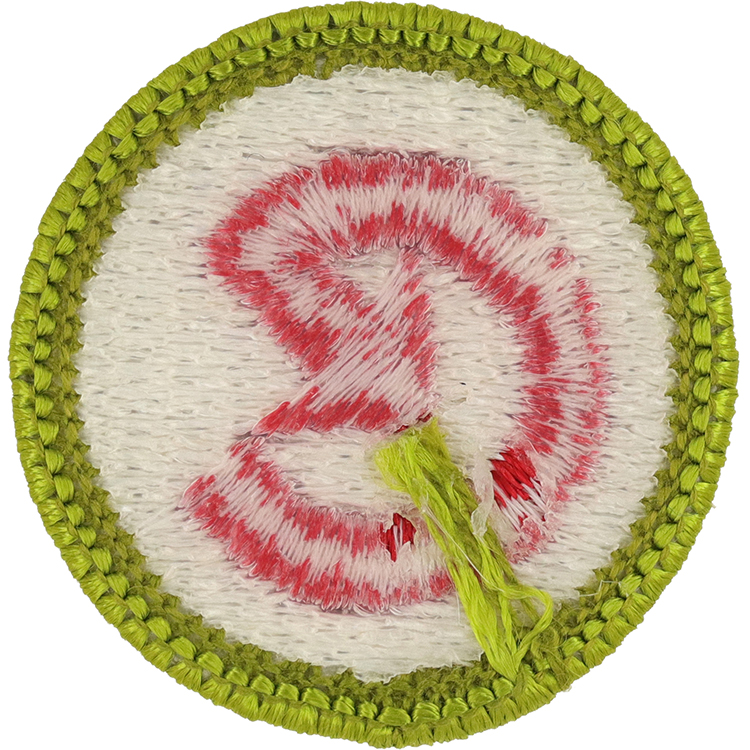
Fig. 2: Energy-H3-Reverse
- Back: Molded plastic
Item Name: Energy 1976 - 1978
Item ID: Energy-H3
Collector Rating: 1
Pamphlets Used to Earn this Badge
Requirements February 1979 until September 1987
1. Make a solar energy box. Use it to show how solar energy can be collected, and how loss of heat can be controlled. Keep records of your investigations. Show these records in explaining how the box collects solar energy and how heat loss is controlled.
2. In your own words, without notes, explain: energy, kinetic energy, potential energy, power, engine, useful work, exhaust, engine efficiency, pollution.
3. Draw a diagram showing how a gasoline, diesel, or other type engine converts energy in a fuel into mechanical energy. Label your diagram to show the energy conversions that take place.
4. Find out about and write down in a notebook 10 different examples of energy waste going on in your home or town. Suggest in each case possible ways to reduce this waste. Find and write down in your notebook about five examples you observed of pollution from energy use. Suggest in each case how this pollution might be reduced.
5. Show two articles from a current newspaper or magazine about the use or conservation of energy. Tell about each.
6. Draw a color chart chow the earth's known and estimated quantities of nonrenewable obtainable energy materials. Show how long each of these is expected to last. (Based on the best estimate available.) Tell where you got your information.
7. *Do the following:
(a) Tell how our lives in the United States might be affected if energy supplies became less than enough to meet our present demands.
(b) Tell what is being done to make any three of the following produce larger amounts of useful energy economically (Include possible pollution and safety problems): nuclear-fission generators, nuclear-fusion generators, the wind, the sun, the oceans, heat from inside the earth.
8. Give a talk titles "Energy, Why We Need To Conserve It." Use all materials from requirements 1 through 6. Choose as your audience your counselor, a den of Cub Scouts, or a group approved by your counselor.
*Notes may be used.