-
Merit Badges
- Legend to identify Merit Badges
- 1910 British Merit Badges
- Square 1911 - 33
- Wide Crimped 1934 & 35
-
Narrow Tan Crimped 1936 - 42
- Tan Heavyweight Cloth with Silk Embroidery and Printed Back 1936 - 37
- Tan Heavyweight Cloth with Silk Embroidery and Plain Back 1937 - 38
- Tan Lightweight Cloth with Silk Embroidery and Plain Back 1938 - 39
- Tan Lightweight Cloth with Cotton Continuous Loop Embroidery and Plain Back 1939 - 42
- Tan Lightweight Cloth with Cotton Lockstitch Embroidery and Plain Back 1939 - 42
- Blue Background 1942 - 46
- Wartime 1942 - 46
- Khaki Narrow Crimped 1946 - 59
- Green Twill Gauze Back 1960 - 68
- Fully Embroidered Merrowed Edge 1960 - 72
- Unprinted Plastic Back 1972 - 01
- Printed Plastic Back 2002 - Current
-
Merit Badge Paper
- Merit Badge Applications
- Merit Badge Cards
-
Merit Badge Pamphlets
- Type 1 White Cover - Rectangle Drawing On Cover
- Type 2 White Cover 5-375" x 8" Title at Top
- Type 3A Tan Cover - 200 Fifth Avenue
- Type 3B Tan Cover - 2 line address New York City
- Type 3C Tan Cover - 2 line address New York N.Y.
- Type 3D Tan Cover - 1 line address New York N.Y.
- Type 4 Standing Scout Cover
- Type 5A War Cover
- Type 5B Red and White
- Type 6 Photo-Red Cover
- Type 7 Full Photo Cover or Bulls-eye Cover
- Type 8 Full Photo - Green Stripe Cover
- Type 9 Full Photo - Red Stripe Cover
- Type 10A Blue Stripe - Logo above bottom blue stripe - FDL centered
- Type 10B - Blue Stripe in bottom of photo area. FDL to left of text
- Special Covers
- Boy Craft Helps
- Merit Badge Counselor's Guides
-
Youth Position
- Junior Assistant Scoutmaster
- Senior Patrol Leader
- Assistant Senior Patrol Leader
- Patrol Leader
- Assistant Patrol Leader
- Troop Guide
- Scribe
- Quartermaster
- Instructor
- Chaplain Aide
- Den Chief
- Librarian
- Musician
- Webmaster
- Bugler
- Troop Historian
- Troop Representative
- Unit Representative
- Leadership Corps
- Honor Guard
- Leave No Trace Trainer
- Outdoor Ethics Guide
-
Patrol Medallions
- Patrol Medallions Introduction
- Legend to identify Patrol Medallions
- Patrol Shoulder Knot-Ribbons
- Felt Handmade Patrol Medallions
- Square Felt Patrol Medallions
- Round Broadcloth Patrol Medallions
- Red Twill Patrol Medallions
- Multi-Color Cloth Patrol Medallions
- Tan Cloth Patrol Medallions
- Patrol Medallion Back Patches
- Woodbadge Patrol Medallion
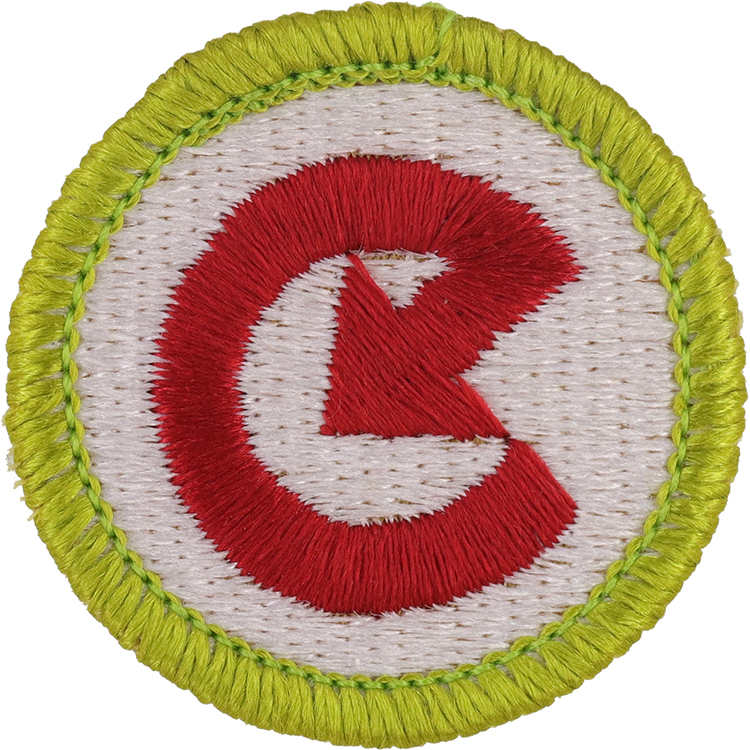
Fig. 1: Energy-J2-Front
- Embroidery: Rayon thread
- Border: Merrowed

Fig. 2: Energy-J2-Reverse
- Back: Smooth clear NO Scout Stuff imprint Bisphenol A (BPA) free plastic
Item Name: Energy 2009 - 2010
Item ID: Energy-J2
Collector Rating: 1
Pamphlets Used to Earn this Badge
Requirements January 2006 until January 2015
1. Do the following:
(a) Find an article on the use or conservation of energy. Discuss with your counselor what in the article was interesting to you, the questions it raises, and what ideas it addresses that you do not understand.
(b) After you have completed requirements 2 through 8, revisit the article you found for requirement 1a. Explain to your counselor what you have learned in completing the requirements that helps you better understand the article.
2. Show you understand energy forms and conversions by doing the following:
(a) Explain how THREE of the following devices use energy, and explain their energy conversions: toaster, greenhouse, lightbulb, bow drill, nuclear reactor, sweat lodge.
(b) Construct a system that makes at least two energy conversions and explain this to your counselor.
3. Show you understand energy efficiency by explaining to your counselor a common example of a situation where energy moves through a system to produce a useful result. Do the following:
(a) Identify the parts of the system that are affected by the energy movement.
(b) Name the system’s primary source of energy.
(c) Identify the useful outcomes of the system.
(d) Identify the energy losses of the system.
4. Conduct an energy audit of your home. Keep a 14-day log that records what you and your family did to reduce energy use. Include the following in your report and, after the 14-day period, discuss what you have learned with your counselor.
(a) List the types of energy used in your home such as electricity, wood, oil, liquid petroleum, and natural gas, and tell how each is delivered and measured, and the current cost; OR record the transportation fuel used, miles driven, miles per gallon, and tips using your family car or another vehile.
(b) Describe ways you and your family can use energy resources more wisely. In preparing your discussion, consider the energy required for the things you do and use on a daily basis (cooking, showering, using lights, driving, watching TV, using the computer). Explain how you can change your energy use through reuse and recycling.
5. In a notebook, identify and describe five examples of energy waste in your school or community. Suggest in each case possible ways to reduce this waste. Describe the idea of trade-offs in energy use. In your response, do the following:
(a) Explain how the changes you suggest would lower costs, reduce pollution, or otherwise improve your community.
(b) Explain what changes to routines, habits, or convevience are necessary to reduce energy waste. Tell why people might resist the changes you suggest.
6. Prepare pie charts showing the following information, and explain to your counselor the important ideas each chart reveals. Tell where you got your information. Explain how cost affects the use of a nonrenewable energy resource and makes alternatives practical.
(a) The energy resources that supply the United States with most of its energy
(b) The share of energy resources used by the United States that comes from other countries
(c) The proportion of energy resources used by homes, businesses, industry, and transportation
(d) The fuel used to generate America’s electricity
(e) The world’s know and estimated primary energy resource reserves
7. Tell what is being done to make FIVE of the following energy systems produce more usable energy. In your explanation, describe the technology, cost, environmental impacts, and safety concerns.
- Biomass digesters or waste-to-energy plants
- Cogeneration plants
- Fossil fuel power plants
- Fuel cells
- Geothermal power plants
- Nuclear power plants
- Solar power plants
- Tidal energy, wave energy, or ocean thermal energy conversion divices
- Wind turbines
8. Find out what opportunities are available for a career in energy. Choose one position that interests you and describe the education and training required.