-
Merit Badges
- Legend to identify Merit Badges
- 1910 British Merit Badges
- Square 1911 - 33
- Wide Crimped 1934 & 35
-
Narrow Tan Crimped 1936 - 42
- Tan Heavyweight Cloth with Silk Embroidery and Printed Back 1936 - 37
- Tan Heavyweight Cloth with Silk Embroidery and Plain Back 1937 - 38
- Tan Lightweight Cloth with Silk Embroidery and Plain Back 1938 - 39
- Tan Lightweight Cloth with Cotton Continuous Loop Embroidery and Plain Back 1939 - 42
- Tan Lightweight Cloth with Cotton Lockstitch Embroidery and Plain Back 1939 - 42
- Blue Background 1942 - 46
- Wartime 1942 - 46
- Khaki Narrow Crimped 1946 - 59
- Green Twill Gauze Back 1960 - 68
- Fully Embroidered Merrowed Edge 1960 - 72
- Unprinted Plastic Back 1972 - 01
- Printed Plastic Back 2002 - Current
-
Merit Badge Paper
- Merit Badge Applications
- Merit Badge Cards
-
Merit Badge Pamphlets
- Type 1 White Cover - Rectangle Drawing On Cover
- Type 2 White Cover 5-375" x 8" Title at Top
- Type 3A Tan Cover - 200 Fifth Avenue
- Type 3B Tan Cover - 2 line address New York City
- Type 3C Tan Cover - 2 line address New York N.Y.
- Type 3D Tan Cover - 1 line address New York N.Y.
- Type 4 Standing Scout Cover
- Type 5A War Cover
- Type 5B Red and White
- Type 6 Photo-Red Cover
- Type 7 Full Photo Cover or Bulls-eye Cover
- Type 8 Full Photo - Green Stripe Cover
- Type 9 Full Photo - Red Stripe Cover
- Type 10A Blue Stripe - Logo above bottom blue stripe - FDL centered
- Type 10B - Blue Stripe in bottom of photo area. FDL to left of text
- Special Covers
- Boy Craft Helps
- Merit Badge Counselor's Guides
-
Youth Position
- Junior Assistant Scoutmaster
- Senior Patrol Leader
- Assistant Senior Patrol Leader
- Patrol Leader
- Assistant Patrol Leader
- Troop Guide
- Scribe
- Quartermaster
- Instructor
- Chaplain Aide
- Den Chief
- Librarian
- Musician
- Webmaster
- Bugler
- Troop Historian
- Troop Representative
- Unit Representative
- Leadership Corps
- Honor Guard
- Leave No Trace Trainer
- Outdoor Ethics Guide
-
Patrol Medallions
- Patrol Medallions Introduction
- Legend to identify Patrol Medallions
- Patrol Shoulder Knot-Ribbons
- Felt Handmade Patrol Medallions
- Square Felt Patrol Medallions
- Round Broadcloth Patrol Medallions
- Red Twill Patrol Medallions
- Multi-Color Cloth Patrol Medallions
- Tan Cloth Patrol Medallions
- Patrol Medallion Back Patches
- Woodbadge Patrol Medallion

Fig. 1: Engine-H4-Front
- Embroidery: Cotton thread, dull sheen
- Border: Lt green merrowed

Fig. 2: Engine-H4-Reverse
- Back: Lt green lock stitch, molded plastic
Item Name: Engineering 1978 - 1990
Item ID: Engine-H4
Collector Rating: 1
Pamphlets Used to Earn this Badge
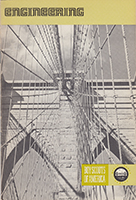
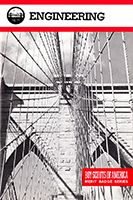
Requirements December 1977 until September 1993
1. Visit a construction site or manufacturing or processing plant. Discuss engineering design and construction with the engineer in charge. Ask to see engineering drawings and have them explained. Tell what you learned about engineering and the day-to-day work of an engineer from this visit.
2. Visit another engineer (other than your counselor or the person in requirement 1) in his office. Tell how the work done there relates to the work done in the field.
3. Explain the work of six of the following types of engineers: civil, mechanical, chemical, electrical, industrial, agricultural, aeronautical, mining, astronautical, metallurgical, nuclear, biomedical, ceramic, petroleum.
4. With your counselor's advice, select a subject for research in engineering. Do research in publications and interview experts. Tell what you learned and how you got the facts. (Notes may be used.)
5. Tell why measurements and calculations are important in an engineer's work. Explain the difference between accurate and precise measurements and calculations. Explain the values of the metric system.
6. Using an engineering college or university catalog, learn what high school courses you should take to be admitted to an accredited engineering college. Report to your counselor. Tell what an "accredited" college means.
7. Do ONE of the following:
(a) Show how the "engineering approach" to problems works by laying out plans, step by step, for your next camp-out. List alternative ideas on such items as costs, campsites, and transportation. Tell why you decided as you did.
(b) Make an original design for a piece of patrol equipment. Draw plans for it. Show the plans to your counselor.
8. Do TWO of the following:
(a) Transforming Motion. Show how a bicycle transforms motion, or tell how a car or truck transmission transforms motion.
(b) Harnessing Electricity. Make a model of an electrical device. A kit may be used. Or, make a list of all electrical appliances in your home and find out approximately how much electricity each uses in 1 month. Tell five ways to conserve electricity.
(c) Materials Science. Do experiments to show the differences in strength and heat conductivity among wood, plastic, and metal. Discuss with your counselor what you have learned.
(d) Energy Conservation. Tell how a car or flashlight battery converts chemical energy into electrical energy. Do an experiment to show the value and potential of solar energy. Explain your results. Tell about one way to convert mechanical to electrical energy.
(e) Traffic Study. With the advice of your counselor, select a busy street or highway intersection in your community. Make a study of the traffic flow there in both heavy and light traffic periods. Find out your community's predicted population 5 years from now. Using all the data, tell your counselor what could be done to improve traffic flow 5 years hence.
(f) Build an engineering project for entry into a science-engineering fair. Show it to your counselor.
9. Study "Faith of the Engineer". Tell how this is like the Scout Oath.