-
Merit Badges
- Legend to identify Merit Badges
- 1910 British Merit Badges
- Square 1911 - 33
- Wide Crimped 1934 & 35
-
Narrow Tan Crimped 1936 - 42
- Tan Heavyweight Cloth with Silk Embroidery and Printed Back 1936 - 37
- Tan Heavyweight Cloth with Silk Embroidery and Plain Back 1937 - 38
- Tan Lightweight Cloth with Silk Embroidery and Plain Back 1938 - 39
- Tan Lightweight Cloth with Cotton Continuous Loop Embroidery and Plain Back 1939 - 42
- Tan Lightweight Cloth with Cotton Lockstitch Embroidery and Plain Back 1939 - 42
- Blue Background 1942 - 46
- Wartime 1942 - 46
- Khaki Narrow Crimped 1946 - 59
- Green Twill Gauze Back 1960 - 68
- Fully Embroidered Merrowed Edge 1960 - 72
- Unprinted Plastic Back 1972 - 01
- Printed Plastic Back 2002 - Current
-
Merit Badge Paper
- Merit Badge Applications
- Merit Badge Cards
-
Merit Badge Pamphlets
- Type 1 White Cover - Rectangle Drawing On Cover
- Type 2 White Cover 5-375" x 8" Title at Top
- Type 3A Tan Cover - 200 Fifth Avenue
- Type 3B Tan Cover - 2 line address New York City
- Type 3C Tan Cover - 2 line address New York N.Y.
- Type 3D Tan Cover - 1 line address New York N.Y.
- Type 4 Standing Scout Cover
- Type 5A War Cover
- Type 5B Red and White
- Type 6 Photo-Red Cover
- Type 7 Full Photo Cover or Bulls-eye Cover
- Type 8 Full Photo - Green Stripe Cover
- Type 9 Full Photo - Red Stripe Cover
- Type 10A Blue Stripe - Logo above bottom blue stripe - FDL centered
- Type 10B - Blue Stripe in bottom of photo area. FDL to left of text
- Special Covers
- Boy Craft Helps
- Merit Badge Counselor's Guides
-
Youth Position
- Junior Assistant Scoutmaster
- Senior Patrol Leader
- Assistant Senior Patrol Leader
- Patrol Leader
- Assistant Patrol Leader
- Troop Guide
- Scribe
- Quartermaster
- Instructor
- Chaplain Aide
- Den Chief
- Librarian
- Musician
- Webmaster
- Bugler
- Troop Historian
- Troop Representative
- Unit Representative
- Leadership Corps
- Honor Guard
- Leave No Trace Trainer
- Outdoor Ethics Guide
-
Patrol Medallions
- Patrol Medallions Introduction
- Legend to identify Patrol Medallions
- Patrol Shoulder Knot-Ribbons
- Felt Handmade Patrol Medallions
- Square Felt Patrol Medallions
- Round Broadcloth Patrol Medallions
- Red Twill Patrol Medallions
- Multi-Color Cloth Patrol Medallions
- Tan Cloth Patrol Medallions
- Patrol Medallion Back Patches
- Woodbadge Patrol Medallion
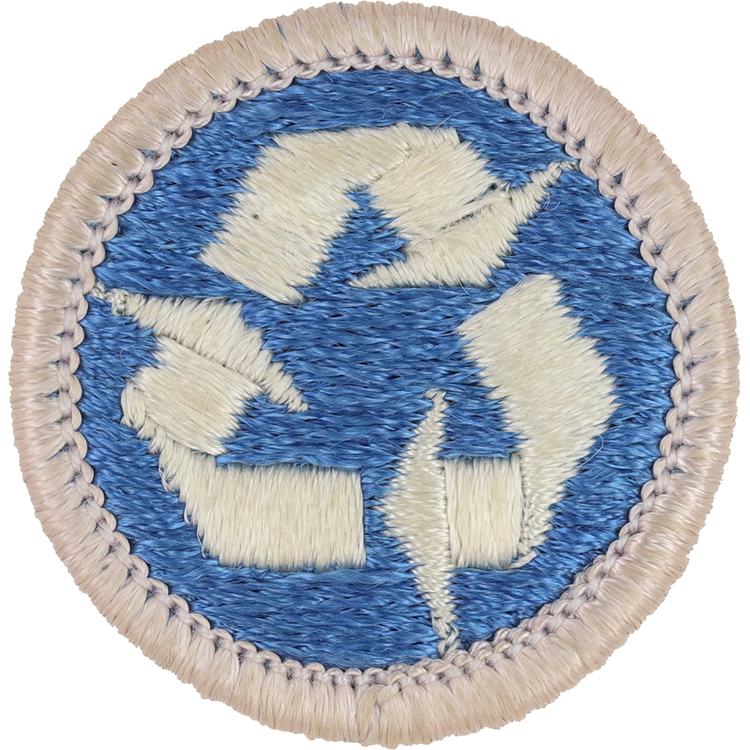
Fig. 1: EnvSci-H3-Front
- Embroidery: Cotton thread, dull sheen
- Border: Dk green merrowed
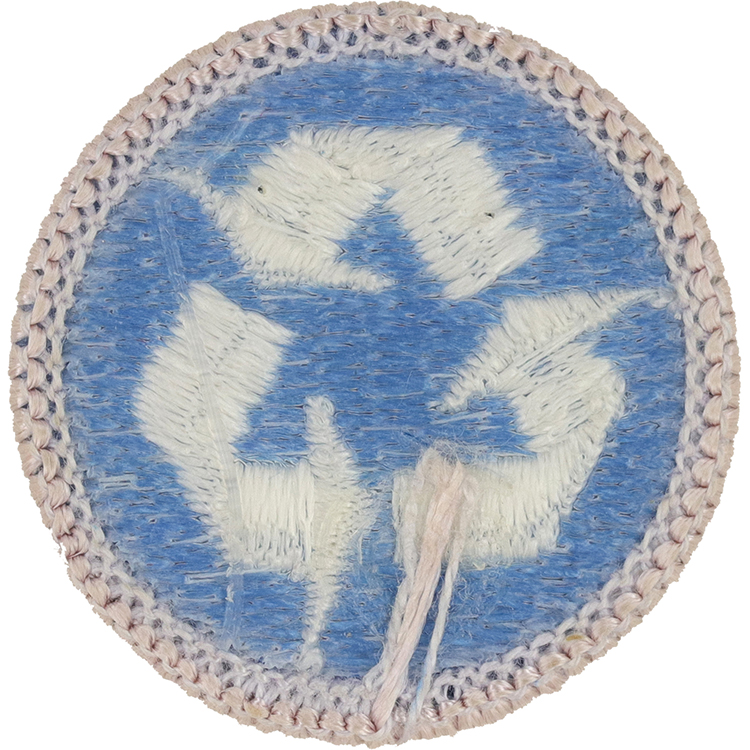
Fig. 2: EnvSci-H3-Reverse
- Embroidery: Cotton thread, dull sheen
- Border: Silver merrowed
Item Name: Environmental Science 1976 - 1978
Item ID: EnvSci-H3
Collector Rating: 1
Pamphlets Used to Earn this Badge
Requirements June 1972 until February 1979
1. Explain the meaning of the following: ecology, biosphere, ecosystem, plant succession, limiting factor. Give an example of the last two.
2. With the help of your counselor, pick an area of 10 acres* for study.
3. Visit the area four times for 2 hours each time. On each visit do the following:
(a) Record the temperature, rain, and wind.
(b) List the animals you saw. Tell what they were doing.
(c) List the plants you saw. Name the kinds of rocks and soil.
4. Write about your study in 500 words or more showing:
(a) How the climate, topography, and geology have influenced the number and kinds of plants and animals.
(b) How the living and nonliving elements are interrelated.
(c) Why it is important that people understand this.
5. With your counselor, plan and carry out a project on ONE of the following:
(a) The effect of water-holding capacity of soil on plant life. The relation of plant cover to runoff. How both are related to the water and oxygen cycles.
(b) The influence of land plant life on temperature, light intensity, wind velocity, and humidity. The influence of water plant life on the water environment. How both land and water plants affect animal life.
6. Make a report, in the form of a short talk to a Scout group, on what you did in No. 5.
7. Show you understand the following:
(a) The causes of water pollution. Tell what it does to rivers and lakes.
(b) The causes of land pollution. Tell what it does to the environment.
(c) The causes of air pollution. Tell what it does to the environment.
(d) How some chemicals get into the tissues of animals miles from where they were used.
8. Describe what you and others can do to help solve a local problem of air pollution, water pollution, or litter.
9. Describe the duties of three positions in environmental science.
*City Scouts may pick an area in a large park, if a better place is not available.