-
Merit Badges
- Legend to identify Merit Badges
- 1910 British Merit Badges
- Square 1911 - 33
- Wide Crimped 1934 & 35
-
Narrow Tan Crimped 1936 - 42
- Tan Heavyweight Cloth with Silk Embroidery and Printed Back 1936 - 37
- Tan Heavyweight Cloth with Silk Embroidery and Plain Back 1937 - 38
- Tan Lightweight Cloth with Silk Embroidery and Plain Back 1938 - 39
- Tan Lightweight Cloth with Cotton Continuous Loop Embroidery and Plain Back 1939 - 42
- Tan Lightweight Cloth with Cotton Lockstitch Embroidery and Plain Back 1939 - 42
- Blue Background 1942 - 46
- Wartime 1942 - 46
- Khaki Narrow Crimped 1946 - 59
- Green Twill Gauze Back 1960 - 68
- Fully Embroidered Merrowed Edge 1960 - 72
- Unprinted Plastic Back 1972 - 01
- Printed Plastic Back 2002 - Current
-
Merit Badge Paper
- Merit Badge Applications
- Merit Badge Cards
-
Merit Badge Pamphlets
- Type 1 White Cover - Rectangle Drawing On Cover
- Type 2 White Cover 5-375" x 8" Title at Top
- Type 3A Tan Cover - 200 Fifth Avenue
- Type 3B Tan Cover - 2 line address New York City
- Type 3C Tan Cover - 2 line address New York N.Y.
- Type 3D Tan Cover - 1 line address New York N.Y.
- Type 4 Standing Scout Cover
- Type 5A War Cover
- Type 5B Red and White
- Type 6 Photo-Red Cover
- Type 7 Full Photo Cover or Bulls-eye Cover
- Type 8 Full Photo - Green Stripe Cover
- Type 9 Full Photo - Red Stripe Cover
- Type 10A Blue Stripe - Logo above bottom blue stripe - FDL centered
- Type 10B - Blue Stripe in bottom of photo area. FDL to left of text
- Special Covers
- Boy Craft Helps
- Merit Badge Counselor's Guides
-
Youth Position
- Junior Assistant Scoutmaster
- Senior Patrol Leader
- Assistant Senior Patrol Leader
- Patrol Leader
- Assistant Patrol Leader
- Troop Guide
- Scribe
- Quartermaster
- Instructor
- Chaplain Aide
- Den Chief
- Librarian
- Musician
- Webmaster
- Bugler
- Troop Historian
- Troop Representative
- Unit Representative
- Leadership Corps
- Honor Guard
- Leave No Trace Trainer
- Outdoor Ethics Guide
-
Patrol Medallions
- Patrol Medallions Introduction
- Legend to identify Patrol Medallions
- Patrol Shoulder Knot-Ribbons
- Felt Handmade Patrol Medallions
- Square Felt Patrol Medallions
- Round Broadcloth Patrol Medallions
- Red Twill Patrol Medallions
- Multi-Color Cloth Patrol Medallions
- Tan Cloth Patrol Medallions
- Patrol Medallion Back Patches
- Woodbadge Patrol Medallion
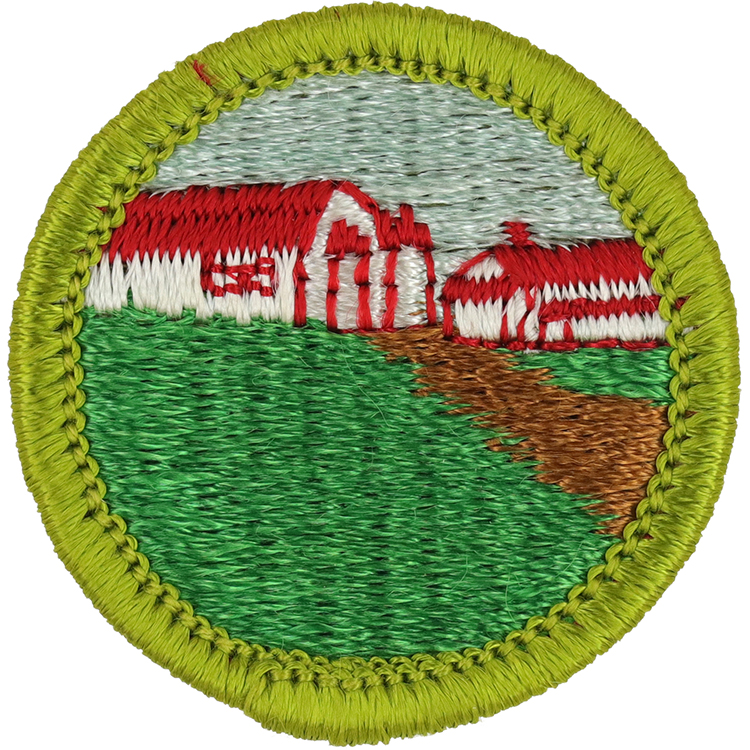
Fig. 1: FarArr-G1-Front
- Embroidery: Cotton thread
- Border: Merrowed
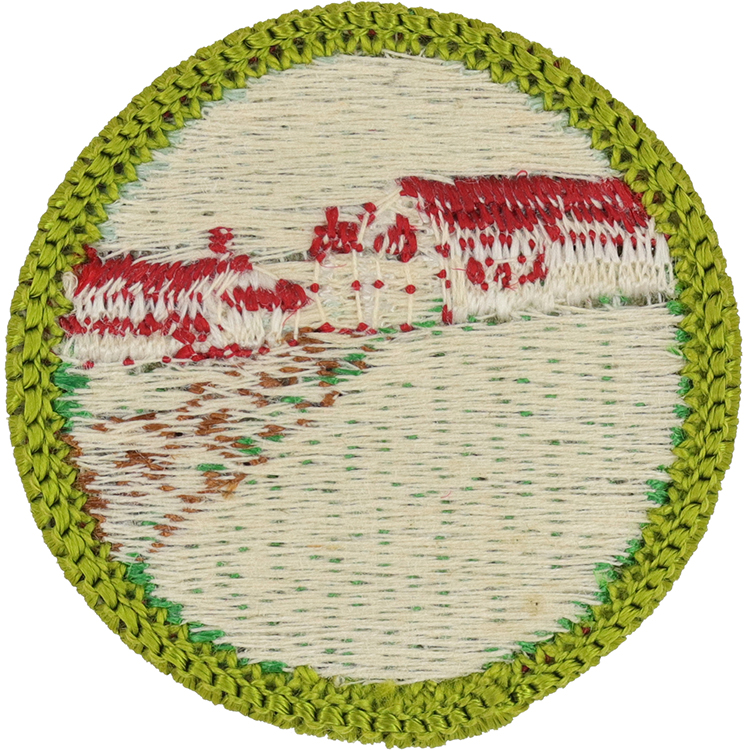
Fig. 2: FarArr-G1-Reverse
- Back: Starched cloth
Item Name: Farm Arrangement 1961 - 1962
Item ID: FarArr-G1
Collector Rating: 1
Pamphlets Used to Earn this Badge
Requirements January 1960 until June 1972
1. Complete the requirements in the Building Rearrangement Plan or the New Farmstead Plan.
(a) Make a scale drawing of a farmstead as it now exists. Indicate location of structures (identify them and label as permanent, temporary, obsolete, or movable), windbreaks, desirable trees, nearest roads and farm lanes, electric power lines, direction of prevailing winds in winter and summer, good and poor drainage spots, wells, ponds, streams.
(b) On a tissue or tracing paper overlay, show where you would relocate the basic farmstead centers (house, machinery center, grain center, feeding center, dairy or poultry center), to best suit the needs of your particular type of farm operation. Explain to your counselor why you would relocate any of the centers.
New Farmstead Plan
(a) Make a scale drawing of a farmstead site that has no buildings. This drawing should show present location of the following: trees (indicate whether desirable or not), natural windbreaks, slope of land, nearest roads, streams, ponds, direction of prevailing wind in winter and summer, high and low spots, electric power lines.
(b) On this plan show where you would locate the basic farmstead centers (house, machinery center, grain center, dairy or poultry center) to best suit the needs of your particular type of farm operation. Explain to your counselor why you would locate the centers where you have.
2. Do one:
(a) Secure from a reliable source plans for one building (farmhouse, dairy barn, poultry house, etc.) that would best fit into your farmstead. Explain how you would change and fit the plan to your particular needs.
(b) Develop and explain a detailed plan for water and sanitation facilities (well, water lines, sewage disposal system) for a farm.
(c) On a tissue or tracing paper overlay show the most efficient travel paths for getting from one center of the farmstead to another, and from the farmstead to fields, pastures, and road. Explain your drawing to your counselor.
This merit badge may be earned as a 4-H'er by completing a club project in that subject or as an FFA member by meeting these requirements through the FFA supervised farming program.