-
Merit Badges
- Legend to identify Merit Badges
- 1910 British Merit Badges
- Square 1911 - 33
- Wide Crimped 1934 & 35
-
Narrow Tan Crimped 1936 - 42
- Tan Heavyweight Cloth with Silk Embroidery and Printed Back 1936 - 37
- Tan Heavyweight Cloth with Silk Embroidery and Plain Back 1937 - 38
- Tan Lightweight Cloth with Silk Embroidery and Plain Back 1938 - 39
- Tan Lightweight Cloth with Cotton Continuous Loop Embroidery and Plain Back 1939 - 42
- Tan Lightweight Cloth with Cotton Lockstitch Embroidery and Plain Back 1939 - 42
- Blue Background 1942 - 46
- Wartime 1942 - 46
- Khaki Narrow Crimped 1946 - 59
- Green Twill Gauze Back 1960 - 68
- Fully Embroidered Merrowed Edge 1960 - 72
- Unprinted Plastic Back 1972 - 01
- Printed Plastic Back 2002 - Current
-
Merit Badge Paper
- Merit Badge Applications
- Merit Badge Cards
-
Merit Badge Pamphlets
- Type 1 White Cover - Rectangle Drawing On Cover
- Type 2 White Cover 5-375" x 8" Title at Top
- Type 3A Tan Cover - 200 Fifth Avenue
- Type 3B Tan Cover - 2 line address New York City
- Type 3C Tan Cover - 2 line address New York N.Y.
- Type 3D Tan Cover - 1 line address New York N.Y.
- Type 4 Standing Scout Cover
- Type 5A War Cover
- Type 5B Red and White
- Type 6 Photo-Red Cover
- Type 7 Full Photo Cover or Bulls-eye Cover
- Type 8 Full Photo - Green Stripe Cover
- Type 9 Full Photo - Red Stripe Cover
- Type 10A Blue Stripe - Logo above bottom blue stripe - FDL centered
- Type 10B - Blue Stripe in bottom of photo area. FDL to left of text
- Special Covers
- Boy Craft Helps
- Merit Badge Counselor's Guides
-
Youth Position
- Junior Assistant Scoutmaster
- Senior Patrol Leader
- Assistant Senior Patrol Leader
- Patrol Leader
- Assistant Patrol Leader
- Troop Guide
- Scribe
- Quartermaster
- Instructor
- Chaplain Aide
- Den Chief
- Librarian
- Musician
- Webmaster
- Bugler
- Troop Historian
- Troop Representative
- Unit Representative
- Leadership Corps
- Honor Guard
- Leave No Trace Trainer
- Outdoor Ethics Guide
-
Patrol Medallions
- Patrol Medallions Introduction
- Legend to identify Patrol Medallions
- Patrol Shoulder Knot-Ribbons
- Felt Handmade Patrol Medallions
- Square Felt Patrol Medallions
- Round Broadcloth Patrol Medallions
- Red Twill Patrol Medallions
- Multi-Color Cloth Patrol Medallions
- Tan Cloth Patrol Medallions
- Patrol Medallion Back Patches
- Woodbadge Patrol Medallion
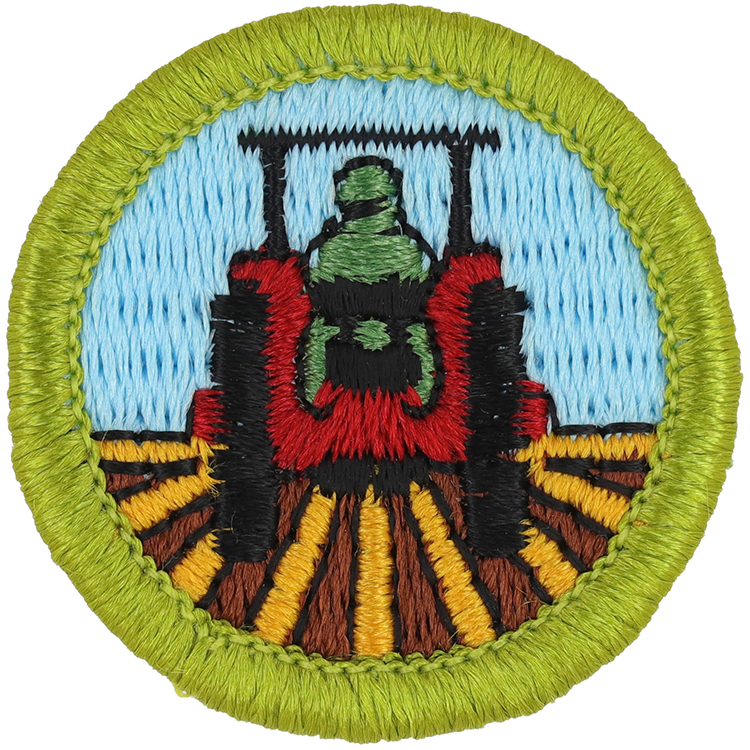
Fig. 1: FarMec-H5b-Front
- Embroidery: Rayon thread
- Border: Merrowed
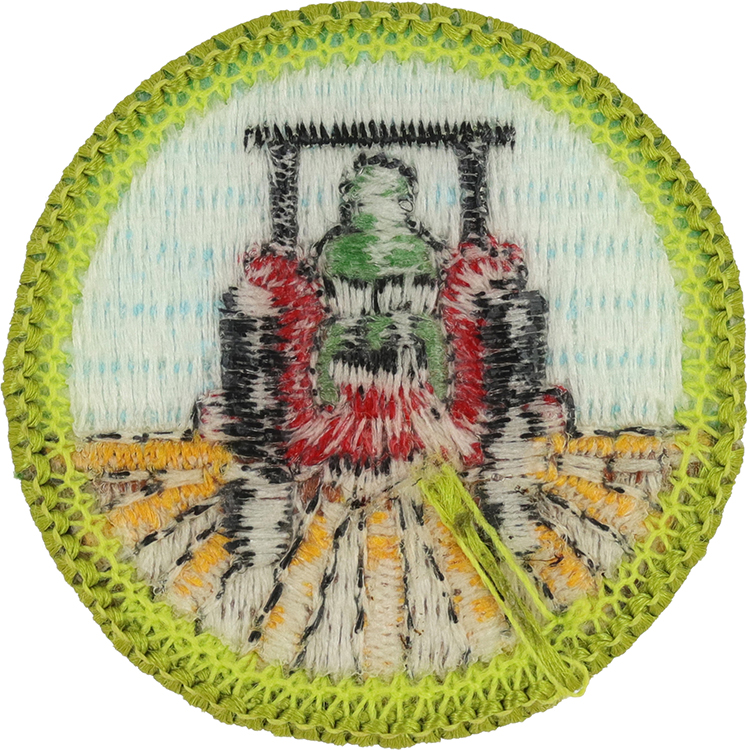
Fig. 2: FarMec-H5b-Reverse
- Back: Molded plastic
Item Name: Farm Mechanics 1999 - 2002
Item ID: FarMec-H5b
Collector Rating: 1
Pamphlets Used to Earn this Badge

Requirements January 1984 until January 1998
1. List 10 common tools found in a well-equipped farm shop and explain how to safety use each one.
2. Explain how power is produced or transferred in a:
(a) Diesel engine
(b) Hydraulic system
(c) Transmission or any other power system
3. Do ONE of the following:
(a) Put a new handle in any tool found on the farm.
(b) Build a tool rack with storage for nails, bolts, nuts, and washers.
(c) List safety features that should be found in a farm shop.
4. Do ONE of the following:
(a) Adjust farm equipment or machinery.br> (b) Pick a piece of farm machinery or equipment. Check all nuts, bolts, and screws. (c) Repair broken or worn farm machinery or equipment.
5. Do ONE of the following:
(a) Do the following on an engine-powered machine: grease, change oil and oil filter, clean air cleaner, flush cooling system, clean radiator fins, replace diesel fuel filters.
(b) With any farm machine, do a daily service check for filed use. (Do things needed for best field performance.)
(c) Prepare any farm machine for winter.
6. Visit an implement dealer. Interview the dealer technician or service manager for hints on good preventive maintenance. Ask why it is important. What are the costs? What happens that causes wear or damage? Report what you discovered?
Requirements January 1998 until January 2009
1. List 10 common tools found in a well-equipped farm shop and explain how to safety use each one.
2. Do the following:
(a) List ten safety devices in a well-equipped farm shop and explain the function of each.
(b) Demonstrate proper safety apparel and equipment to be worn and used when operating a grinder, wire-brush wheel, welder, or drill.
(c) Draw a plan showing a well-equipped farm shop. Point out mandatory safety devices and features in the shop.
3. Explain how power is produced or transferred in a:
(a) Diesel engine
(b) Hydraulic system
(c) Transmission or any other power system
4. Do TWO of the following:
(a) Replace the handle of any tool found on the farm.
(b) Build a tool rack with storage for nails, bolts, nuts, and washers.
(c) Properly grind the mushroom head off a chisel or punch.
(d) Correctly grind or file a screwdriver tip.
5. Do ONE of the following:
(a) Make the necessary adjustments to ready a piece of farm equipment or machinery for field operation.
(b) Choose a piece of farm machinery or equipment. Check all nuts, bolts, and screws. Tighten any that are loose. Replace those that are missing, worn, or damaged.
(c) Repair broken or worn farm machinery or equipment.
6. Make a list of safety precautions for adjustments or repairs you make for requirement 5.
7. Do ONE of the following:
(a) Do the following on an engine-powered machine: grease all fittings, change oil and oil filter, clean air cleaner, flush cooling system, clean radiator fins, replace diesel fuel filters.
(b) With any farm machine, do a daily service check for filed use. (Do things needed for best field performance.)
(c) Prepare any farm machine for winter.
8. Visit an implement dealer. Interview the dealer technician or service manager for hints on good preventive maintenance. Ask why it is important. What are the costs? What happens that causes wear or damage? Report what you discovered?
9. Explain each step in ONE of the following maintenance procedures:
(a) Tightening hydraulic fittings
(b) Servicing spark plugs
(c) Lubricating a cluch-release bearing
(d) Cleaning a work piece with a wire-brush wheel