-
Merit Badges
- Legend to identify Merit Badges
- 1910 British Merit Badges
- Square 1911 - 33
- Wide Crimped 1934 & 35
-
Narrow Tan Crimped 1936 - 42
- Tan Heavyweight Cloth with Silk Embroidery and Printed Back 1936 - 37
- Tan Heavyweight Cloth with Silk Embroidery and Plain Back 1937 - 38
- Tan Lightweight Cloth with Silk Embroidery and Plain Back 1938 - 39
- Tan Lightweight Cloth with Cotton Continuous Loop Embroidery and Plain Back 1939 - 42
- Tan Lightweight Cloth with Cotton Lockstitch Embroidery and Plain Back 1939 - 42
- Blue Background 1942 - 46
- Wartime 1942 - 46
- Khaki Narrow Crimped 1946 - 59
- Green Twill Gauze Back 1960 - 68
- Fully Embroidered Merrowed Edge 1960 - 72
- Unprinted Plastic Back 1972 - 01
- Printed Plastic Back 2002 - Current
-
Merit Badge Paper
- Merit Badge Applications
- Merit Badge Cards
-
Merit Badge Pamphlets
- Type 1 White Cover - Rectangle Drawing On Cover
- Type 2 White Cover 5-375" x 8" Title at Top
- Type 3A Tan Cover - 200 Fifth Avenue
- Type 3B Tan Cover - 2 line address New York City
- Type 3C Tan Cover - 2 line address New York N.Y.
- Type 3D Tan Cover - 1 line address New York N.Y.
- Type 4 Standing Scout Cover
- Type 5A War Cover
- Type 5B Red and White
- Type 6 Photo-Red Cover
- Type 7 Full Photo Cover or Bulls-eye Cover
- Type 8 Full Photo - Green Stripe Cover
- Type 9 Full Photo - Red Stripe Cover
- Type 10A Blue Stripe - Logo above bottom blue stripe - FDL centered
- Type 10B - Blue Stripe in bottom of photo area. FDL to left of text
- Special Covers
- Boy Craft Helps
- Merit Badge Counselor's Guides
-
Youth Position
- Junior Assistant Scoutmaster
- Senior Patrol Leader
- Assistant Senior Patrol Leader
- Patrol Leader
- Assistant Patrol Leader
- Troop Guide
- Scribe
- Quartermaster
- Instructor
- Chaplain Aide
- Den Chief
- Librarian
- Musician
- Webmaster
- Bugler
- Troop Historian
- Troop Representative
- Unit Representative
- Leadership Corps
- Honor Guard
- Leave No Trace Trainer
- Outdoor Ethics Guide
-
Patrol Medallions
- Patrol Medallions Introduction
- Legend to identify Patrol Medallions
- Patrol Shoulder Knot-Ribbons
- Felt Handmade Patrol Medallions
- Square Felt Patrol Medallions
- Round Broadcloth Patrol Medallions
- Red Twill Patrol Medallions
- Multi-Color Cloth Patrol Medallions
- Tan Cloth Patrol Medallions
- Patrol Medallion Back Patches
- Woodbadge Patrol Medallion
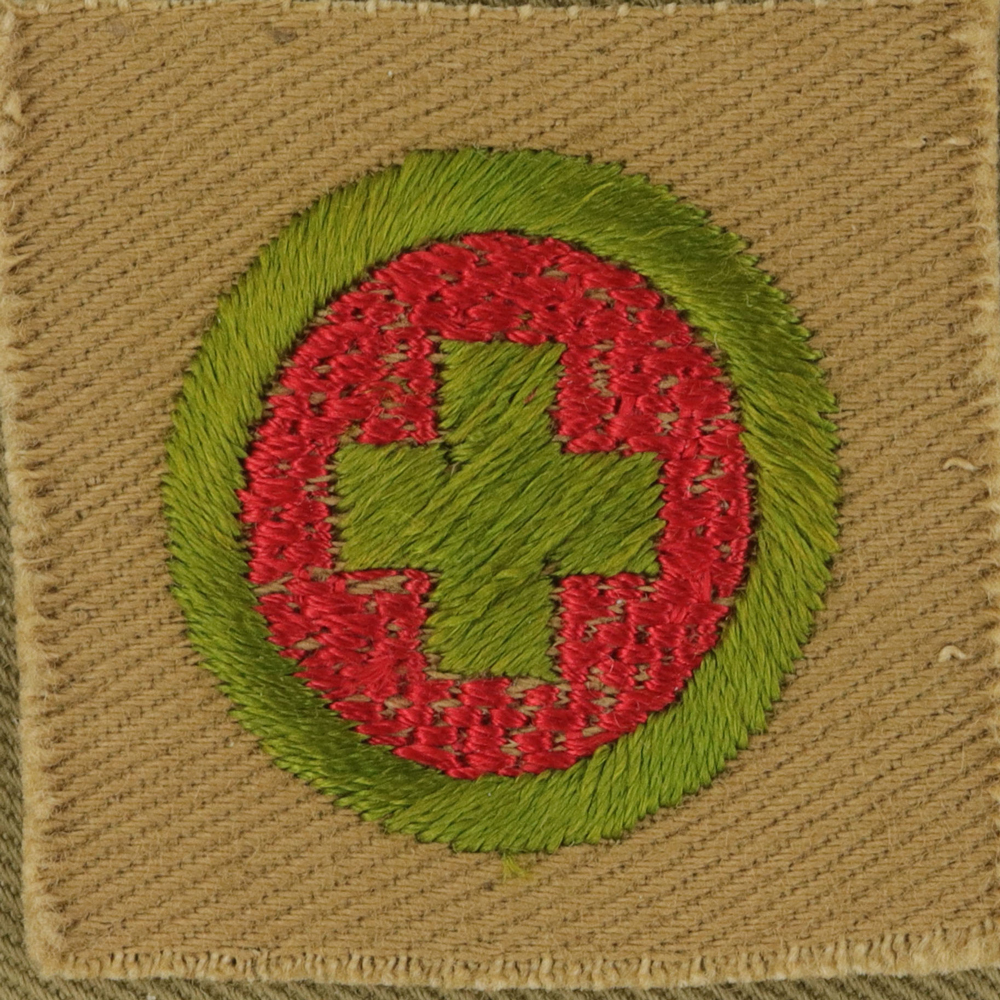
Fig. 1: FirAid-AH03-Front
- Cloth: Heavyweight tan right twill
- Embroidery: Silk continuous
- Border: Clockwise, round & dense
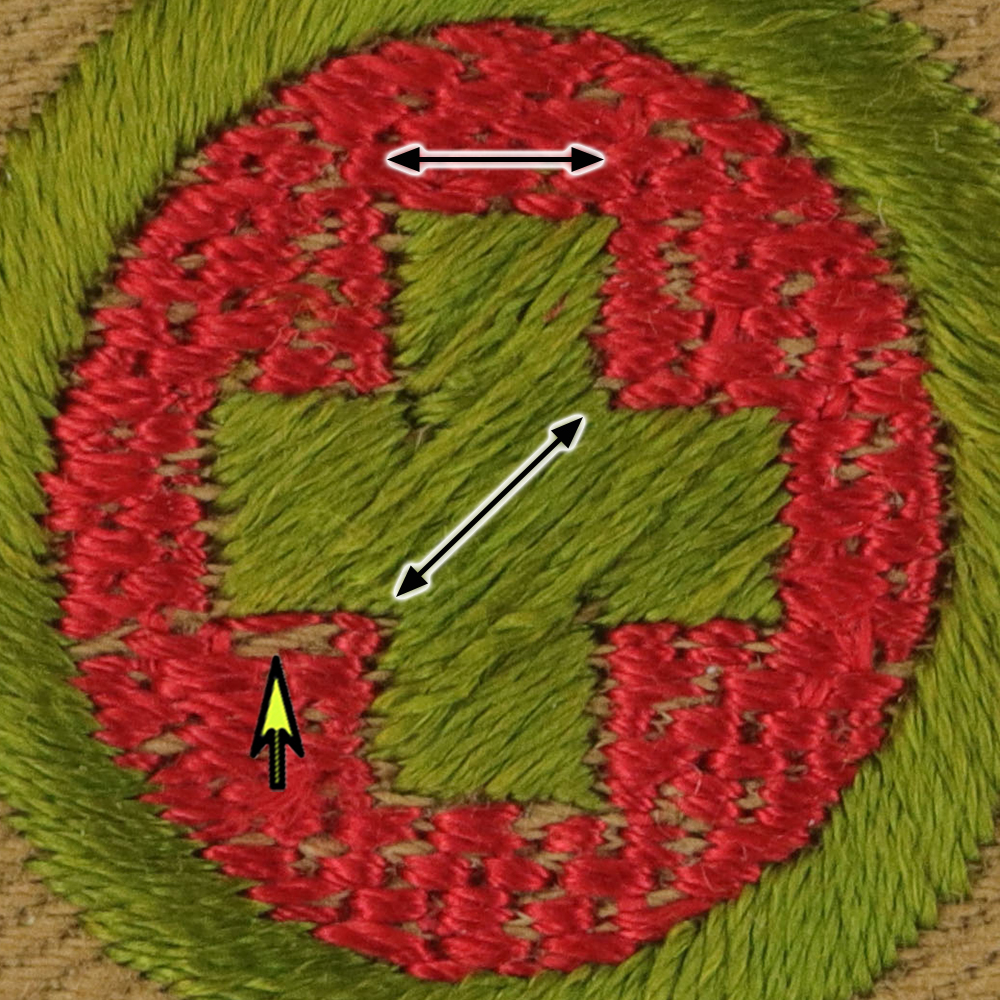
Fig. 2: FirAid-AH03-Magnified
- Design: Red is horizontal embroidery with woven look, a few tan threads show through the red, cross embroidery angled downward right to left, NO embroidery line in cross
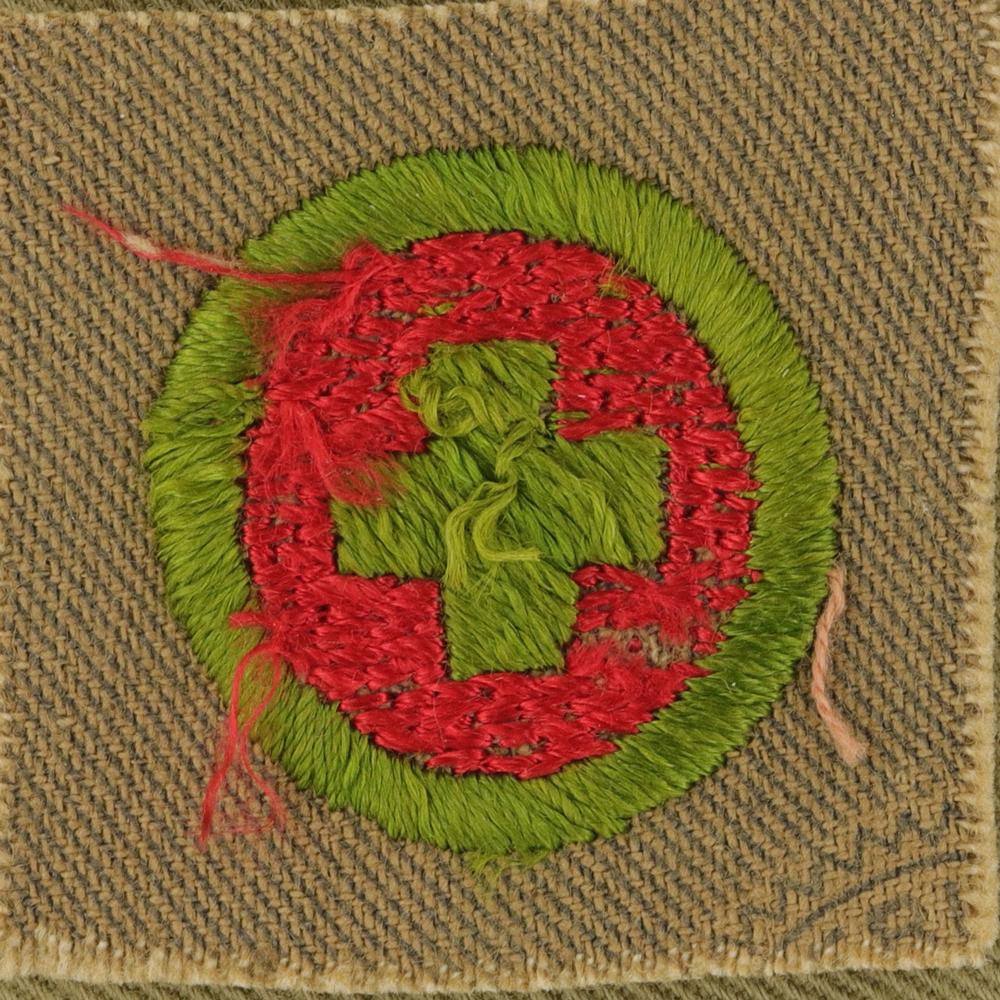
Fig. 3: FirAid-AH03-Reverse
- Back: Brown imprint
Item Name: First Aid 1913 - 1921
Item ID: FirAid-AH03
Collector Rating: 1
Pamphlets Used to Earn this Badge

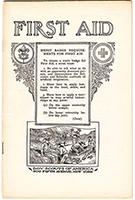
Requirements August 1911 until October 1914
1. Be able to demonstrate the Sylvester and Schaefer methods of resuscitation.
2. Carry a person down a ladder.
3. Bandage head and ankle.
4. Demonstrate treatment of wound of the neck with severe arterial hemorrhage.
5. Treat mangling injury of the leg without severe hemorrhage.
6. Demonstrate treatment for rupture of varicose veins of the leg with severe hemorrhage.
7. Show treatment for bite of finger by mad dog.
8. Demonstrate rescue of person in contact with electric wire.
9. Apply tourniquet to a principal artery.
10. State chief differences between carbolic poisoning and intoxication.
11. Explain what to do for snake bite.
12. Pass first aid test of American Red Cross Society.
Requirements October 1914 until May 1925.
1. Be able to tell what to do with an apparently drowned person, and demonstrate the Sylvester and Schaefer methods of artificial respiration.
2. Show how to apply bandages to the head, ankle, and hand.
3. Show how to apply a tourniquet to stop arterial hemorrhage at any point:
(a) on the upper extremity below armpit;
(b) on lower extremity below hip joint.
4. Demonstrate how to arrest venous hemorrhage on any part of the body.
5. Show how to apply a gauze dressing to a wound so that it will not be contaminated - that is, do it in an aseptic manner.
6. Show how to support by splints, etc., a broken arm or a broken leg so that the patient can bear transportation.
7. Be able to explain what to do for the bite of a mad dog, a venomous snake, a mosquito, and a scorpion sting.
8. Show how to rescue an individual from contact with an electric wire.
9. Produce satisfactory evidence that he has taken advantage of every opportunity to put into actual practice his knowledge of first-aid work during a period of at least six months since becoming a first class scout.