-
Merit Badges
- Legend to identify Merit Badges
- 1910 British Merit Badges
- Square 1911 - 33
- Wide Crimped 1934 & 35
-
Narrow Tan Crimped 1936 - 42
- Tan Heavyweight Cloth with Silk Embroidery and Printed Back 1936 - 37
- Tan Heavyweight Cloth with Silk Embroidery and Plain Back 1937 - 38
- Tan Lightweight Cloth with Silk Embroidery and Plain Back 1938 - 39
- Tan Lightweight Cloth with Cotton Continuous Loop Embroidery and Plain Back 1939 - 42
- Tan Lightweight Cloth with Cotton Lockstitch Embroidery and Plain Back 1939 - 42
- Blue Background 1942 - 46
- Wartime 1942 - 46
- Khaki Narrow Crimped 1946 - 59
- Green Twill Gauze Back 1960 - 68
- Fully Embroidered Merrowed Edge 1960 - 72
- Unprinted Plastic Back 1972 - 01
- Printed Plastic Back 2002 - Current
-
Merit Badge Paper
- Merit Badge Applications
- Merit Badge Cards
-
Merit Badge Pamphlets
- Type 1 White Cover - Rectangle Drawing On Cover
- Type 2 White Cover 5-375" x 8" Title at Top
- Type 3A Tan Cover - 200 Fifth Avenue
- Type 3B Tan Cover - 2 line address New York City
- Type 3C Tan Cover - 2 line address New York N.Y.
- Type 3D Tan Cover - 1 line address New York N.Y.
- Type 4 Standing Scout Cover
- Type 5A War Cover
- Type 5B Red and White
- Type 6 Photo-Red Cover
- Type 7 Full Photo Cover or Bulls-eye Cover
- Type 8 Full Photo - Green Stripe Cover
- Type 9 Full Photo - Red Stripe Cover
- Type 10A Blue Stripe - Logo above bottom blue stripe - FDL centered
- Type 10B - Blue Stripe in bottom of photo area. FDL to left of text
- Special Covers
- Boy Craft Helps
- Merit Badge Counselor's Guides
-
Youth Position
- Junior Assistant Scoutmaster
- Senior Patrol Leader
- Assistant Senior Patrol Leader
- Patrol Leader
- Assistant Patrol Leader
- Troop Guide
- Scribe
- Quartermaster
- Instructor
- Chaplain Aide
- Den Chief
- Librarian
- Musician
- Webmaster
- Bugler
- Troop Historian
- Troop Representative
- Unit Representative
- Leadership Corps
- Honor Guard
- Leave No Trace Trainer
- Outdoor Ethics Guide
-
Patrol Medallions
- Patrol Medallions Introduction
- Legend to identify Patrol Medallions
- Patrol Shoulder Knot-Ribbons
- Felt Handmade Patrol Medallions
- Square Felt Patrol Medallions
- Round Broadcloth Patrol Medallions
- Red Twill Patrol Medallions
- Multi-Color Cloth Patrol Medallions
- Tan Cloth Patrol Medallions
- Patrol Medallion Back Patches
- Woodbadge Patrol Medallion
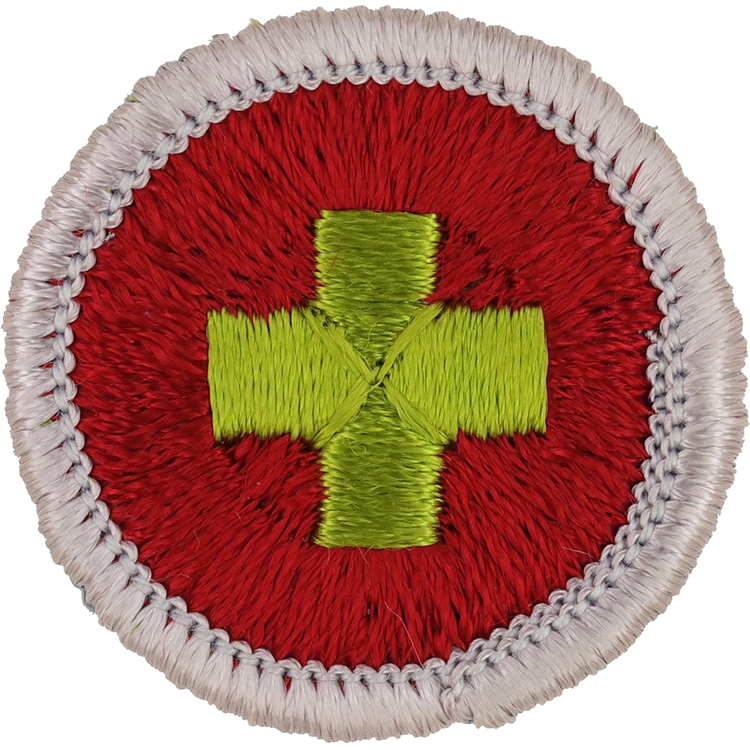
Fig. 1: FirAid-G2-Front
- Embroidery: Cotton thread
- Border: Merrowed
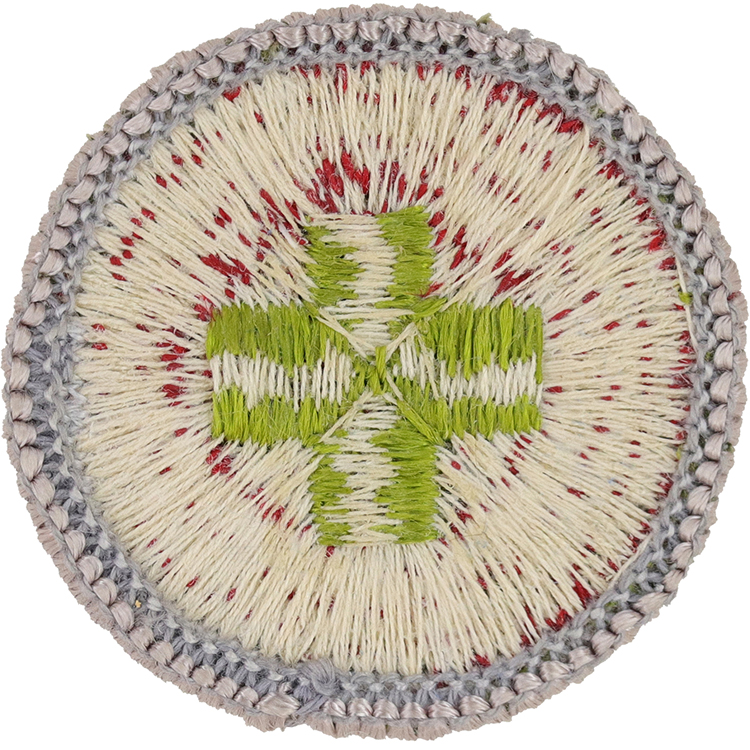
Fig. 2: FirAid-G2-Reverse
- Back: Starched cloth
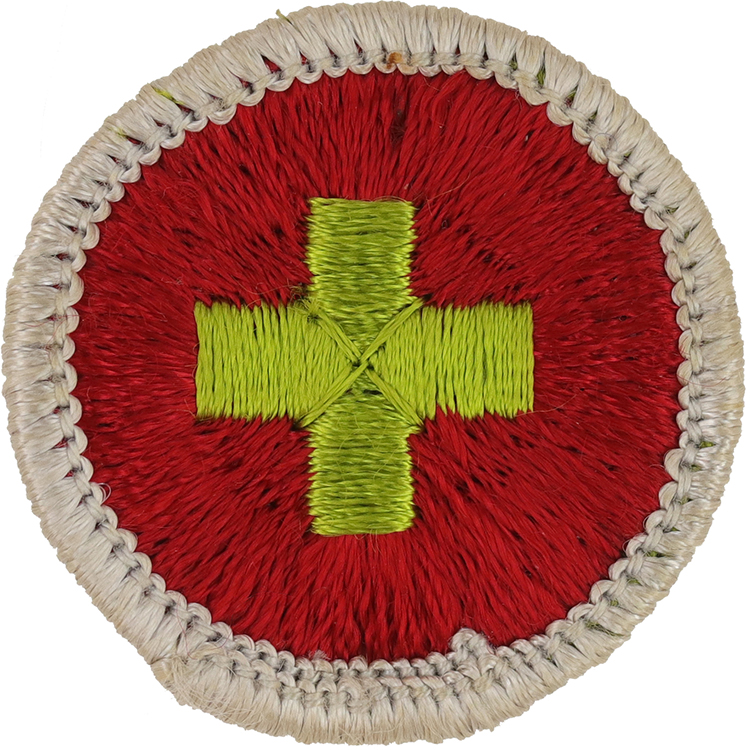
Fig. 3: FirAid-G2-mve1-front
- Minor variation: Finger print differences
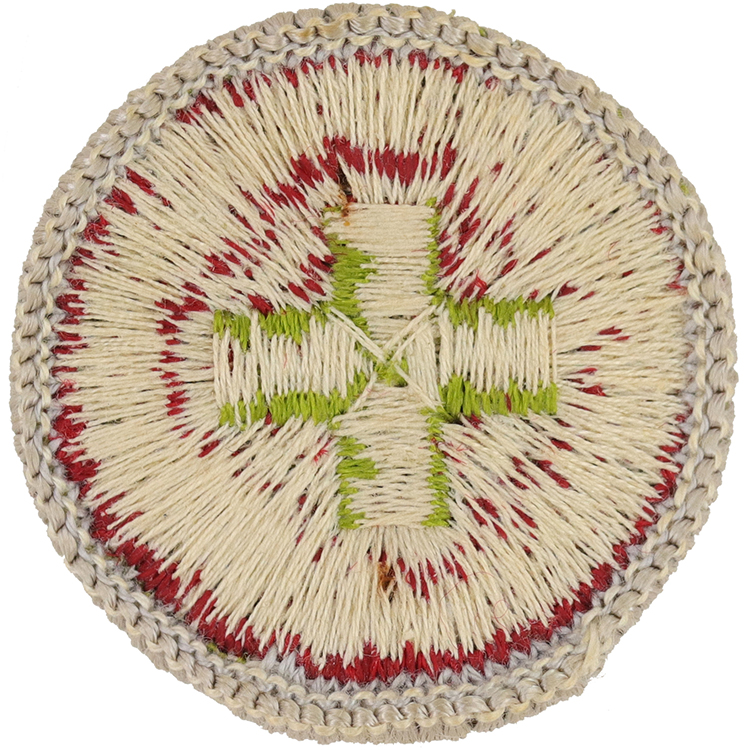
Fig. 4: FirAid-G2-mve1-reverse
- Back: Starched cloth
Item Name: First Aid 1969 - 1972
Item ID: FirAid-G2
Collector Rating: 1
Pamphlets Used to Earn this Badge
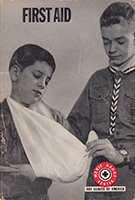
Requirements September 1963 until June 1972
Complete First Class Test 10.
1. State what first aid is and why it is important.
2. Do the following:
(a) Describe the causes and signs of shock.
(b) Demonstrate on another person the first aid for shock.
3. Do the following:
(a) Explain what should be done for severe bleeding.
(b) Tell under what extreme circumstances the use of a tourniquet may be justified.
(c) Demonstrate how to stop bleeding from a severe cut of the lower leg and wrist.
4. Do the following:
(a) State under what circumstances artificial respiration may be needed and explain how you can tell that a person has stopped breathing.
(b) Demonstrate ability to perform artificial respiration.*
(c) State what you can safely do to rescue a person from one of the following: contact with a live electric wire in a home, from a room containing carbon monoxide and other fumes or smoke, and from drowning.
5. Do the following:
(a) State how poisoning by mouth can be prevented.
(b) Describe the first aid for poisoning by mouth and why quick action is necessary.
6. Do the following:
(a) Describe the signs of a broken bone and give general rules for first aid for fractures.
(b) On a person lying down, and using improvised materials, demonstrate the first aid for any two of the following fractures: forearm, upper leg, lower leg, crushed foot.
7. Do the following:
(a) State the purpose of bandages and sterile dressings.
(b) Demonstrate, using dressings when needed, the following bandages: (triangular) arm sling, foot, head; (cravat) eye, knee, hand.
8. Do the following:
(a) Tell the dangers in moving a seriously injured person.
(b) If a sick or injured person must be moved, tell how you would decide what method to use.
(c) Demonstrate alone and with assistance one carry for a mild injury and one for a serious injury.
9. Do the following:
(a) State the first aid for the following: sunburn, burn with blisters on the back of the hand, deep burn of the forearm, frostbitten ear or foot.
(b) Demonstrate the proper way to extinguish flames on a person whose clothes are on fire and what you would do after the flames are out.
10. Do the following:
(a) State some causes and proper first aid for unconsciousness.
(b) Explain how to prevent simple fainting and describe first aid for simple fainting and epileptic convulsions.
11. Do the following:
(a) Describe proper first aid for one of the following: puncture wound, animal bite, poisonous snakebite, eye injury.
(b) Explain what to do for one of the following: pain in the belly, blisters caused by rubbing, boils and pimples, colds, arm and leg cramps, bruises, earache, hiccup, choking on food, insect bites, tick bites, poison ivy.
12. Do the following:
(a) Make a list of materials to be included in a home first aid kit, first aid equipment for an automobile, or a patrol first aid kit.
(b) Assist in teaching first aid (such as First Class first aid requirements) to one or more persons.
10. Do the following:
(a) Show that you have retained your Second Class first aid knowledge by being able to demonstrate any of it asked for by your examiner.
(b) Show how to use a triangular bandage for arm sling and as a binder, for wounds on head, hand, knee, and foot.
(c) Explain first aid for puncture wounds from splinter, nail, fishhook, dog bite, poisonous snakebite.
(d) Describe how to recognize and care for victims of heat exhaustion, sunstroke, frostbite.
(e) Explain danger of taking laxative for a stomachache.
(f) Demonstrate first aid for fracture of collarbone, upper arm, forearm, lower leg.
(g) Tell under what circumstance and injured person should or should not be moved.
(h) Demonstrate walking assist, one-man and two-man carries.
(i) Improvise a stretcher and, with helpers under your direction, transport a presumably unconscious person.
* The most practical method is mouth-to-mouth artificial respiration. Under certain conditions the manual chest-pressure arm-lift or the back-pressure arm-lift methods may be used.