-
Merit Badges
- Legend to identify Merit Badges
- 1910 British Merit Badges
- Square 1911 - 33
- Wide Crimped 1934 & 35
-
Narrow Tan Crimped 1936 - 42
- Tan Heavyweight Cloth with Silk Embroidery and Printed Back 1936 - 37
- Tan Heavyweight Cloth with Silk Embroidery and Plain Back 1937 - 38
- Tan Lightweight Cloth with Silk Embroidery and Plain Back 1938 - 39
- Tan Lightweight Cloth with Cotton Continuous Loop Embroidery and Plain Back 1939 - 42
- Tan Lightweight Cloth with Cotton Lockstitch Embroidery and Plain Back 1939 - 42
- Blue Background 1942 - 46
- Wartime 1942 - 46
- Khaki Narrow Crimped 1946 - 59
- Green Twill Gauze Back 1960 - 68
- Fully Embroidered Merrowed Edge 1960 - 72
- Unprinted Plastic Back 1972 - 01
- Printed Plastic Back 2002 - Current
-
Merit Badge Paper
- Merit Badge Applications
- Merit Badge Cards
-
Merit Badge Pamphlets
- Type 1 White Cover - Rectangle Drawing On Cover
- Type 2 White Cover 5-375" x 8" Title at Top
- Type 3A Tan Cover - 200 Fifth Avenue
- Type 3B Tan Cover - 2 line address New York City
- Type 3C Tan Cover - 2 line address New York N.Y.
- Type 3D Tan Cover - 1 line address New York N.Y.
- Type 4 Standing Scout Cover
- Type 5A War Cover
- Type 5B Red and White
- Type 6 Photo-Red Cover
- Type 7 Full Photo Cover or Bulls-eye Cover
- Type 8 Full Photo - Green Stripe Cover
- Type 9 Full Photo - Red Stripe Cover
- Type 10A Blue Stripe - Logo above bottom blue stripe - FDL centered
- Type 10B - Blue Stripe in bottom of photo area. FDL to left of text
- Special Covers
- Boy Craft Helps
- Merit Badge Counselor's Guides
-
Youth Position
- Junior Assistant Scoutmaster
- Senior Patrol Leader
- Assistant Senior Patrol Leader
- Patrol Leader
- Assistant Patrol Leader
- Troop Guide
- Scribe
- Quartermaster
- Instructor
- Chaplain Aide
- Den Chief
- Librarian
- Musician
- Webmaster
- Bugler
- Troop Historian
- Troop Representative
- Unit Representative
- Leadership Corps
- Honor Guard
- Leave No Trace Trainer
- Outdoor Ethics Guide
-
Patrol Medallions
- Patrol Medallions Introduction
- Legend to identify Patrol Medallions
- Patrol Shoulder Knot-Ribbons
- Felt Handmade Patrol Medallions
- Square Felt Patrol Medallions
- Round Broadcloth Patrol Medallions
- Red Twill Patrol Medallions
- Multi-Color Cloth Patrol Medallions
- Tan Cloth Patrol Medallions
- Patrol Medallion Back Patches
- Woodbadge Patrol Medallion
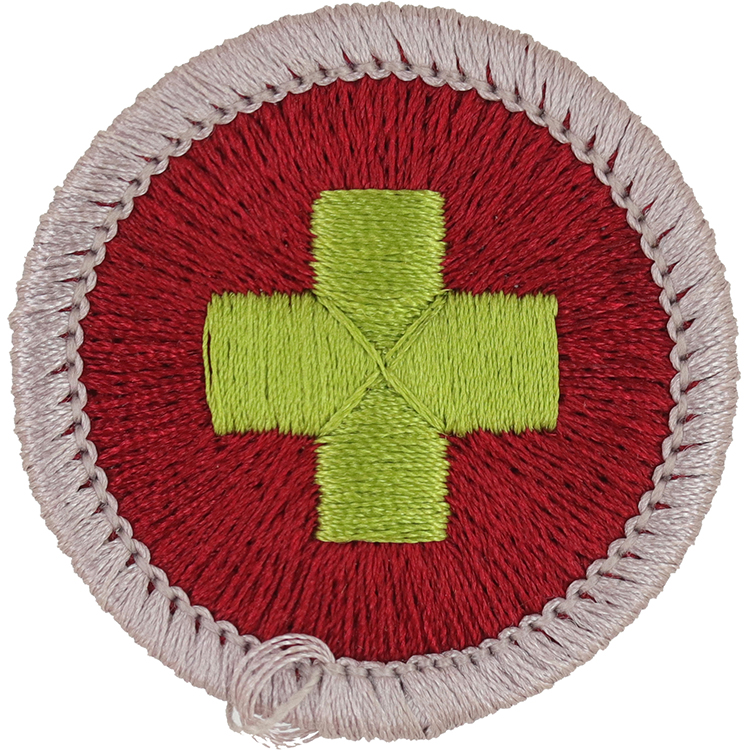
Fig. 1: FirAid-L1-Front
- Embroidery: Rayon thread
- Border: Merrowed
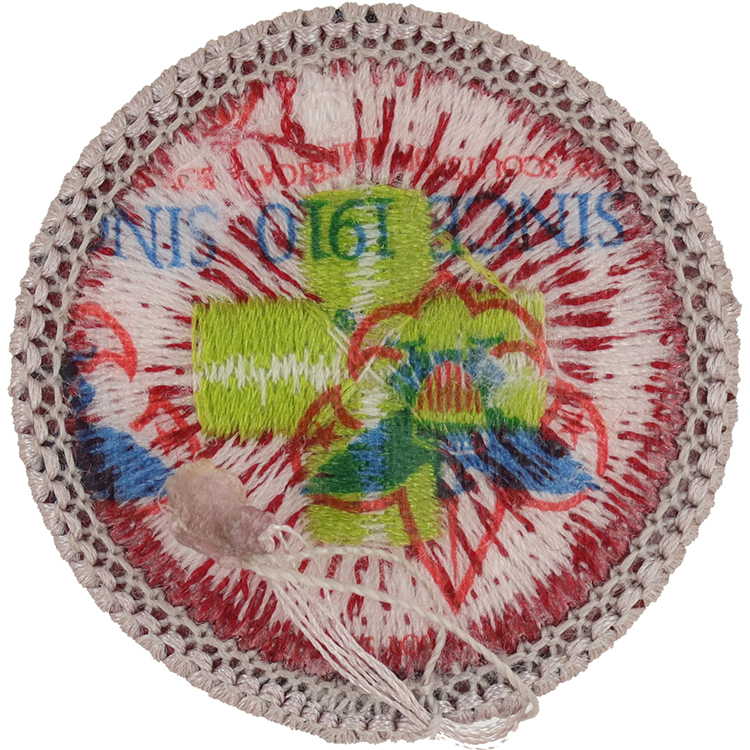
Fig. 2: FirAid-L1-Reverse
- Back: Since 1910 imprint with large Tenderfoot image
Item Name: First Aid 2014 - Current
Item ID: FirAid-L1
Collector Rating: 1
Pamphlets Used to Earn this Badge

Requirements January 2008 until January 2015
1. Satisfy your counselor that you have current knowledge of all first-aid requirements for Tenderfoot, Second Class, and First Class ranks.
2. Do the Following;
- Explain how you would obtain emergency medical assistance from your home, on a wilderness camping trip, and during an activity on open water.
- Explain the term triage.
- Explain the standard precautions as applied to bloodborne pathogens.
- Prepare a first-aid kit for your home. Display and discuss its contents with your counselor.
3. Do the following:
- Explain what action you should take for someone who shows signals of shock, for someone who shows signals of a heart attack, and for someone who shows signals of a stroke.
- Identify the conditions that must exist before performing CPR on a person. Then demonstrate proper technique in performing CPR using a training device approved by your counselor.
- Explain the use of an automated external defibrillator (AED).
- Show the steps that need to be taken for someone suffering from a severe cut on the leg and on the wrist. Tell the dangers in the use of a tourniquet and the conditions under which its use is justified.
- Explain when a bee sting could be life threatening and what action should be taken for prevention and for first-aid.
- Explain the symptoms of heatstroke and what action should be taken for first aid and for prevention.
4. Do the following:
- Describe the signals of a broken bone. Show first-aid procedures for handling fractures (broken bones), including open (compound) fractures of the forearm, wrist, upper leg, and lower leg using improvised materials.
- Describe the symptoms and possible complications and demonstrate proper procedures for treating suspected injuries to the head, neck, and back. Explain what measures should be taken to reduce the possibility of further complicating these injuries.
5. Describe the symptoms, proper first-aid procedures, and possible prevention measures for the following conditions:
- Hypothermia
- Convulsions/seizures
- Frostbite
- Dehydration
- Bruises, strains, sprains
- Burns
- Abdominal pain
- Broken, chipped, or loosened tooth
- Knocked out tooth
- Muscle cramps
6. Do TWO of the following:
- If a sick or an injured person must be moved, thell how you would determine the best method. Demonstrate this method.
- With helpers under your supervision, improvise a stretcher and move a presumably unconscious person.
- With your counselors’ approval, arrange a visit with your patrol or troop to an emergency medical facility or through an American Red Cross chapter for a demonstration of how an AED is used.
7. Teach another Scout a first-aid skill selected by your counselor.
Requirements January 2015 until January 2016
1. Satisfy your counselor that you have current knowledge of all first-aid requirements for Tenderfoot, Second Class, and First Class ranks.
- 2. Do the Following;
- Explain how you would obtain emergency medical assistance from your home, on a wilderness camping trip, and during an activity on open water.
- Explain the term triage. Explain the steps necessary to access and handle a medical emergency until help arrives.
- Explain the standard precautions as applied to bloodborne pathogens.
- Prepare a first-aid kit for your home. Display and discuss its contents with your counselor.
3. Do the following:
- Explain what action you should take for someone who shows signals of shock, for someone who shows signals of a heart attack, and for someone who shows signals of a stroke.
- Identify the conditions that must exist before performing CPR on a person. Then demonstrate proper technique in performing CPR using a training device approved by your counselor.
- Explain the use of an automated external defibrillator (AED).
- Show the steps that need to be taken for someone suffering from a severe cut on the leg and on the wrist. Tell the dangers in the use of a tourniquet and the conditions under which its use is justified.
- Explain when a bee sting could be life threatening and what action should be taken for prevention and for first-aid.
- Explain the symptoms of heatstroke and what action should be taken for first aid and for prevention.
4. Do the following:
- Describe the signals of a broken bone. Show first-aid procedures for handling fractures (broken bones), including open (compound) fractures of the forearm, wrist, upper leg, and lower leg using improvised materials.
- Describe the symptoms and possible complications and demonstrate proper procedures for treating suspected injuries to the head, neck, and back. Explain what measures should be taken to reduce the possibility of further complicating these injuries.
5. Describe the symptoms, proper first-aid procedures, and possible prevention measures for the following conditions:
- Hypothermia
- Convulsions/seizures
- Frostbite
- Dehydration
- Bruises, strains, sprains
- Burns
- Abdominal pain
- Broken, chipped, or loosened tooth
- Knocked out tooth
- Muscle cramps
6. Do TWO of the following:
- If a sick or an injured person must be moved, thell how you would determine the best method. Demonstrate this method.
- With helpers under your supervision, improvise a stretcher and move a presumably unconscious person.
- With your counselors’ approval, arrange a visit with your patrol or troop to an emergency medical facility or through an American Red Cross chapter for a demonstration of how an AED is used.
7. Teach another Scout a first-aid skill selected by your counselor.
Requirements January 2016 until Current
1. Satisfy your counselor that you have current knowledge of all first-aid requirements for Tenderfoot, Second Class, and First Class ranks.
2. Do the Following;
- Explain how you would obtain emergency medical assistance from your home, on a wilderness camping trip, and during an activity on open water.
- Define the term triage. Explain the steps necessary to access and handle a medical emergency until help arrives.
- Explain the standard precautions as applied to bloodborne pathogens.
- Prepare a first-aid kit for your home. Display and discuss its contents with your counselor.
3. Do the following:
- Explain what action you should take for someone who shows signals of shock, for someone who shows signals of a heart attack, and for someone who shows signals of a stroke.
- Identify the conditions that must exist before performing CPR on a person. Then demonstrate proper technique in performing CPR using a training device approved by your counselor.
- Explain the use of an automated external defibrillator (AED).
- Show the steps that need to be taken for someone suffering from a severe cut on the leg and on the wrist. Tell the dangers in the use of a tourniquet and the conditions under which its use is justified.
- Explain when a bee sting could be life threatening and what action should be taken for prevention and for first-aid.
- Explain the symptoms of heatstroke and what action should be taken for first aid and for prevention.
4. Do the following:
- Describe the signals of a broken bone. Show first-aid procedures for handling fractures (broken bones), including open (compound) fractures of the forearm, wrist, upper leg, and lower leg using improvised materials.
- Describe the symptoms and possible complications and demonstrate proper procedures for treating suspected injuries to the head, neck, and back. Explain what measures should be taken to reduce the possibility of further complicating these injuries.
5. Describe the symptoms, proper first-aid procedures, and possible prevention measures for the following conditions:
- Hypothermia
- Convulsions/seizures
- Frostbite
- Dehydration
- Bruises, strains, sprains
- Burns
- Abdominal pain
- Broken, chipped, or loosened tooth
- Knocked out tooth
- Muscle cramps
6. Do TWO of the following:
- If a sick or an injured person must be moved, thell how you would determine the best method. Demonstrate this method.
- With helpers under your supervision, improvise a stretcher and move a presumably unconscious person.
- With your counselors’ approval, arrange a visit with your patrol or troop to an emergency medical facility or through an American Red Cross chapter for a demonstration of how an AED is used.
7. Teach another Scout a first-aid skill selected by your counselor.