-
Merit Badges
- Legend to identify Merit Badges
- 1910 British Merit Badges
- Square 1911 - 33
- Wide Crimped 1934 & 35
-
Narrow Tan Crimped 1936 - 42
- Tan Heavyweight Cloth with Silk Embroidery and Printed Back 1936 - 37
- Tan Heavyweight Cloth with Silk Embroidery and Plain Back 1937 - 38
- Tan Lightweight Cloth with Silk Embroidery and Plain Back 1938 - 39
- Tan Lightweight Cloth with Cotton Continuous Loop Embroidery and Plain Back 1939 - 42
- Tan Lightweight Cloth with Cotton Lockstitch Embroidery and Plain Back 1939 - 42
- Blue Background 1942 - 46
- Wartime 1942 - 46
- Khaki Narrow Crimped 1946 - 59
- Green Twill Gauze Back 1960 - 68
- Fully Embroidered Merrowed Edge 1960 - 72
- Unprinted Plastic Back 1972 - 01
- Printed Plastic Back 2002 - Current
-
Merit Badge Paper
- Merit Badge Applications
- Merit Badge Cards
-
Merit Badge Pamphlets
- Type 1 White Cover - Rectangle Drawing On Cover
- Type 2 White Cover 5-375" x 8" Title at Top
- Type 3A Tan Cover - 200 Fifth Avenue
- Type 3B Tan Cover - 2 line address New York City
- Type 3C Tan Cover - 2 line address New York N.Y.
- Type 3D Tan Cover - 1 line address New York N.Y.
- Type 4 Standing Scout Cover
- Type 5A War Cover
- Type 5B Red and White
- Type 6 Photo-Red Cover
- Type 7 Full Photo Cover or Bulls-eye Cover
- Type 8 Full Photo - Green Stripe Cover
- Type 9 Full Photo - Red Stripe Cover
- Type 10A Blue Stripe - Logo above bottom blue stripe - FDL centered
- Type 10B - Blue Stripe in bottom of photo area. FDL to left of text
- Special Covers
- Boy Craft Helps
- Merit Badge Counselor's Guides
-
Youth Position
- Junior Assistant Scoutmaster
- Senior Patrol Leader
- Assistant Senior Patrol Leader
- Patrol Leader
- Assistant Patrol Leader
- Troop Guide
- Scribe
- Quartermaster
- Instructor
- Chaplain Aide
- Den Chief
- Librarian
- Musician
- Webmaster
- Bugler
- Troop Historian
- Troop Representative
- Unit Representative
- Leadership Corps
- Honor Guard
- Leave No Trace Trainer
- Outdoor Ethics Guide
-
Patrol Medallions
- Patrol Medallions Introduction
- Legend to identify Patrol Medallions
- Patrol Shoulder Knot-Ribbons
- Felt Handmade Patrol Medallions
- Square Felt Patrol Medallions
- Round Broadcloth Patrol Medallions
- Red Twill Patrol Medallions
- Multi-Color Cloth Patrol Medallions
- Tan Cloth Patrol Medallions
- Patrol Medallion Back Patches
- Woodbadge Patrol Medallion
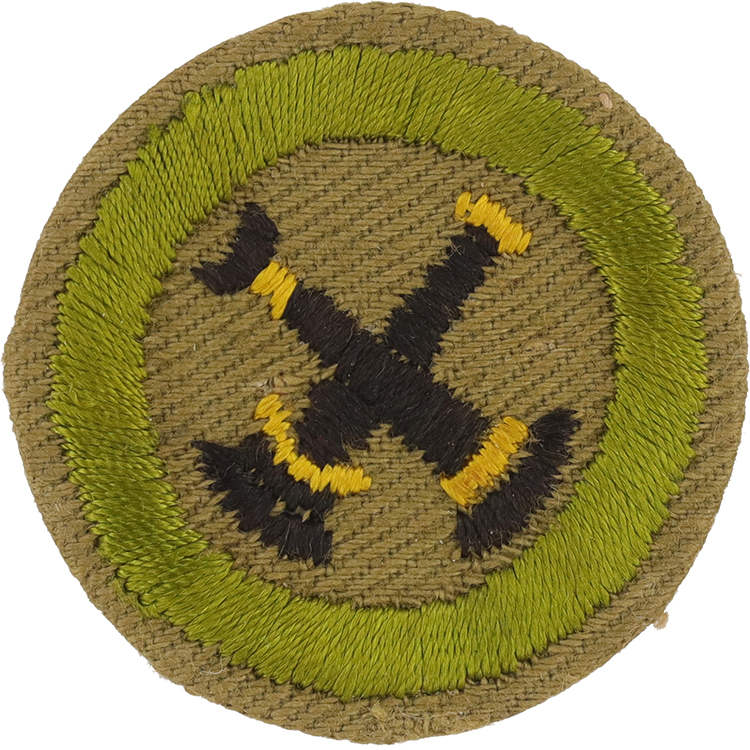
Fig. 1: Firema-C2b-Front
- Cloth: Heavyweight tan right twill
- Embroidery: Tight twisted silk continuous loop thread
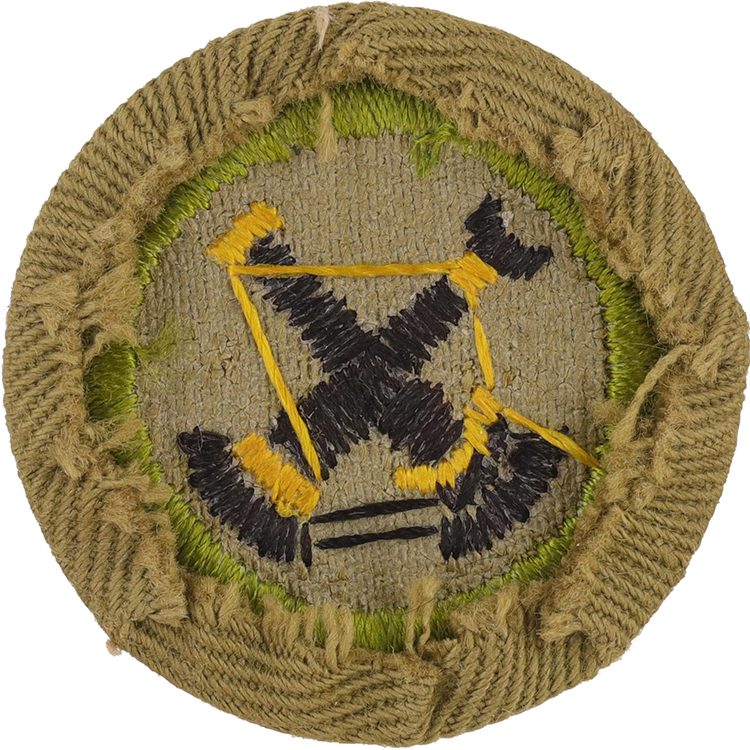
Fig. 2: Firema-C2b-Reverse
- Back: Plain NO imprint with starch
Item Name: Firemanship 1938
Item ID: Firema-C2b
Collector Rating: 1
Pamphlets Used to Earn this Badge
Requirements July 1933 until September 1945
1. Describe in his own words, the contrast between fire as man's servant (under control), and that same fire as man's enemy (beyond control). From actual incidents, of which he knows personally or has read, describe the loss and other harm which resulted from lack of proper fire protection both in the case of a home and a community. Give statistics indicating the average yearly loss of life and property due to fire.
2. Demonstrate or submit sketches illustrating two of the following:
(a) Proper building of camp fire with relation to inflammable material both around and under place where fire is laid;
(b) How to extinguish a camp fire;
(c) Three practical methods of forest fire prevention;
(d) Three simple methods of forest fire fighting where elaborate equipment is not available.
3. (a) Give three most common causes of fire in the home, other than careless use and storage of gasoline, and tell how each may be guarded against or prevented.
(b) What precautions should be taken for safe use and storage of gasoline and other inflammable liquids.
(c) Submit practical plan of action for the safe escape of the whole household, including himself in case of fire at night; such plan to include:
(1) Diagram of the floors on which family sleeps and of the floors below, if any;
(2) Details of how he would rouse the family and direct their escape;
(3) List of fire protection equipment necessary in his home, depending upon whether he lives in urban or rural community.
4. Personally conduct at least one fire drill in his Troop meeting place.
5. Demonstrate:
(a) How to light and discard a match safely;
(b) With another Scout as subject, what to do in case latter's clothes become ignited, both where blanket or rug is available, and where no such aid is available;
(c) With several other Scouts, formation of a "bucket brigade";
(d) How to make a satisfactory fire pail from a No. 10 can;
(e) What he would do if caught in a room filled with chemical fumes or smoke;
(f) How to extinguish fire under hood of automobile.
6. Explain:
(a) At least two causes which are likely to result in spontaneous combustion and how it may be prevented in each case;
(b) Three ways of turning in a fire alarm, citing best local method and giving exact location of nearest fire alarm to his home, Troop meeting place, and place of employment or school;
(c) Principles underlying at least three common types of fire extinguishers and how to operate each;
(d) Precautions and measures he would take to rescue animals from a burning stable.