-
Merit Badges
- Legend to identify Merit Badges
- 1910 British Merit Badges
- Square 1911 - 33
- Wide Crimped 1934 & 35
-
Narrow Tan Crimped 1936 - 42
- Tan Heavyweight Cloth with Silk Embroidery and Printed Back 1936 - 37
- Tan Heavyweight Cloth with Silk Embroidery and Plain Back 1937 - 38
- Tan Lightweight Cloth with Silk Embroidery and Plain Back 1938 - 39
- Tan Lightweight Cloth with Cotton Continuous Loop Embroidery and Plain Back 1939 - 42
- Tan Lightweight Cloth with Cotton Lockstitch Embroidery and Plain Back 1939 - 42
- Blue Background 1942 - 46
- Wartime 1942 - 46
- Khaki Narrow Crimped 1946 - 59
- Green Twill Gauze Back 1960 - 68
- Fully Embroidered Merrowed Edge 1960 - 72
- Unprinted Plastic Back 1972 - 01
- Printed Plastic Back 2002 - Current
-
Merit Badge Paper
- Merit Badge Applications
- Merit Badge Cards
-
Merit Badge Pamphlets
- Type 1 White Cover - Rectangle Drawing On Cover
- Type 2 White Cover 5-375" x 8" Title at Top
- Type 3A Tan Cover - 200 Fifth Avenue
- Type 3B Tan Cover - 2 line address New York City
- Type 3C Tan Cover - 2 line address New York N.Y.
- Type 3D Tan Cover - 1 line address New York N.Y.
- Type 4 Standing Scout Cover
- Type 5A War Cover
- Type 5B Red and White
- Type 6 Photo-Red Cover
- Type 7 Full Photo Cover or Bulls-eye Cover
- Type 8 Full Photo - Green Stripe Cover
- Type 9 Full Photo - Red Stripe Cover
- Type 10A Blue Stripe - Logo above bottom blue stripe - FDL centered
- Type 10B - Blue Stripe in bottom of photo area. FDL to left of text
- Special Covers
- Boy Craft Helps
- Merit Badge Counselor's Guides
-
Youth Position
- Junior Assistant Scoutmaster
- Senior Patrol Leader
- Assistant Senior Patrol Leader
- Patrol Leader
- Assistant Patrol Leader
- Troop Guide
- Scribe
- Quartermaster
- Instructor
- Chaplain Aide
- Den Chief
- Librarian
- Musician
- Webmaster
- Bugler
- Troop Historian
- Troop Representative
- Unit Representative
- Leadership Corps
- Honor Guard
- Leave No Trace Trainer
- Outdoor Ethics Guide
-
Patrol Medallions
- Patrol Medallions Introduction
- Legend to identify Patrol Medallions
- Patrol Shoulder Knot-Ribbons
- Felt Handmade Patrol Medallions
- Square Felt Patrol Medallions
- Round Broadcloth Patrol Medallions
- Red Twill Patrol Medallions
- Multi-Color Cloth Patrol Medallions
- Tan Cloth Patrol Medallions
- Patrol Medallion Back Patches
- Woodbadge Patrol Medallion
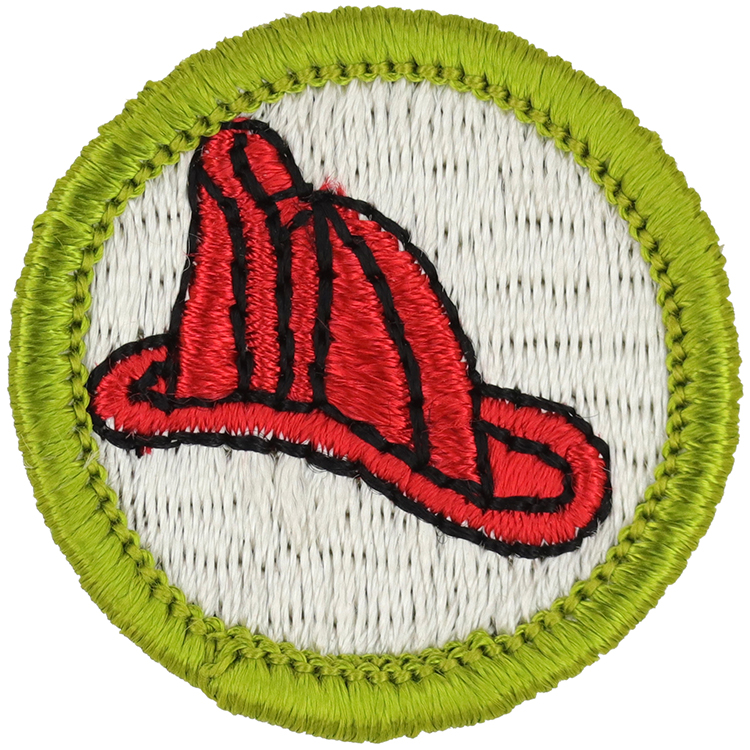
Fig. 1: Firema-G-Front
- Embroidery: Cotton thread
- Border: Merrowed
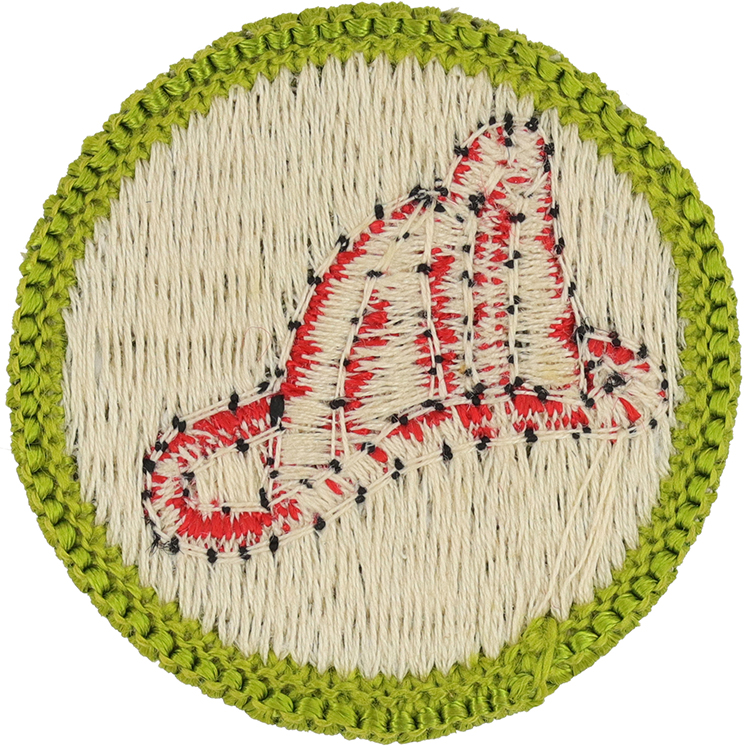
Fig. 2: Firema-G-Reverse
- Back: Starched cloth
Item Name: Firemanship 1969 - 1972
Item ID: Firema-G
Collector Rating: 1
Pamphlets Used to Earn this Badge
Requirements September 1967 until June 1972
1. Discuss how heat, fuel, and air are the three essential components necessary to cause fire. Explain how the elimination of any one of these will extinguish fire.
2. Explain five principal causes of fire in the home and tell how to guard against each.
3. Explain the safe way to:
(a) Provide a light in a dark closet.br<> (b) React when you smell gas indicating a leak.
(c) Light and use a charcoal grill or fireplace.
(d) Burn leaves and trash where permitted.
(e) Use home gas and electrical appliances.
(f) Fuel gasoline-powered equipment.
(g) Melt wax on a stove.
4. With the help of your parents make a thorough fire safety inspection of your home. Then prepare the following in writing:
(a) List the amount and location of any gasoline, cleaning fluid, paint, thinner, turpentine, etc., in and around your home.
(b) A list of all those things you have found in your home that could start a fire, using the home fire safety checklist in the merit badge pamphlet. Have one of your parents sign this list.
(c) Tell which one, if any, were stored unsafely and what you did to correct the condition.
(d) List all equipment of any sort in your home that can be used to extinguish fires.
5. Make a rough sketch of the sleeping area in your home and show which persons sleep in what rooms. Then explain:
(a) A home fire-escape plan that you have discussed with your entire family.
(b) What you would do if a small fire started in your house and you were alone.
(c) The ways of turning in an alarm in your community.
(d) What to do if you smell smoke when you wake up at night.
(e) What you would do to save a person whose clothes are on fire.
(f) What you should do to save yourself and your family in case of fire.
(g) Explain what special fire precautions are needed during the winter holiday season.
6. Do the following:
(a) Visit the fire station nearest your home. Identify the fire fighting equipment there and describe its specific purpose, including equipment used to fight electrical, chemical, and oil fires.
7. Do the following:
(a) Tell how to set up a camp, making it safe from fire.
(b) Describe the fire equipment you should have available before lighting a fire in camp.
(c) Bring a note from your unit leader stating that you have properly put out a campfire. Describe where and how you did this.
(d) Tell how forest fires start. Explain what is done to prevent them and how you can help.
(e) Tell what you would do in case fire breaks out on a camping trip.
(f) Explain how a grass or brush fire can be fought with improvised equipment.