-
Merit Badges
- Legend to identify Merit Badges
- 1910 British Merit Badges
- Square 1911 - 33
- Wide Crimped 1934 & 35
-
Narrow Tan Crimped 1936 - 42
- Tan Heavyweight Cloth with Silk Embroidery and Printed Back 1936 - 37
- Tan Heavyweight Cloth with Silk Embroidery and Plain Back 1937 - 38
- Tan Lightweight Cloth with Silk Embroidery and Plain Back 1938 - 39
- Tan Lightweight Cloth with Cotton Continuous Loop Embroidery and Plain Back 1939 - 42
- Tan Lightweight Cloth with Cotton Lockstitch Embroidery and Plain Back 1939 - 42
- Blue Background 1942 - 46
- Wartime 1942 - 46
- Khaki Narrow Crimped 1946 - 59
- Green Twill Gauze Back 1960 - 68
- Fully Embroidered Merrowed Edge 1960 - 72
- Unprinted Plastic Back 1972 - 01
- Printed Plastic Back 2002 - Current
-
Merit Badge Paper
- Merit Badge Applications
- Merit Badge Cards
-
Merit Badge Pamphlets
- Type 1 White Cover - Rectangle Drawing On Cover
- Type 2 White Cover 5-375" x 8" Title at Top
- Type 3A Tan Cover - 200 Fifth Avenue
- Type 3B Tan Cover - 2 line address New York City
- Type 3C Tan Cover - 2 line address New York N.Y.
- Type 3D Tan Cover - 1 line address New York N.Y.
- Type 4 Standing Scout Cover
- Type 5A War Cover
- Type 5B Red and White
- Type 6 Photo-Red Cover
- Type 7 Full Photo Cover or Bulls-eye Cover
- Type 8 Full Photo - Green Stripe Cover
- Type 9 Full Photo - Red Stripe Cover
- Type 10A Blue Stripe - Logo above bottom blue stripe - FDL centered
- Type 10B - Blue Stripe in bottom of photo area. FDL to left of text
- Special Covers
- Boy Craft Helps
- Merit Badge Counselor's Guides
-
Youth Position
- Junior Assistant Scoutmaster
- Senior Patrol Leader
- Assistant Senior Patrol Leader
- Patrol Leader
- Assistant Patrol Leader
- Troop Guide
- Scribe
- Quartermaster
- Instructor
- Chaplain Aide
- Den Chief
- Librarian
- Musician
- Webmaster
- Bugler
- Troop Historian
- Troop Representative
- Unit Representative
- Leadership Corps
- Honor Guard
- Leave No Trace Trainer
- Outdoor Ethics Guide
-
Patrol Medallions
- Patrol Medallions Introduction
- Legend to identify Patrol Medallions
- Patrol Shoulder Knot-Ribbons
- Felt Handmade Patrol Medallions
- Square Felt Patrol Medallions
- Round Broadcloth Patrol Medallions
- Red Twill Patrol Medallions
- Multi-Color Cloth Patrol Medallions
- Tan Cloth Patrol Medallions
- Patrol Medallion Back Patches
- Woodbadge Patrol Medallion
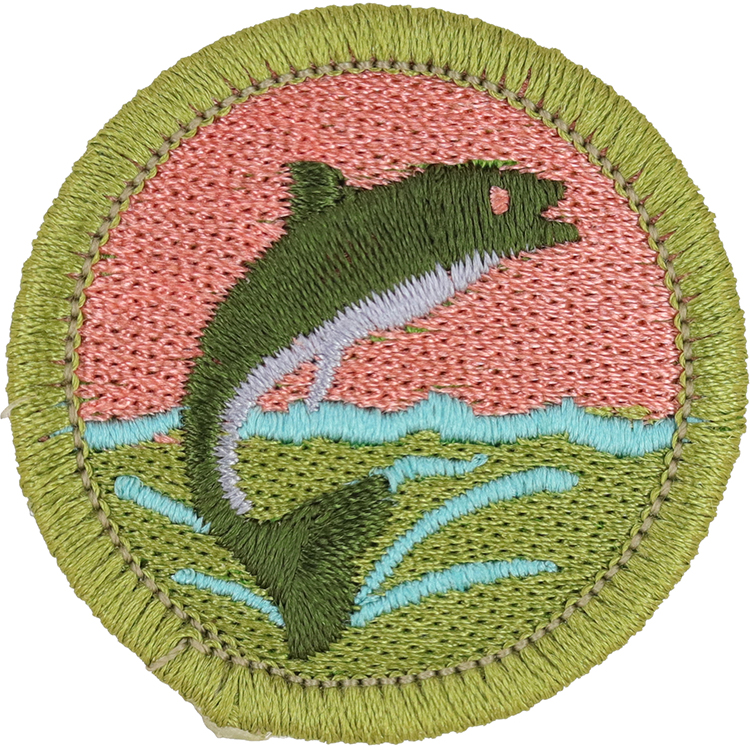
Fig. 1: Fishin-L1-Front
- Embroidery: Rayon thread
- Border: Merrowed
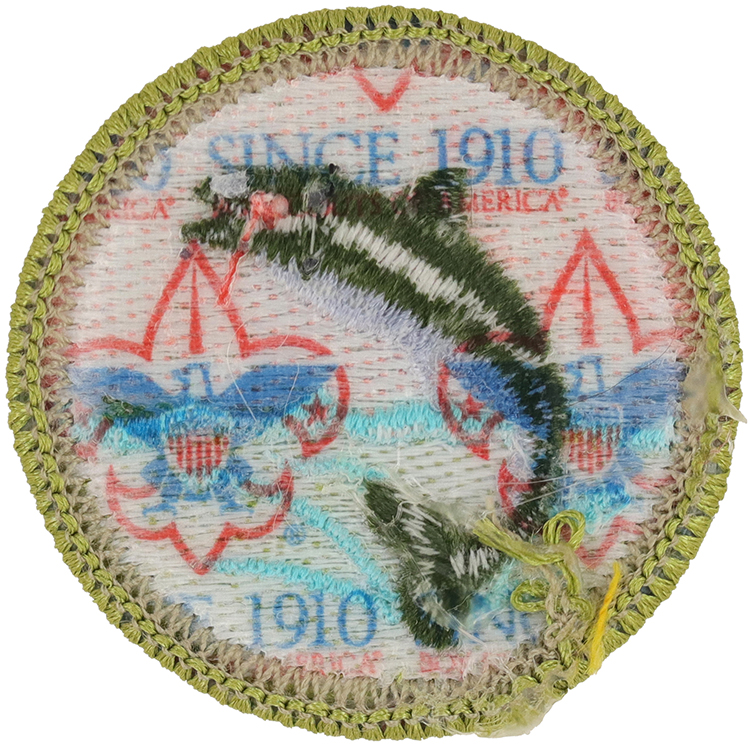
Fig. 2: Fishin-L1-Reverse
- Back: Since 1910 imprint with large Tenderfoot image
Item Name: Fishing 2014 - Current
Item ID: Fishin-L1
Collector Rating: 1
Pamphlets Used to Earn this Badge

Requirements January 2014 until January 2015
1. Do the following:
- Explain to your counselor the most likely hazards you may encounter while participating in fishing activities, and what you should do to anticipate, help prevent, mitigate, and respond to these hazards.
- Discuss the prevention of and treatment for the following health concerns that could occur while fishing, including cuts and scratches, puncture wounds, insect bites, hypothermia, dehydration, heat exhaustion, heatstroke, and sunburn.
- Explain how to remove a hook that has lodged in your arm.
- Name and explain five safety practices you should always follow while fishing.
2. Discuss the differences between two type of fishing outfits. Point out and identify the parts of several types of rods and reels. Explain how and when each would be used. Review with your counselor how to care for this equipment.
3. Demonstrate the proper use of two different types of fishing equipment.
4. Demonstrate how to tie the following knots; Clinch, Palomar, turle, blood loop (barrel knot), and double surgeon’s loop. Explain how and when each knot is used.
5. Name and identify five basic artificial lures and five natural baits and explain how to fish with them. Explain why baitfish are not to be released.
6. Do the following:
- Explain the importance of practicing Leave No Trace techniques. Discuss the positive effects of Leave No Trace on fishing resources.
- Discuss the meaning and importance of catch and release. Describe how to properly release a fish safely to the water.
7. Obtain and review the regulations affecting game fishing where you live. Explain why they were adopted and what is accomplished by following them.
8. Explain what good outdoor sportsmanlike behavior is and how it relates to anglers. Tell how the Outdoor Code of the Boy Scouts of America relates to a fishing sports enthusiast, including the aspects of littering, trespassing, courteous behavior, and obeying fishing regulations.
9. Catch at least one fish and identify it. If regulations and health concerns permit, clean and cook a fish you have caught. Otherwise, acquire a fish and cook it.
Requirements January 2015 until January 2017
1. Do the following:
- Explain to your counselor the most likely hazards you may encounter while participating in fishing activities, and what you should do to anticipate, help prevent, mitigate, and respond to these hazards.
- Discuss the prevention of and treatment for the following health concerns that could occur while fishing, including cuts and scratches, puncture wounds, insect bites, hypothermia, dehydration, heat exhaustion, heatstroke, and sunburn.
- Explain how to remove a hook that has lodged in your arm.
- Name and explain five safety practices you should always follow while fishing.
2. Discuss the differences between two type of fishing outfits. Point out and identify the parts of several types of rods and reels. Explain how and when each would be used. Review with your counselor how to care for this equipment.
3. Demonstrate the proper use of two different types of fishing equipment.
4. Demonstrate how to tie the following knots; improved clinch, Palomar, turle, blood loop (barrel knot), and double surgeon’s loop. Explain how and when each knot is used.
5. Name and identify five basic artificial lures and five natural baits and explain how to fish with them. Explain why baitfish are not to be released.
6. Do the following:
- Explain the importance of practicing Leave No Trace techniques. Discuss the positive effects of Leave No Trace on fishing resources.
- Discuss the meaning and importance of catch and release. Describe how to properly release a fish safely to the water.
7. Obtain and review the regulations affecting game fishing where you live. Explain why they were adopted and what is accomplished by following them.
8. Explain what good outdoor sportsmanlike behavior is and how it relates to anglers. Tell how the Outdoor Code of the Boy Scouts of America relates to a fishing sports enthusiast, including the aspects of littering, trespassing, courteous behavior, and obeying fishing regulations.
9. Catch at least one fish and identify it. If regulations and health concerns permit, clean and cook a fish you have caught. Otherwise, acquire a fish and cook it.
Requirements January 2017 until Current
1. Do the following:
- Explain to your counselor the most likely hazards you may encounter while participating in fishing activities, and what you should do to anticipate, help prevent, mitigate, and respond to these hazards.
- Discuss the prevention of and treatment for the following health concerns that could occur while fishing, including cuts and scratches, puncture wounds, insect bites, hypothermia, dehydration, heat exhaustion, heatstroke, and sunburn.
- Explain how to remove a hook that has lodged in your arm.
- Name and explain five safety practices you should always follow while fishing.
2. Discuss the differences between two type of fishing outfits. Point out and identify the parts of several types of rods and reels. Explain how and when each would be used. Review with your counselor how to care for this equipment.
3. Demonstrate the proper use of two different types of fishing equipment.
4. Demonstrate how to tie the following knots: improved clinch knot, Palomar knot, uni knot, uni to uni knot, and arbor knot. Explain how and when each knot is used.
5. Name and identify five basic artificial lures and five natural baits and explain how to fish with them. Explain why baitfish are not to be released.
6. Do the following:
- Explain the importance of practicing Leave No Trace techniques. Discuss the positive effects of Leave No Trace on fishing resources.
- Discuss the meaning and importance of catch and release. Describe how to properly release a fish safely to the water.
7. Obtain and review the regulations affecting game fishing where you live. Explain why they were adopted and what is accomplished by following them.
8. Explain what good outdoor sportsmanlike behavior is and how it relates to anglers. Tell how the Outdoor Code of the Boy Scouts of America relates to a fishing sports enthusiast, including the aspects of littering, trespassing, courteous behavior, and obeying fishing regulations.
9. Catch at least one fish and identify it.
10. If regulations and health concerns permit, clean and cook a fish you have caught. Otherwise, acquire a fish and cook it. (You do not need to eat your fish)