-
Merit Badges
- Legend to identify Merit Badges
- 1910 British Merit Badges
- Square 1911 - 33
- Wide Crimped 1934 & 35
-
Narrow Tan Crimped 1936 - 42
- Tan Heavyweight Cloth with Silk Embroidery and Printed Back 1936 - 37
- Tan Heavyweight Cloth with Silk Embroidery and Plain Back 1937 - 38
- Tan Lightweight Cloth with Silk Embroidery and Plain Back 1938 - 39
- Tan Lightweight Cloth with Cotton Continuous Loop Embroidery and Plain Back 1939 - 42
- Tan Lightweight Cloth with Cotton Lockstitch Embroidery and Plain Back 1939 - 42
- Blue Background 1942 - 46
- Wartime 1942 - 46
- Khaki Narrow Crimped 1946 - 59
- Green Twill Gauze Back 1960 - 68
- Fully Embroidered Merrowed Edge 1960 - 72
- Unprinted Plastic Back 1972 - 01
- Printed Plastic Back 2002 - Current
-
Merit Badge Paper
- Merit Badge Applications
- Merit Badge Cards
-
Merit Badge Pamphlets
- Type 1 White Cover - Rectangle Drawing On Cover
- Type 2 White Cover 5-375" x 8" Title at Top
- Type 3A Tan Cover - 200 Fifth Avenue
- Type 3B Tan Cover - 2 line address New York City
- Type 3C Tan Cover - 2 line address New York N.Y.
- Type 3D Tan Cover - 1 line address New York N.Y.
- Type 4 Standing Scout Cover
- Type 5A War Cover
- Type 5B Red and White
- Type 6 Photo-Red Cover
- Type 7 Full Photo Cover or Bulls-eye Cover
- Type 8 Full Photo - Green Stripe Cover
- Type 9 Full Photo - Red Stripe Cover
- Type 10A Blue Stripe - Logo above bottom blue stripe - FDL centered
- Type 10B - Blue Stripe in bottom of photo area. FDL to left of text
- Special Covers
- Boy Craft Helps
- Merit Badge Counselor's Guides
-
Youth Position
- Junior Assistant Scoutmaster
- Senior Patrol Leader
- Assistant Senior Patrol Leader
- Patrol Leader
- Assistant Patrol Leader
- Troop Guide
- Scribe
- Quartermaster
- Instructor
- Chaplain Aide
- Den Chief
- Librarian
- Musician
- Webmaster
- Bugler
- Troop Historian
- Troop Representative
- Unit Representative
- Leadership Corps
- Honor Guard
- Leave No Trace Trainer
- Outdoor Ethics Guide
-
Patrol Medallions
- Patrol Medallions Introduction
- Legend to identify Patrol Medallions
- Patrol Shoulder Knot-Ribbons
- Felt Handmade Patrol Medallions
- Square Felt Patrol Medallions
- Round Broadcloth Patrol Medallions
- Red Twill Patrol Medallions
- Multi-Color Cloth Patrol Medallions
- Tan Cloth Patrol Medallions
- Patrol Medallion Back Patches
- Woodbadge Patrol Medallion
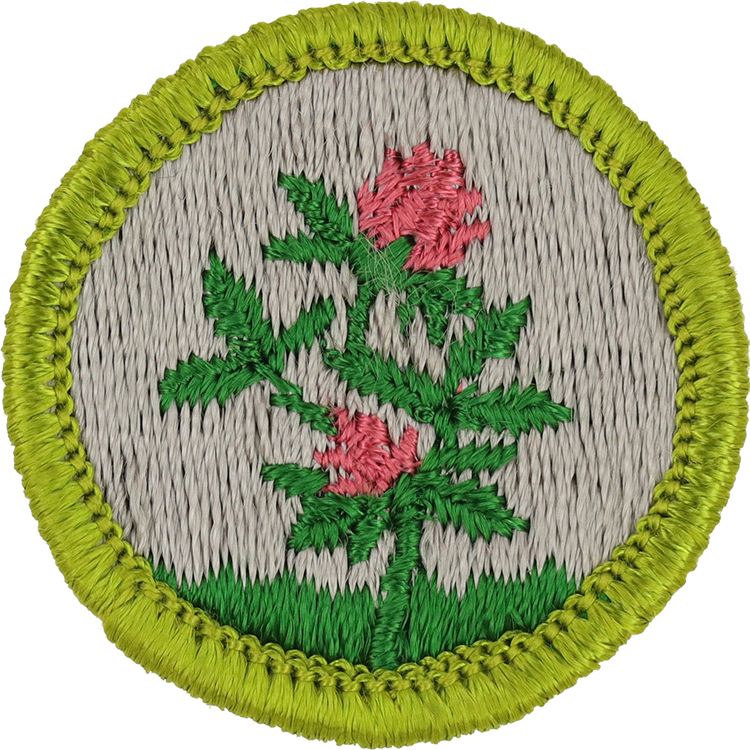
Fig. 1: ForCro-G-Front
- Embroidery: Cotton thread
- Border: Merrowed
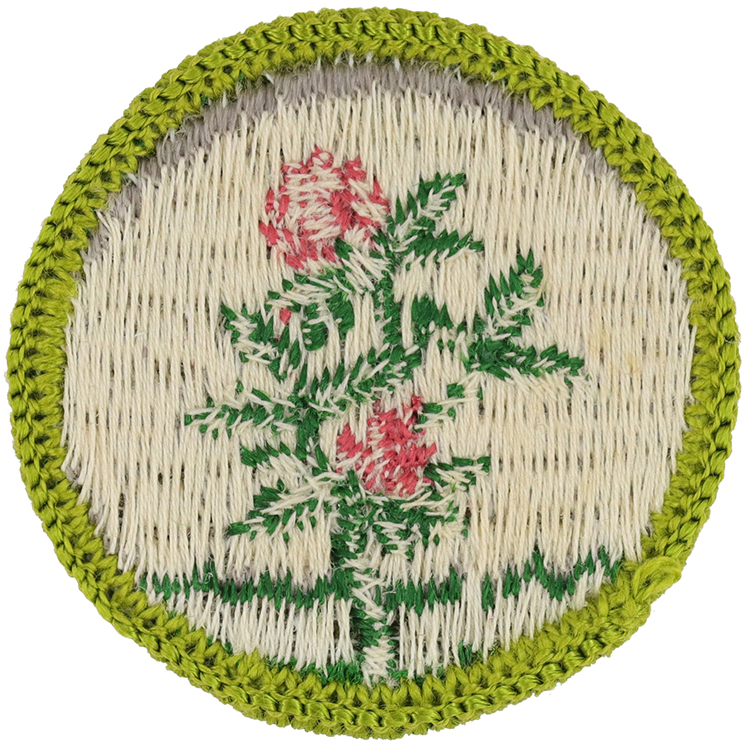
Fig. 2: ForCro-G-Reverse
- Back: Starched cloth
Item Name: Forage Crops 1961 -71
Item ID: ForCro-G
Collector Rating: 1
Pamphlets Used to Earn this Badge
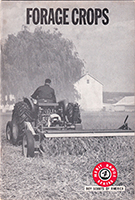
Requirements January 1960 until June 1972
Meet three out of five requirements as indicated in each of the four divisions, or a total of twelve requirements out of the twenty.
Grasses-any three
1. Show samples of five kinds of perennial grasses and explain their uses for feed purposes, soil conservation, and control of erosion.
2. Show how to prepare a seedbed for a lawn, pasture, or meadow.
3. Show: (a) samples of three annual grasses used both for hay and pastures; (b) samples of three large seed grasses, explaining the practical use of each.
4. Make a blotter, plate, or rag doll seed tester and show how to use in testing seeds for vitality.
5. (a) Make an exhibit of six most important grasses common to your locality. Identify and explain the use of each; (b) explain the difference between "bunch grasses" and "sod-forming" grasses and their uses.
Legumes-any three including Requirement 1 or 3.
1. Show samples and name the five most important legume crops grown in your section.
2. Name three small seed legumes and three large seed legumes. Explain use of this for feed, soil conservation, cash crop, and for maintaining soil moisture.
3. Show how to fertilize, lime, prepare seedbed, seed, and manage a crop of legumes grown in your locality.
4. Explain: (a) how legumes, such as soybeans, cow peas, alfalfa, and clover may be used to build soil fertility and control erosion; (b) under what conditions legumes deplete the soil.
5. Explain: (a) what is meant by inoculation of legumes; (b) how this is done, and why it is important.
Pastures-any three including Requirement 3 or 5.
1. Explain the best method for improvement of old pastures and how to manage and maintain pasture fertility in your section.
2. Explain under what conditions grasses, legumes, and hayfields may be used for pastures.
3. Make an exhibit or collection of five poisonous or undesirable grasses and weeds which are injurious to pastures or poisonous to livestock.
4. Explain from personal observation how cows, horses, and sheep differ in their grazing methods or habits.
5. Prepare an exhibit of at least five pasture grasses, showing whole plant with stem, leaf, flower, and seed.
Hay Crops-any three.
1. Explain how grasses such as legumes and grain crops may be used for hay or feed for livestock and wild game.
2. Give directions on how to store hay crops safely in barns, stacks, sheds, and in bales. Explain how to prevent hay barn fires and combustion.
3. Make a mounted exhibit of five kinds of properly cured hay crops; explain the qualities of "succulent" or "well-cured" hay.
4. Show samples of not less than two kinds of hay crops best suited to different livestock, such as dairy cows, horses, sheep, deer and beef cattle.
5. Show how to operate one hay-making machine and one hand tool; name five tools and machines used for hay-making in your locality; explain the purpose of each.
This merit badge may be earned as a 4-H'er by completing a club project in that subject or as an FFA member by meeting these requirements through the FFA supervised farming program.