-
Merit Badges
- Legend to identify Merit Badges
- 1910 British Merit Badges
- Square 1911 - 33
- Wide Crimped 1934 & 35
-
Narrow Tan Crimped 1936 - 42
- Tan Heavyweight Cloth with Silk Embroidery and Printed Back 1936 - 37
- Tan Heavyweight Cloth with Silk Embroidery and Plain Back 1937 - 38
- Tan Lightweight Cloth with Silk Embroidery and Plain Back 1938 - 39
- Tan Lightweight Cloth with Cotton Continuous Loop Embroidery and Plain Back 1939 - 42
- Tan Lightweight Cloth with Cotton Lockstitch Embroidery and Plain Back 1939 - 42
- Blue Background 1942 - 46
- Wartime 1942 - 46
- Khaki Narrow Crimped 1946 - 59
- Green Twill Gauze Back 1960 - 68
- Fully Embroidered Merrowed Edge 1960 - 72
- Unprinted Plastic Back 1972 - 01
- Printed Plastic Back 2002 - Current
-
Merit Badge Paper
- Merit Badge Applications
- Merit Badge Cards
-
Merit Badge Pamphlets
- Type 1 White Cover - Rectangle Drawing On Cover
- Type 2 White Cover 5-375" x 8" Title at Top
- Type 3A Tan Cover - 200 Fifth Avenue
- Type 3B Tan Cover - 2 line address New York City
- Type 3C Tan Cover - 2 line address New York N.Y.
- Type 3D Tan Cover - 1 line address New York N.Y.
- Type 4 Standing Scout Cover
- Type 5A War Cover
- Type 5B Red and White
- Type 6 Photo-Red Cover
- Type 7 Full Photo Cover or Bulls-eye Cover
- Type 8 Full Photo - Green Stripe Cover
- Type 9 Full Photo - Red Stripe Cover
- Type 10A Blue Stripe - Logo above bottom blue stripe - FDL centered
- Type 10B - Blue Stripe in bottom of photo area. FDL to left of text
- Special Covers
- Boy Craft Helps
- Merit Badge Counselor's Guides
-
Youth Position
- Junior Assistant Scoutmaster
- Senior Patrol Leader
- Assistant Senior Patrol Leader
- Patrol Leader
- Assistant Patrol Leader
- Troop Guide
- Scribe
- Quartermaster
- Instructor
- Chaplain Aide
- Den Chief
- Librarian
- Musician
- Webmaster
- Bugler
- Troop Historian
- Troop Representative
- Unit Representative
- Leadership Corps
- Honor Guard
- Leave No Trace Trainer
- Outdoor Ethics Guide
-
Patrol Medallions
- Patrol Medallions Introduction
- Legend to identify Patrol Medallions
- Patrol Shoulder Knot-Ribbons
- Felt Handmade Patrol Medallions
- Square Felt Patrol Medallions
- Round Broadcloth Patrol Medallions
- Red Twill Patrol Medallions
- Multi-Color Cloth Patrol Medallions
- Tan Cloth Patrol Medallions
- Patrol Medallion Back Patches
- Woodbadge Patrol Medallion
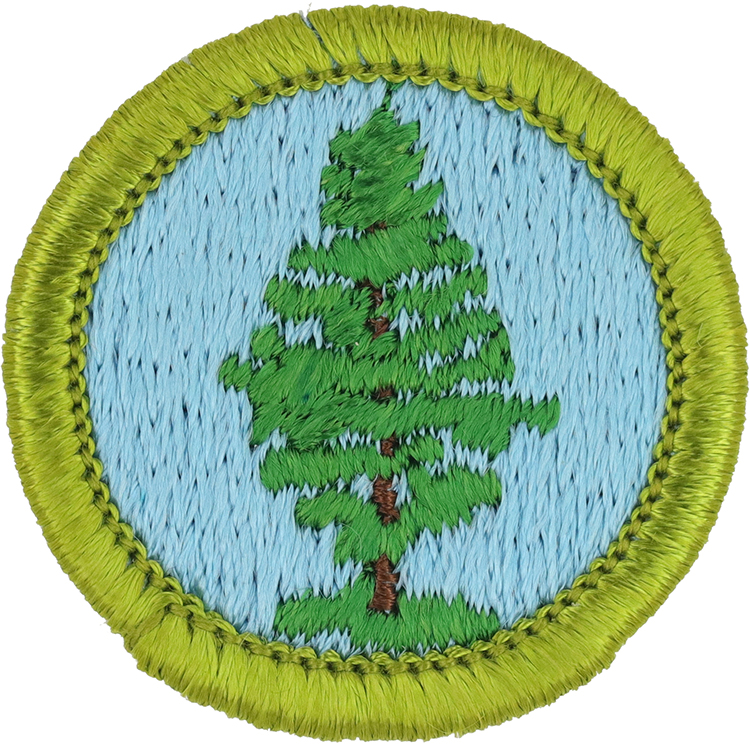
Fig. 1: Forest-H2-Front
- Embroidery: Cotton thread
- Border: Merrowed
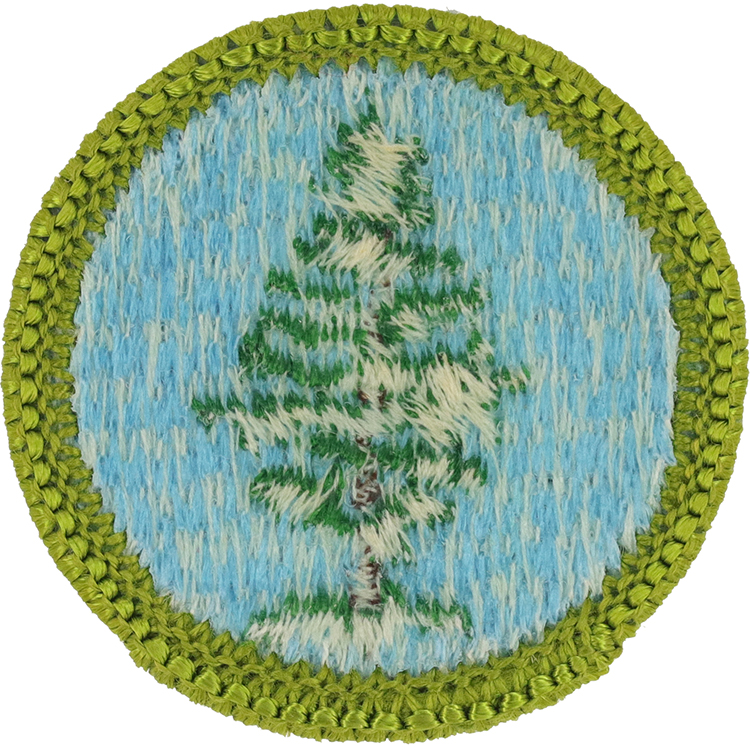
Fig. 2: Forest-H2-Reverse
- Back: Clear plastic with waffle pattern
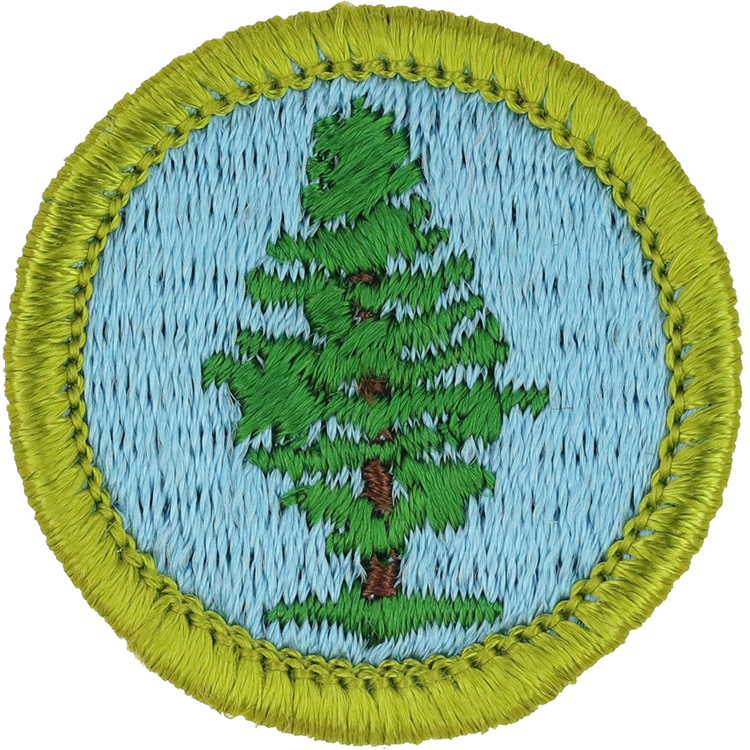
Fig. 3: Forest-H2-mve1-front
- Embroidery: Cotton thread
- Border: Merrowed
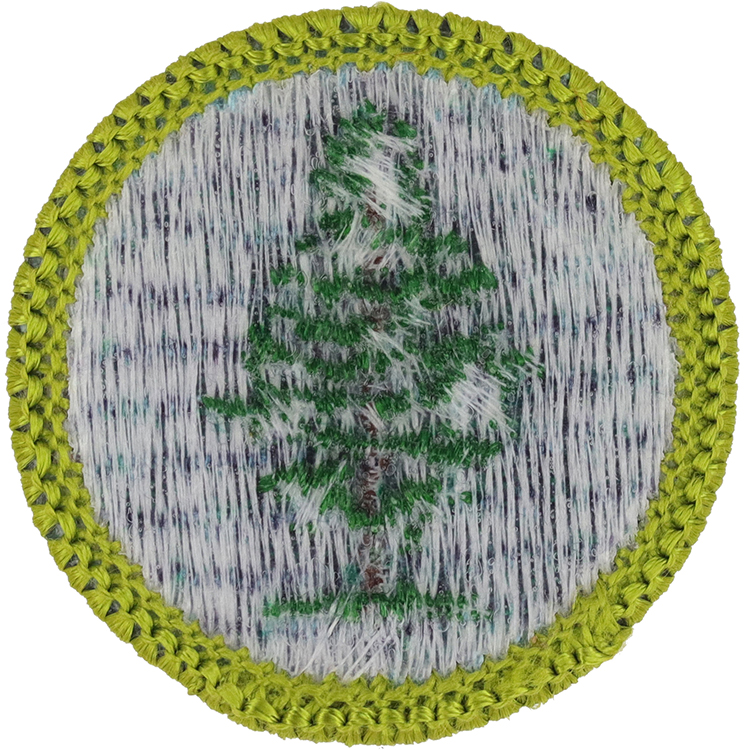
Fig. 4: Forest-H2-mve1-reverse
- Back: Dark base cloth, clear plastic with waffle pattern
Item Name: Forestry 1972 - 1975
Item ID: Forest-H2
Collector Rating: 1
Pamphlets Used to Earn this Badge
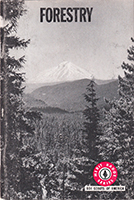

Requirements June 1972 until January 1998
4-H FFA
1. Point out 15 different species of trees or wild shrubs in the field and tell their names and chief uses. (If fewer than 15 kinds grow locally, identify and tell the uses of those that may be found.)
2. Do ONE of the following:
(a) Collect leaves or winter twigs of 15 forest trees or shrubs; mount them in a notebook, writing the name of each, where it grows in the United States and the chief uses.
(b) Obtain wood samples of 10 different trees and tell some of the uses of each kind of wood.
3. Do the following:
(a) Describe the value of forests in protecting soil and building fertility, regulating the flow of water, wildlife management, and as recreational areas. Tell from what watershed or other source your community obtains its water.
(b) Describe briefly the part that forest products play in our everyday life.
4. Do ONE of the following:
(a) Make a diameter tape or Biltmore Stick. Show how to determine the height and diameter of trees. Estimate the board foot volume of three trees selected by the Counselor.
(b) Find and examine several stumps or logs that have variations in the rate of growth as shown by rings and discuss reasons for these variations.
5. Describe what is meant by forest management.
6. Working with your counselor or a forester, plan and carry out a forestry project that meets a need such as tree planting, seed collecting, range improvement, or forest wildlife management.
7. Do the following:
(a) Describe the damage to forests and watersheds resulting from fire, insects, tree diseases, overgrazing, unwise cutting practices. Tell what is being done to reduce this damage.
(b) Tell what to do if a fire is discovered in woodlands.
(c) Take part in a forest fire prevention campaign or build a fire lane of at least 100 yards at a location designated by a local fire warden, forester, or counselor.
8. Do ONE of the following:
(a) Take a field trip to a logging operation or to a wood-using industrial plant and write a 500 word report telling what the raw material is, where is comes from, how the finished product is made, how products are used, and how waste materials are disposed of.
(b) Visit a managed public or private forest area or watershed area with its supervisor and write a 500-word report on how the area is managed to grow repeated crops of lumber, to protect the watershed, to support repeated crops of wildlife, or to provide other services and benefits.