-
Merit Badges
- Legend to identify Merit Badges
- 1910 British Merit Badges
- Square 1911 - 33
- Wide Crimped 1934 & 35
-
Narrow Tan Crimped 1936 - 42
- Tan Heavyweight Cloth with Silk Embroidery and Printed Back 1936 - 37
- Tan Heavyweight Cloth with Silk Embroidery and Plain Back 1937 - 38
- Tan Lightweight Cloth with Silk Embroidery and Plain Back 1938 - 39
- Tan Lightweight Cloth with Cotton Continuous Loop Embroidery and Plain Back 1939 - 42
- Tan Lightweight Cloth with Cotton Lockstitch Embroidery and Plain Back 1939 - 42
- Blue Background 1942 - 46
- Wartime 1942 - 46
- Khaki Narrow Crimped 1946 - 59
- Green Twill Gauze Back 1960 - 68
- Fully Embroidered Merrowed Edge 1960 - 72
- Unprinted Plastic Back 1972 - 01
- Printed Plastic Back 2002 - Current
-
Merit Badge Paper
- Merit Badge Applications
- Merit Badge Cards
-
Merit Badge Pamphlets
- Type 1 White Cover - Rectangle Drawing On Cover
- Type 2 White Cover 5-375" x 8" Title at Top
- Type 3A Tan Cover - 200 Fifth Avenue
- Type 3B Tan Cover - 2 line address New York City
- Type 3C Tan Cover - 2 line address New York N.Y.
- Type 3D Tan Cover - 1 line address New York N.Y.
- Type 4 Standing Scout Cover
- Type 5A War Cover
- Type 5B Red and White
- Type 6 Photo-Red Cover
- Type 7 Full Photo Cover or Bulls-eye Cover
- Type 8 Full Photo - Green Stripe Cover
- Type 9 Full Photo - Red Stripe Cover
- Type 10A Blue Stripe - Logo above bottom blue stripe - FDL centered
- Type 10B - Blue Stripe in bottom of photo area. FDL to left of text
- Special Covers
- Boy Craft Helps
- Merit Badge Counselor's Guides
-
Youth Position
- Junior Assistant Scoutmaster
- Senior Patrol Leader
- Assistant Senior Patrol Leader
- Patrol Leader
- Assistant Patrol Leader
- Troop Guide
- Scribe
- Quartermaster
- Instructor
- Chaplain Aide
- Den Chief
- Librarian
- Musician
- Webmaster
- Bugler
- Troop Historian
- Troop Representative
- Unit Representative
- Leadership Corps
- Honor Guard
- Leave No Trace Trainer
- Outdoor Ethics Guide
-
Patrol Medallions
- Patrol Medallions Introduction
- Legend to identify Patrol Medallions
- Patrol Shoulder Knot-Ribbons
- Felt Handmade Patrol Medallions
- Square Felt Patrol Medallions
- Round Broadcloth Patrol Medallions
- Red Twill Patrol Medallions
- Multi-Color Cloth Patrol Medallions
- Tan Cloth Patrol Medallions
- Patrol Medallion Back Patches
- Woodbadge Patrol Medallion
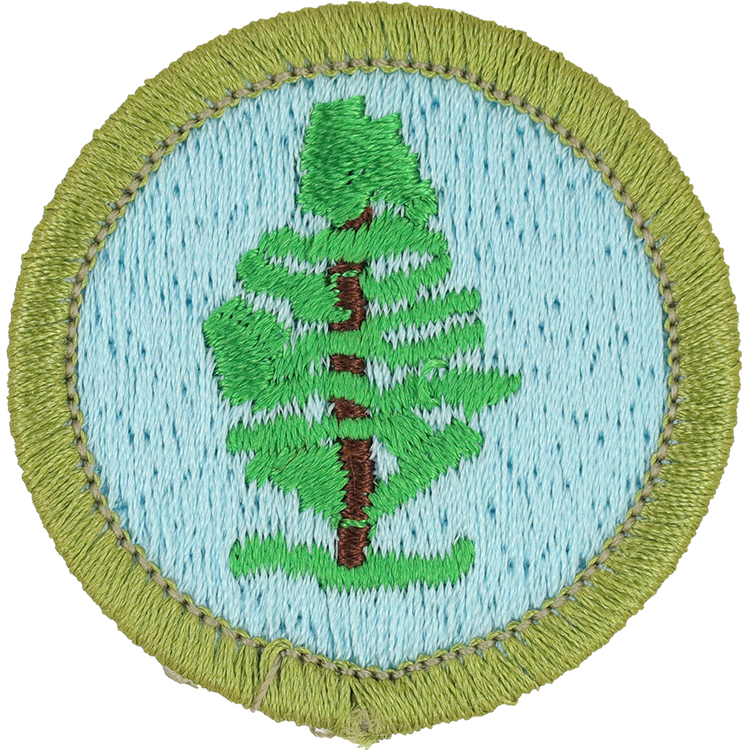
Fig. 1: Forest-L1-Front
- Embroidery: Rayon thread
- Border: Merrowed
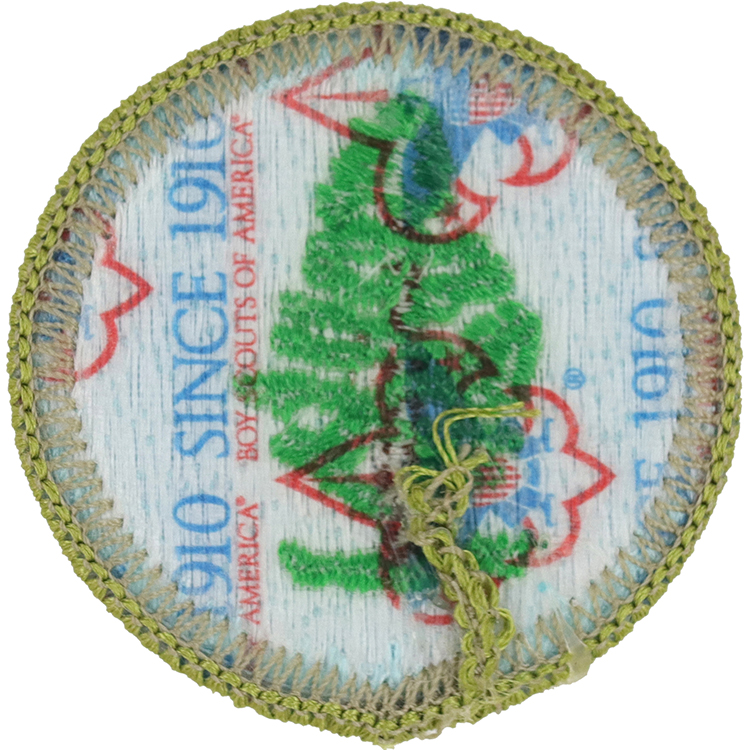
Fig. 2: Forest-L1-Reverse
- Back: Since 1910 imprint with large Tenderfoot image
Item Name: Forestry 2014 - Current
Item ID: Forest-L1
Collector Rating: 1
Pamphlets Used to Earn this Badge

Requirements January 2006 until January 2017
1. Prepare a field notebook, make a collection, and identify 15 species of trees or wild shrubs, or vines in a local forested area. Write a description in which you identify and discuss the following:
(a) The characteristics of leaf, twig, cone, or fruiting bodies.
(b) The habitat in which these trees, shrubs, or vines are found.
(c) The important way each tree, shrub, or vine is used by humans or wildlife and whether the species is native or was introduced to the area. If it is not native, explain whether it is considered invasive or potentially invasive.
2. Do ONE of the following:
(a) Collect and identify wood samples of 10 species of trees. List several ways each species of wood can be used.
(b) Find and examine several stumps, logs, or core samples that show variations in the growth rate of their ring patterns. In the field notebook you prepared for requirement 1, describe the location or origin of each example (including elevation, aspect, slope, and the position on the slope), and discuss possible reasons for the variations in growth rate. Photograph or sketch each sample.
(c) Find and examine two types of animal, insect, or damage on tres. In the field notebook you prepared for requirement 1, identify the damage, explain how the damage was caused, and describe the effects of the damage on the trees. Photograph or sketch each sample.
3. Be able to do the following:
(a) Describe contributions forests make to:
(1) Our economy in the form of products
(2) Our social well being, including recreation.
(3) Soil protection and increased fertility
(4) Clean water
(5) Clean air (carbon cycling, sequestration)
(6) Wildlife habitat
(7) Fisheries habitat
(8) Threatened and endangered species of plants and animals
(b) Tell which watershed or other source your community relies on for its water supply.
4. Describe what forest management means, including the following:
(a) Multiple-use management.
(b) Sustainable forest management
(c) Even-aged and uneven-aged management and the silvicultural systems associated with each
(d) Intermediate cuttings
(e) The role of prescribed burning and related forest management practices
5. With your parent’s and counselor’s approval, do ONE of the following:
(a) Visit a managed public or private forest area with its manager or a forester who is familiar with it. Write a brief report describing the type of forest, the management objectives, and the forestry techniques used to achieve the objectives:
(b) With a knowledgeable individual, visit to a logging operation or wood-using manufacturing plant. Write a brief report describing the following:
(1) The species and size of trees being harvested or used and the location of the harsest area on manufacturer
(2) The origin of the forest or stands of trees being utilized (e.g., planted or natural)
(3) The forest’s successional stage. What is its future?
(4) Where the trees are coming from (land ownership) or where they are going (type of mill or processing plant)
(5) The products that are made from the trees
(6) How the products that are made and used
(7) How waste materials from the logging operation or manufacturing plant are disposed of or utilized
(c) Take part in a forest-fire prevention campaign in cooperation with your local fire warden, state wildlife agency, forester, or counselor. Write a brief report describing the campaign, how it will help prevent wildfires, and your part in it.
6. Do the following:
(a) Describe the consequences to forests that result from FIVE of the following elements: wildfire, absence of fire, insects, tree diseases, air pollution, overgrazing, deer or other wildlife overpopulation, improper harvest, and urbanization.
(b) Explain what can be done to reduce the consequences you discussed in 6a.
(c) Describe what you should do if you discover a forest fire and how a professional firefighting crew might control it. Name your state or local wildfire control agency.
7. Visit with one of more local foresters and write a brief report about the person (or persons). Or, write a forester’s occupation including education, qualifications, career opportunities, and duties related to forestry.
Requirements January 2017 until Current
1. Prepare a field notebook, make a collection, and identify 15 species of trees or wild shrubs, or vines in a local forested area. Write a description in which you identify and discuss the following:
(a) The characteristics of leaf, twig, cone, or fruiting bodies.
(b) The habitat in which these trees, shrubs, or vines are found.
(c) The important way each tree, shrub, or vine is used by humans or wildlife and whether the species is native or was introduced to the area. If it is not native, explain whether it is considered invasive or potentially invasive.
2. Do ONE of the following:
(a) Collect and identify wood samples of 10 species of trees. List several ways each species of wood can be used.
(b) Find and examine several stumps, logs, or core samples that show variations in the growth rate of their ring patterns. In the field notebook you prepared for requirement 1, describe the location or origin of each example (including elevation, aspect, slope, and the position on the slope), and discuss possible reasons for the variations in growth rate. Photograph or sketch each sample.
(c) Find and examine two types of animal, insect, or damage on tres. In the field notebook you prepared for requirement 1, identify the damage, explain how the damage was caused, and describe the effects of the damage on the trees. Photograph or sketch each sample.
3. Be able to do the following:
(a) Describe contributions forests make to:
(1) Our economy in the form of products
(2) Our social well being, including recreation.
(3) Soil protection and increased fertility
(4) Clean water
(5) Clean air (carbon cycling, sequestration)
(6) Wildlife habitat
(7) Fisheries habitat
(8) Threatened and endangered species of plants and animals
(b) Tell which watershed or other source your community relies on for its water supply.
4. Describe what forest management means, including the following:
(a) Multiple-use management.
(b) Sustainable forest management
(c) Even-aged and uneven-aged management and the silvicultural systems associated with each
(d) Intermediate cuttings
(e) The role of prescribed burning and related forest management practices
5. With your parent’s and counselor’s approval, do ONE of the following:
(a) Visit a managed public or private forest area with its manager or a forester who is familiar with it. Write a brief report describing the type of forest, the management objectives, and the forestry techniques used to achieve the objectives:
(b) With a knowledgeable individual, visit to a logging operation or wood-using manufacturing plant. Write a brief report describing the following:
(1) The species and size of trees being harvested or used and the location of the harsest area on manufacturer
(2) The origin of the forest or stands of trees being utilized (e.g., planted or natural)
(3) The forest’s successional stage. What is its future?
(4) Where the trees are coming from (land ownership) or where they are going (type of mill or processing plant)
(5) The products that are made from the trees
(6) How the products that are made and used
(7) How waste materials from the logging operation or manufacturing plant are disposed of or utilized
(c) Take part in a forest-fire prevention campaign in cooperation with your local fire warden, state wildlife agency, forester, or counselor. Write a brief report describing the campaign, how it will help prevent wildfires, and your part in it.
6. In your camp, local recreation area (park or equivalent), or neighborhood, inventory the trees that may be a hazard to structures or people. Make a list by area (campsite, road, trail, street, etc.). Note the species and hazardous condition, and suggest a remedy (removal or trimming). Make your list available to the proper authority or agency.
7. Do the following:
(a) Describe the consequences to forests that result from FIVE of the following elements: wildfire, absence of fire, insects, tree diseases, air pollution, overgrazing, deer or other wildlife overpopulation, improper harvest, and urbanization.
(b) Explain what can be done to reduce the consequences you discussed in 6a.
(c) Describe what you should do if you discover a forest fire and how a professional firefighting crew might control it. Name your state or local wildfire control agency.
8. Visit with one of more local foresters and write a brief report about the person (or persons). Or, write a forester’s occupation including education, qualifications, career opportunities, and duties related to forestry.