-
Merit Badges
- Legend to identify Merit Badges
- 1910 British Merit Badges
- Square 1911 - 33
- Wide Crimped 1934 & 35
-
Narrow Tan Crimped 1936 - 42
- Tan Heavyweight Cloth with Silk Embroidery and Printed Back 1936 - 37
- Tan Heavyweight Cloth with Silk Embroidery and Plain Back 1937 - 38
- Tan Lightweight Cloth with Silk Embroidery and Plain Back 1938 - 39
- Tan Lightweight Cloth with Cotton Continuous Loop Embroidery and Plain Back 1939 - 42
- Tan Lightweight Cloth with Cotton Lockstitch Embroidery and Plain Back 1939 - 42
- Blue Background 1942 - 46
- Wartime 1942 - 46
- Khaki Narrow Crimped 1946 - 59
- Green Twill Gauze Back 1960 - 68
- Fully Embroidered Merrowed Edge 1960 - 72
- Unprinted Plastic Back 1972 - 01
- Printed Plastic Back 2002 - Current
-
Merit Badge Paper
- Merit Badge Applications
- Merit Badge Cards
-
Merit Badge Pamphlets
- Type 1 White Cover - Rectangle Drawing On Cover
- Type 2 White Cover 5-375" x 8" Title at Top
- Type 3A Tan Cover - 200 Fifth Avenue
- Type 3B Tan Cover - 2 line address New York City
- Type 3C Tan Cover - 2 line address New York N.Y.
- Type 3D Tan Cover - 1 line address New York N.Y.
- Type 4 Standing Scout Cover
- Type 5A War Cover
- Type 5B Red and White
- Type 6 Photo-Red Cover
- Type 7 Full Photo Cover or Bulls-eye Cover
- Type 8 Full Photo - Green Stripe Cover
- Type 9 Full Photo - Red Stripe Cover
- Type 10A Blue Stripe - Logo above bottom blue stripe - FDL centered
- Type 10B - Blue Stripe in bottom of photo area. FDL to left of text
- Special Covers
- Boy Craft Helps
- Merit Badge Counselor's Guides
-
Youth Position
- Junior Assistant Scoutmaster
- Senior Patrol Leader
- Assistant Senior Patrol Leader
- Patrol Leader
- Assistant Patrol Leader
- Troop Guide
- Scribe
- Quartermaster
- Instructor
- Chaplain Aide
- Den Chief
- Librarian
- Musician
- Webmaster
- Bugler
- Troop Historian
- Troop Representative
- Unit Representative
- Leadership Corps
- Honor Guard
- Leave No Trace Trainer
- Outdoor Ethics Guide
-
Patrol Medallions
- Patrol Medallions Introduction
- Legend to identify Patrol Medallions
- Patrol Shoulder Knot-Ribbons
- Felt Handmade Patrol Medallions
- Square Felt Patrol Medallions
- Round Broadcloth Patrol Medallions
- Red Twill Patrol Medallions
- Multi-Color Cloth Patrol Medallions
- Tan Cloth Patrol Medallions
- Patrol Medallion Back Patches
- Woodbadge Patrol Medallion
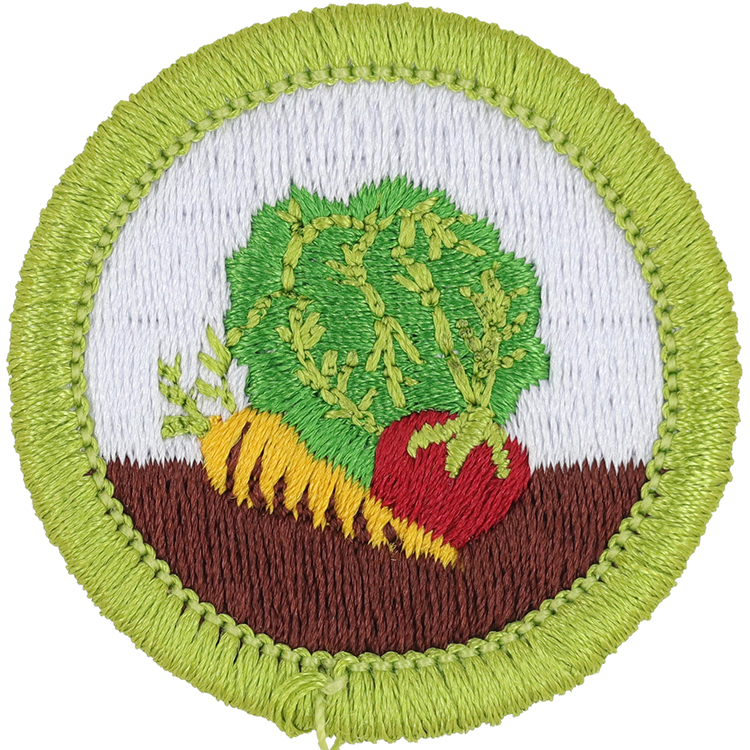
Fig. 1: Garden-L1-Front
- Embroidery: Rayon thread
- Border: Merrowed
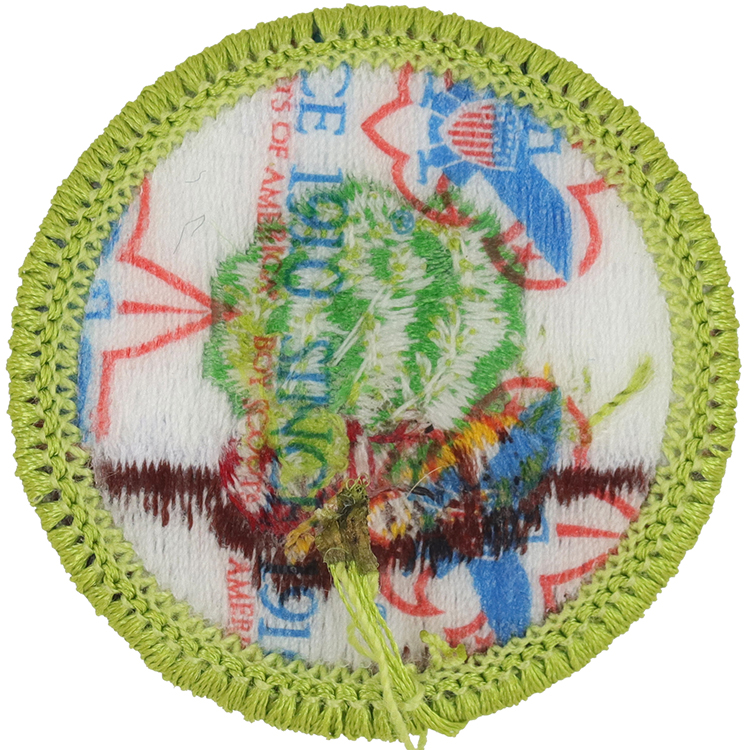
Fig. 2: Garden-L1-Reverse
- Back: Since 1910 imprint with large Tenderfoot image
Item Name: Gardening 2014 - Current
Item ID: Garden-L1
Collector Rating: 1
Pamphlets Used to Earn this Badge

Requirements January 2013 until Current
1. Do the following:
(a) Explain to your counselor the most likely hazards associated with gardening and what you should do to anticipate, help prevent, mitigate, and respond to these hazards.
(b) Discuss the prevention of and treatment for health concerns that could occur while gardening, including cuts, scratches, puncture wounds, insect bites, anaphylactic shock, heat reactions, and reactions from exposure to pesticides and fertilizers.
2. Do the following:
(a) Grow six vegetables, three from seeds and three from seedlings, through harvesting.
(b) Grow six flowers, three from seeds and three from seedlings, through flowering.
3. Give the nutritional value of the following:
(a) Three root or tuber crops.
(b) Three fruits or vegetables which bear above the ground.
(c) Three fruits.
4. Test 100 seeds for germination. Determine the percentage of seeds that germinate. Explain why you think some did not germinate.
5. Visit your country extension agent’s office, local university agricultural college, nursery, or a botanical garden or arboretum. Report on what you learned.
6. Explain to your counselor how and why honeybees are used in pollinating food crops and problems that face the bee population today. Discuss what the impact to humanity would be if there were no pollinators
7. Identify five garden pests (insects, diseased plants). Recommend two solutions for each pest. At least one of the two solutions must be an organic method.
8. Do ONE of the following:
(a) Build a compost bin and maintain it for 90 days.
(b) Build a vermipost bin (worm compost bin) and maintain it for 90 days.
(c) Build a hydroponic garden containing three vegetables or herbs, or three ornamental plants. Maintain this garden through harvest or flowering, or for 90 days.
(d) Build one water garden, either in a container (at least 12 by 6 inches and 6 inches deep), or in the ground as a small, decorative pond no larger than 6 by 3 feet and 24 inches deep. Maintain the water garden for 90 days.
(e) Prepare a honey super for use on a hive or colony. Remove a filled honey super from the hive or colony and prepare the honey for sale.