-
Merit Badges
- Legend to identify Merit Badges
- 1910 British Merit Badges
- Square 1911 - 33
- Wide Crimped 1934 & 35
-
Narrow Tan Crimped 1936 - 42
- Tan Heavyweight Cloth with Silk Embroidery and Printed Back 1936 - 37
- Tan Heavyweight Cloth with Silk Embroidery and Plain Back 1937 - 38
- Tan Lightweight Cloth with Silk Embroidery and Plain Back 1938 - 39
- Tan Lightweight Cloth with Cotton Continuous Loop Embroidery and Plain Back 1939 - 42
- Tan Lightweight Cloth with Cotton Lockstitch Embroidery and Plain Back 1939 - 42
- Blue Background 1942 - 46
- Wartime 1942 - 46
- Khaki Narrow Crimped 1946 - 59
- Green Twill Gauze Back 1960 - 68
- Fully Embroidered Merrowed Edge 1960 - 72
- Unprinted Plastic Back 1972 - 01
- Printed Plastic Back 2002 - Current
-
Merit Badge Paper
- Merit Badge Applications
- Merit Badge Cards
-
Merit Badge Pamphlets
- Type 1 White Cover - Rectangle Drawing On Cover
- Type 2 White Cover 5-375" x 8" Title at Top
- Type 3A Tan Cover - 200 Fifth Avenue
- Type 3B Tan Cover - 2 line address New York City
- Type 3C Tan Cover - 2 line address New York N.Y.
- Type 3D Tan Cover - 1 line address New York N.Y.
- Type 4 Standing Scout Cover
- Type 5A War Cover
- Type 5B Red and White
- Type 6 Photo-Red Cover
- Type 7 Full Photo Cover or Bulls-eye Cover
- Type 8 Full Photo - Green Stripe Cover
- Type 9 Full Photo - Red Stripe Cover
- Type 10A Blue Stripe - Logo above bottom blue stripe - FDL centered
- Type 10B - Blue Stripe in bottom of photo area. FDL to left of text
- Special Covers
- Boy Craft Helps
- Merit Badge Counselor's Guides
-
Youth Position
- Junior Assistant Scoutmaster
- Senior Patrol Leader
- Assistant Senior Patrol Leader
- Patrol Leader
- Assistant Patrol Leader
- Troop Guide
- Scribe
- Quartermaster
- Instructor
- Chaplain Aide
- Den Chief
- Librarian
- Musician
- Webmaster
- Bugler
- Troop Historian
- Troop Representative
- Unit Representative
- Leadership Corps
- Honor Guard
- Leave No Trace Trainer
- Outdoor Ethics Guide
-
Patrol Medallions
- Patrol Medallions Introduction
- Legend to identify Patrol Medallions
- Patrol Shoulder Knot-Ribbons
- Felt Handmade Patrol Medallions
- Square Felt Patrol Medallions
- Round Broadcloth Patrol Medallions
- Red Twill Patrol Medallions
- Multi-Color Cloth Patrol Medallions
- Tan Cloth Patrol Medallions
- Patrol Medallion Back Patches
- Woodbadge Patrol Medallion
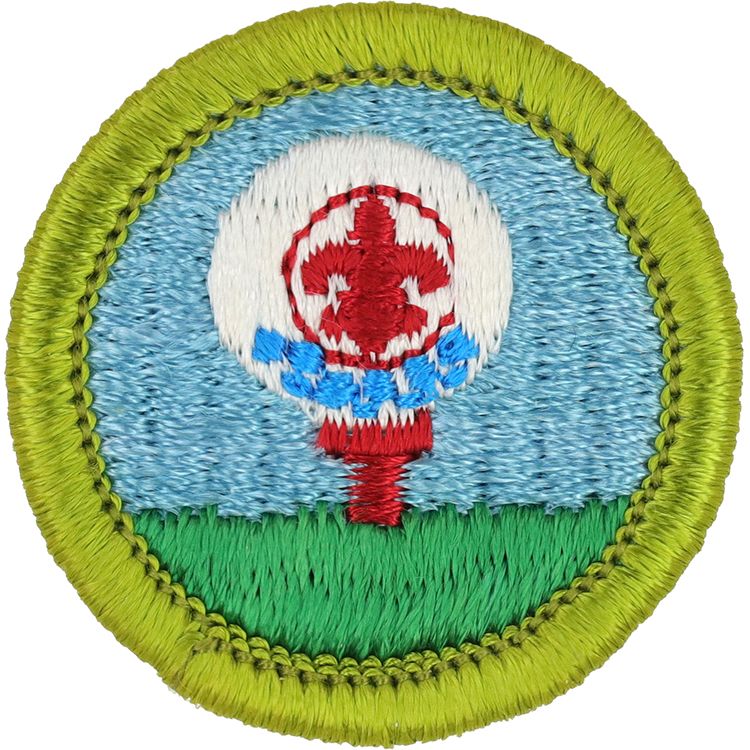
Fig. 1: Golf-H3-Front
- Embroidery: Cotton thread, dull sheen
- Border: Dk green merrowed
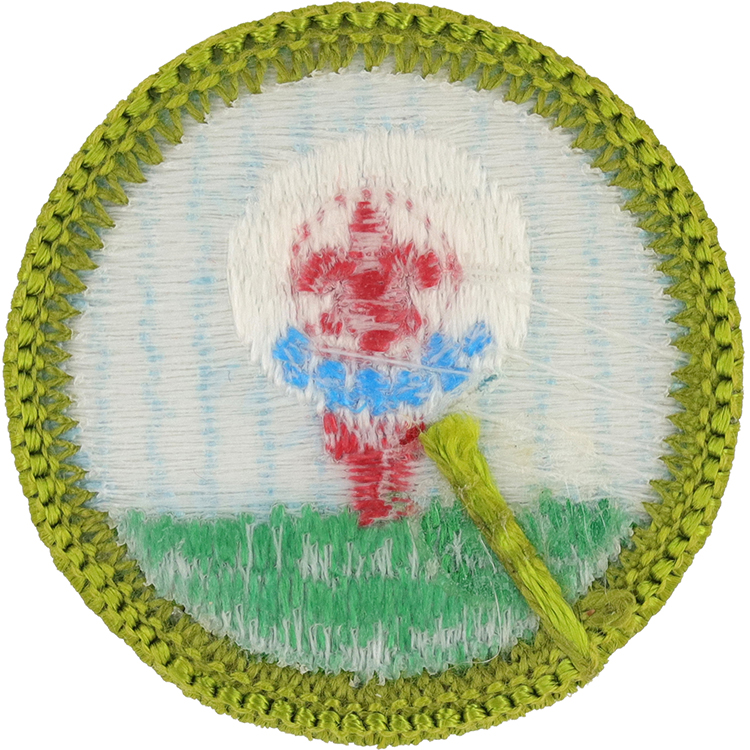
Fig. 2: Golf-H3-Reverse
- Back: Molded plastic
Item Name: Golf 1976 - 1978
Item ID: Golf-H3
Collector Rating: 1
Pamphlets Used to Earn this Badge
Requirements July 1976 until December 1977
1. Study the USGA Rules of Golf now in use.
(a) Tell about the three categories of golf etiquette.
(b) Show that you know about the 36 definitions of golf terms.
(c) Tell about your understanding of the Golf Rules in Brief.
(d) Show that you understand the "Rules of Amateur Status".
2. Tell about your understanding of the USGA system of handicapping. Show that you have established your handicap under this system.
3. Do the following:
(a) Tell about the early history of golf.
(b) Describe its early years in the United States.
(c) Tell about the accomplishments of a top golfer of your choice from each of the following periods:
Before 1900 1940 to 1970
1900 to 1940 1970 to present
4. Talk over the following:
(a) Six vocational opportunities of golf
(b) Advantages of the amateur golfer
5. Tell how a golf exercise plan can help you play better. Show two exercises that would improve your game.
6. Show the following:
(a) The proper grip, stance, pivot, and parts of a good swing.
(b) The full wood shot, played from a tee.
(c) The fairway wood shot.
(d) The long iron shot.
(e) The short iron shot.
(f) The approach, chip, pitch, and pitch-and-run shots.
(g) The sand iron shot, bunker, or heavy rough recovery shots.
(h) A sound putting stroke.
7. Play a competitive round of golf with another golfer about your age and your counselor, or an adult he has approved: OR enter and participate in a competitive golf event. In either case,
(a) Follow the Rules of Gold.
(b) Use an approved handicap.
(c) Practice good golf etiquette.
(d) Show respect to fellow golfers, committee, sponsor, and gallery
Requirements December 1977 until September 1995
1. Study the USGA Rules of Golf now in use.
(a) Tell about the three categories of golf etiquette.
(b) Show that you know about the 36 definitions of golf terms.
(c) Tell about your understanding of the Golf Rules in Brief.
(d) Show that you understand the "Rules of Amateur Status".
2. Tell about your understanding of the USGA system of handicapping. Show that you have established your handicap under this system.
3. Do the following:
(a) Tell about the early history of golf.
(b) Describe its early years in the United States.
(c) Tell about the accomplishments of a top golfer of your choice from each of the following periods:
Before 1900 1940 to 1970
1900 to 1940 1970 to present
4. Talk over the following:
(a) Six vocational opportunities of golf
(b) Advantages of the amateur golfer
5. Tell how a golf exercise plan can help you play better. Show two exercises that would improve your game.
6. Show the following:
(a) The proper grip, stance, pivot, and parts of a good swing.
(b) The full wood shot, played from a tee.
(c) The fairway wood shot.
(d) The long iron shot.
(e) The short iron shot.
(f) The approach, chip, pitch, and pitch-and-run shots.
(g) The sand iron shot, bunker, or heavy rough recovery shots.
(h) A sound putting stroke.
7. Play a competitive round of golf with another golfer about your age and your counselor, or an adult he has approved: OR enter and participate in a competitive golf event. In either case,
(a) Follow the Rules of Gold.
(b) Use an approved handicap.
(c) Practice good golf etiquette.
(d) Show respect to fellow golfers, committee, sponsor, and gallery.