-
Merit Badges
- Legend to identify Merit Badges
- 1910 British Merit Badges
- Square 1911 - 33
- Wide Crimped 1934 & 35
-
Narrow Tan Crimped 1936 - 42
- Tan Heavyweight Cloth with Silk Embroidery and Printed Back 1936 - 37
- Tan Heavyweight Cloth with Silk Embroidery and Plain Back 1937 - 38
- Tan Lightweight Cloth with Silk Embroidery and Plain Back 1938 - 39
- Tan Lightweight Cloth with Cotton Continuous Loop Embroidery and Plain Back 1939 - 42
- Tan Lightweight Cloth with Cotton Lockstitch Embroidery and Plain Back 1939 - 42
- Blue Background 1942 - 46
- Wartime 1942 - 46
- Khaki Narrow Crimped 1946 - 59
- Green Twill Gauze Back 1960 - 68
- Fully Embroidered Merrowed Edge 1960 - 72
- Unprinted Plastic Back 1972 - 01
- Printed Plastic Back 2002 - Current
-
Merit Badge Paper
- Merit Badge Applications
- Merit Badge Cards
-
Merit Badge Pamphlets
- Type 1 White Cover - Rectangle Drawing On Cover
- Type 2 White Cover 5-375" x 8" Title at Top
- Type 3A Tan Cover - 200 Fifth Avenue
- Type 3B Tan Cover - 2 line address New York City
- Type 3C Tan Cover - 2 line address New York N.Y.
- Type 3D Tan Cover - 1 line address New York N.Y.
- Type 4 Standing Scout Cover
- Type 5A War Cover
- Type 5B Red and White
- Type 6 Photo-Red Cover
- Type 7 Full Photo Cover or Bulls-eye Cover
- Type 8 Full Photo - Green Stripe Cover
- Type 9 Full Photo - Red Stripe Cover
- Type 10A Blue Stripe - Logo above bottom blue stripe - FDL centered
- Type 10B - Blue Stripe in bottom of photo area. FDL to left of text
- Special Covers
- Boy Craft Helps
- Merit Badge Counselor's Guides
-
Youth Position
- Junior Assistant Scoutmaster
- Senior Patrol Leader
- Assistant Senior Patrol Leader
- Patrol Leader
- Assistant Patrol Leader
- Troop Guide
- Scribe
- Quartermaster
- Instructor
- Chaplain Aide
- Den Chief
- Librarian
- Musician
- Webmaster
- Bugler
- Troop Historian
- Troop Representative
- Unit Representative
- Leadership Corps
- Honor Guard
- Leave No Trace Trainer
- Outdoor Ethics Guide
-
Patrol Medallions
- Patrol Medallions Introduction
- Legend to identify Patrol Medallions
- Patrol Shoulder Knot-Ribbons
- Felt Handmade Patrol Medallions
- Square Felt Patrol Medallions
- Round Broadcloth Patrol Medallions
- Red Twill Patrol Medallions
- Multi-Color Cloth Patrol Medallions
- Tan Cloth Patrol Medallions
- Patrol Medallion Back Patches
- Woodbadge Patrol Medallion

Fig. 1: Hiking-D2-Front
- Cloth: Fine twill
- Embroidery: Cotton lock stitch >
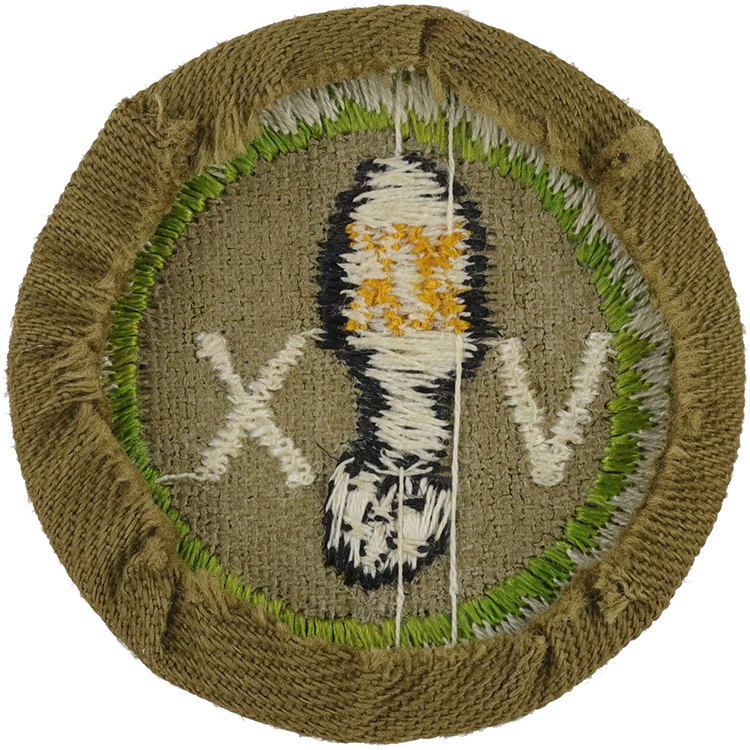
Fig. 2: Hiking-D2-Reverse
- Back: Plain NO imprint with starch
Item Name: Hiking 1942 - 1945
Item ID: Hiking-D2
Collector Rating: 1
Pamphlets Used to Earn this Badge
Requirements October 1936 until December 1943
1. Walk ten continuous miles on each of two days each month for a period of three months; in other words, six walks of ten miles each during the three months. He shall submit to the Merit Badge Counselor, a report of the hikes taken, including dates, routes traveled, and interesting things observed.
2. After the three-month conditioning period in Requirement No. 1, walk twenty miles in one day.
3. Describe to the Counselor the location and interesting features of trails over which he has hiked; and hike to some place marked by some patriotic or historic event, and product photographs, nature specimens or other interesting exhibits secured on such hike.
4. Write his experiences in these several walking trips indicating what he has learned in the way of caring for himself as regards equipment, such as camping and cooking outfit, food, foot-wear, clothing and hygiene. He shall show a thorough knowledge of the care of the feet on a hike.
5. Demonstrate, in connection with the fulfillment of the first three requirements, his ability to read a road map (preferably a Government topographical map,) to use a compass, and make a written plan for a hike from the map.
Requirements December 1943 until June 1946
To obtain this Merit Badge, a Scout must:
1. Take five hikes of ten continuous miles each, on five separate days, within a limit of not more than six months.
2. After sufficient training, take one hike of twenty continuous miles in one day.
3. Within a month of the final hike submit a short report of each of the six hikes, containing dates, routes traveled, weather conditions, and interesting things observed.
4. Demonstrate proper walking techniques with and without a pack. Explain the main points of good hiking practice, including care of feet and toe nails, type of clothing, foot-wear and stockings, prevention and care of blisters, safety on the road and in the use of water for drinking.
5. Submit a written plan for a ten-mile hike, based upon a map, (preferably a topographical map), including description of route, list of necessary clothing and equipment, and list of ingredients of a suitable luncheon meal.