-
Merit Badges
- Legend to identify Merit Badges
- 1910 British Merit Badges
- Square 1911 - 33
- Wide Crimped 1934 & 35
-
Narrow Tan Crimped 1936 - 42
- Tan Heavyweight Cloth with Silk Embroidery and Printed Back 1936 - 37
- Tan Heavyweight Cloth with Silk Embroidery and Plain Back 1937 - 38
- Tan Lightweight Cloth with Silk Embroidery and Plain Back 1938 - 39
- Tan Lightweight Cloth with Cotton Continuous Loop Embroidery and Plain Back 1939 - 42
- Tan Lightweight Cloth with Cotton Lockstitch Embroidery and Plain Back 1939 - 42
- Blue Background 1942 - 46
- Wartime 1942 - 46
- Khaki Narrow Crimped 1946 - 59
- Green Twill Gauze Back 1960 - 68
- Fully Embroidered Merrowed Edge 1960 - 72
- Unprinted Plastic Back 1972 - 01
- Printed Plastic Back 2002 - Current
-
Merit Badge Paper
- Merit Badge Applications
- Merit Badge Cards
-
Merit Badge Pamphlets
- Type 1 White Cover - Rectangle Drawing On Cover
- Type 2 White Cover 5-375" x 8" Title at Top
- Type 3A Tan Cover - 200 Fifth Avenue
- Type 3B Tan Cover - 2 line address New York City
- Type 3C Tan Cover - 2 line address New York N.Y.
- Type 3D Tan Cover - 1 line address New York N.Y.
- Type 4 Standing Scout Cover
- Type 5A War Cover
- Type 5B Red and White
- Type 6 Photo-Red Cover
- Type 7 Full Photo Cover or Bulls-eye Cover
- Type 8 Full Photo - Green Stripe Cover
- Type 9 Full Photo - Red Stripe Cover
- Type 10A Blue Stripe - Logo above bottom blue stripe - FDL centered
- Type 10B - Blue Stripe in bottom of photo area. FDL to left of text
- Special Covers
- Boy Craft Helps
- Merit Badge Counselor's Guides
-
Youth Position
- Junior Assistant Scoutmaster
- Senior Patrol Leader
- Assistant Senior Patrol Leader
- Patrol Leader
- Assistant Patrol Leader
- Troop Guide
- Scribe
- Quartermaster
- Instructor
- Chaplain Aide
- Den Chief
- Librarian
- Musician
- Webmaster
- Bugler
- Troop Historian
- Troop Representative
- Unit Representative
- Leadership Corps
- Honor Guard
- Leave No Trace Trainer
- Outdoor Ethics Guide
-
Patrol Medallions
- Patrol Medallions Introduction
- Legend to identify Patrol Medallions
- Patrol Shoulder Knot-Ribbons
- Felt Handmade Patrol Medallions
- Square Felt Patrol Medallions
- Round Broadcloth Patrol Medallions
- Red Twill Patrol Medallions
- Multi-Color Cloth Patrol Medallions
- Tan Cloth Patrol Medallions
- Patrol Medallion Back Patches
- Woodbadge Patrol Medallion
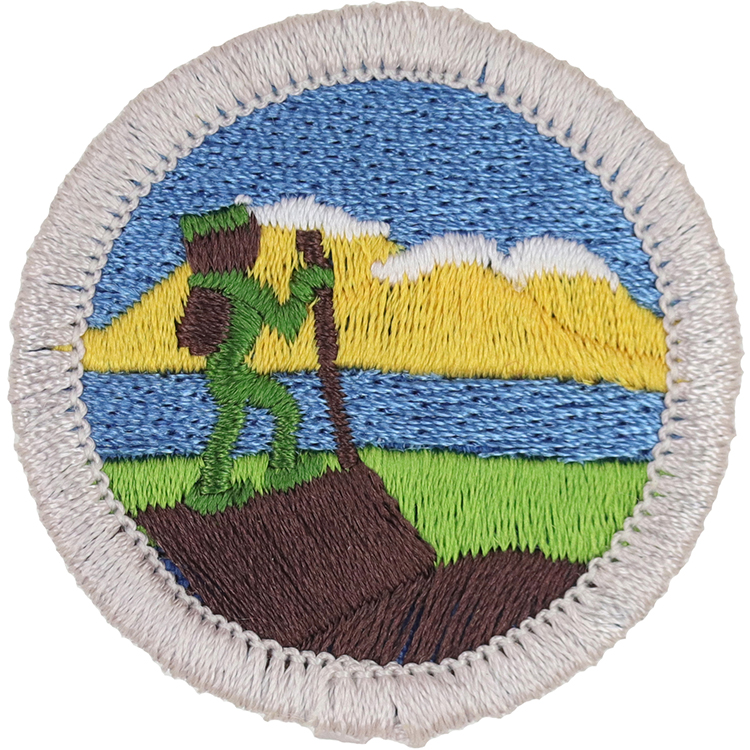
Fig. 1: Hiking-L1-Front
- Embroidery: Rayon thread
- Border: Merrowed
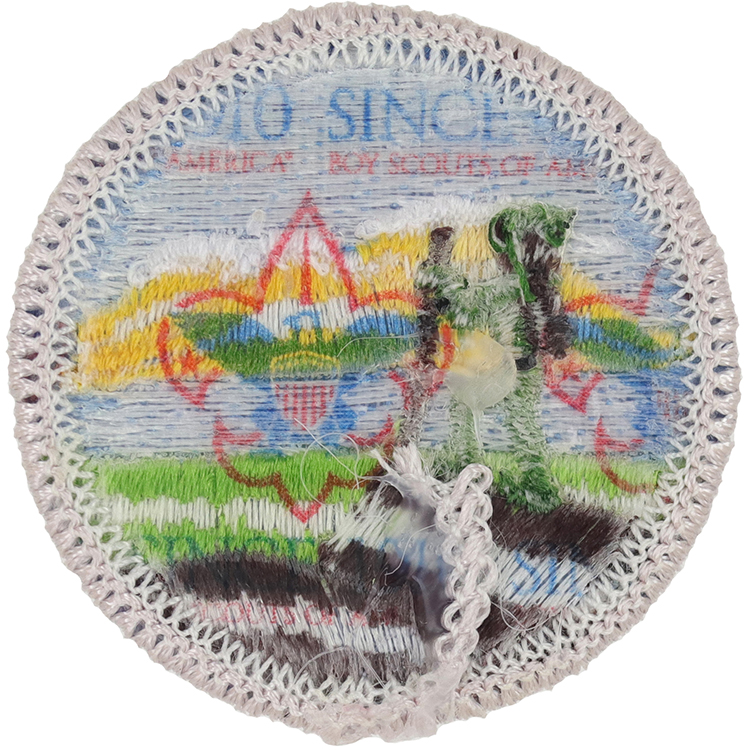
Fig. 2: Hiking-L1-Reverse
- Back: Since 1910 imprint with large Tenderfoot image
Item Name: Hiking 2014 - Current
Item ID: Hiking-L1
Collector Rating: 1
Pamphlets Used to Earn this Badge

Requirements January 2013 until January 2017
1. Do the following:
- Explain to your counselor the most likely hazards you may encounter while hiking, and what you should do to anticipate, help prevent, mitigate, and respond to these hazards.
- Show that you know first aid for injuries or illnesses that could occur while hiking, including hypothermia, heatstroke, heat exhaustion, frostbite, dehydration, sunburn, sprained ankle, insect stings, tick bites, snakebite, blisters, hyperventilation and altitude sickness.
2. Explain and, where possible, show the main points of good hiking practices including the principles of Leave No Trace, hiking safety in the daytime and at night, courtesy to others, choice of footwear, and proper care of feet and footwear.
3. Explain how hiking is an aerobic activity. Develop a plan for conditioning yourself for 10-mile hike, and describe how you will increase your fitness for longer hikes.
4. Make a written plan for a 10-mile hike. Include map routes, a clothing and equipment list, and a list of things for a trail lunch.
5. Take five hikes, each on a different day, and each of at least 10 continuous miles. You may stop for as many short rest periods as needed, as well as on meal, during each hike, but not for an extended period (example: overnight). Prepare a hike plan for each hike.*
6. Take a hike of 20 continuous miles in one day following a hike plan you have prepared. You may stop for as many short rest periods as needed, as well as one meal, during each hike, but not for an extended period (example: overnight).*
7. After each of the hikes (or during each hike if on a continuous “trek”) in requirements 5 and 6, write a short report of your experience. Give dates and descriptions of routes covered, the weather, and interesting things you saw. Share this report with you merit badge counselor.
*The hikes in requirement 5 and 6 can be used in fulfilling Second Class (2a) and First Class (3) rank requirements, but only if Hiking merit badge requirements 1,2,3, and 4 have been completed to the satisfaction of your counselor. The hikes of requirement 5 and 6 cannot be used to fulfill requirements of other merit badges.
Requirements January 2017 until Current
1. Do the following:
- Explain to your counselor the most likely hazards you may encounter while hiking, and what you should do to anticipate, help prevent, mitigate, and respond to these hazards.
- Show that you know first aid for injuries or illnesses that could occur while hiking, including hypothermia, frostbite, dehydration, heat exhaustin, heatstroke, sunburn, hyperventilation, altitude sickness, sprained ankle, blisters, insect stings, tick bites, and snakebite.
2. Explain and, where possible, show the points of good hiking practices including proper outdoor ethics, hiking safety in the daytime and at night, courtesy to others, choice of footwear, and proper care of feet and footwear.
3. Explain how hiking is an aerobic activity. Develop a plan for conditioning yourself for 10-mile hike, and describe how you will increase your fitness for longer hikes.
4. Take the five following hikes, each on a different day, and each of continuous miles. These hiks MUST be taken in the following order:
One 5-mile hike
Three 10-mile hikes
One 15-mile hike
You may stop for as many short rest periods as needed, as well as on meal, during each hike, but not for an extended period (example: overnight). Prepare a written hike plan before each hike and share it with your Scoutmaster or a designee. Include map routes, a clothing and equipment list, and a list of items for a trail lunch.*
5. Take a hike of 20 continuous miles in one day following a hike plan you have prepared. You may stop for as many short rest periods as needed, as well as one meal, during each hike, but not for an extended period (example: overnight).*
6. After each of the hikes (or during each hike if on a continuous “trek”) in requirements 4 and 5, write a short report of your experience. Give dates and descriptions of routes covered, the weather, and any interesting things you saw. It may include something you learned about yourself, about the outdoors, or about others you were hiking with. Share this report with you merit badge counselor.
*The required hikes for this badge may be used in fulfilling hiking requirements for rank advancement. However, these hikes cannot be used to fulfill requirements of other merit badges.