-
Merit Badges
- Legend to identify Merit Badges
- 1910 British Merit Badges
- Square 1911 - 33
- Wide Crimped 1934 & 35
-
Narrow Tan Crimped 1936 - 42
- Tan Heavyweight Cloth with Silk Embroidery and Printed Back 1936 - 37
- Tan Heavyweight Cloth with Silk Embroidery and Plain Back 1937 - 38
- Tan Lightweight Cloth with Silk Embroidery and Plain Back 1938 - 39
- Tan Lightweight Cloth with Cotton Continuous Loop Embroidery and Plain Back 1939 - 42
- Tan Lightweight Cloth with Cotton Lockstitch Embroidery and Plain Back 1939 - 42
- Blue Background 1942 - 46
- Wartime 1942 - 46
- Khaki Narrow Crimped 1946 - 59
- Green Twill Gauze Back 1960 - 68
- Fully Embroidered Merrowed Edge 1960 - 72
- Unprinted Plastic Back 1972 - 01
- Printed Plastic Back 2002 - Current
-
Merit Badge Paper
- Merit Badge Applications
- Merit Badge Cards
-
Merit Badge Pamphlets
- Type 1 White Cover - Rectangle Drawing On Cover
- Type 2 White Cover 5-375" x 8" Title at Top
- Type 3A Tan Cover - 200 Fifth Avenue
- Type 3B Tan Cover - 2 line address New York City
- Type 3C Tan Cover - 2 line address New York N.Y.
- Type 3D Tan Cover - 1 line address New York N.Y.
- Type 4 Standing Scout Cover
- Type 5A War Cover
- Type 5B Red and White
- Type 6 Photo-Red Cover
- Type 7 Full Photo Cover or Bulls-eye Cover
- Type 8 Full Photo - Green Stripe Cover
- Type 9 Full Photo - Red Stripe Cover
- Type 10A Blue Stripe - Logo above bottom blue stripe - FDL centered
- Type 10B - Blue Stripe in bottom of photo area. FDL to left of text
- Special Covers
- Boy Craft Helps
- Merit Badge Counselor's Guides
-
Youth Position
- Junior Assistant Scoutmaster
- Senior Patrol Leader
- Assistant Senior Patrol Leader
- Patrol Leader
- Assistant Patrol Leader
- Troop Guide
- Scribe
- Quartermaster
- Instructor
- Chaplain Aide
- Den Chief
- Librarian
- Musician
- Webmaster
- Bugler
- Troop Historian
- Troop Representative
- Unit Representative
- Leadership Corps
- Honor Guard
- Leave No Trace Trainer
- Outdoor Ethics Guide
-
Patrol Medallions
- Patrol Medallions Introduction
- Legend to identify Patrol Medallions
- Patrol Shoulder Knot-Ribbons
- Felt Handmade Patrol Medallions
- Square Felt Patrol Medallions
- Round Broadcloth Patrol Medallions
- Red Twill Patrol Medallions
- Multi-Color Cloth Patrol Medallions
- Tan Cloth Patrol Medallions
- Patrol Medallion Back Patches
- Woodbadge Patrol Medallion
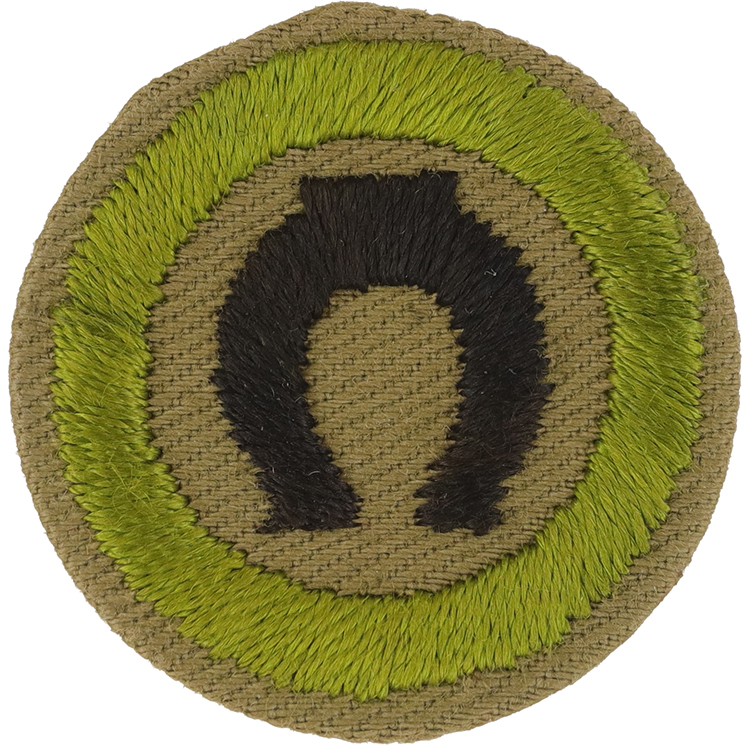
Fig. 1: Horsem-C1-Front
- Cloth: Heavyweight tan right twill
- Embroidery: Continuous loop silk
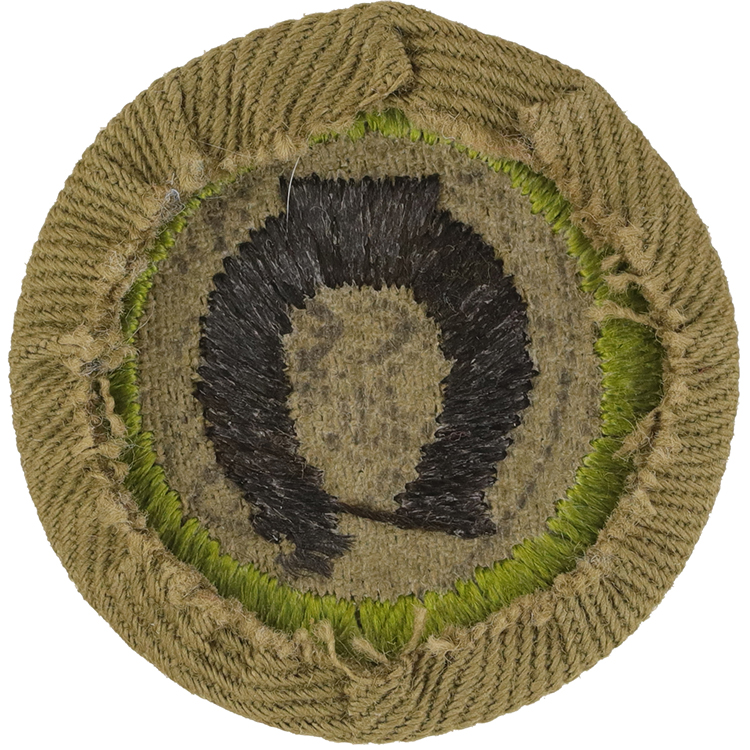
Fig. 2: Horsem-C1-Reverse
- Back: Black imprint with starch
Item Name: Horsemanship 1936 - 1937
Item ID: Horsem-C1
Collector Rating: 1
Pamphlets Used to Earn this Badge
Requirements March 1931 until September 1937. Between September 7, 1937 and January 1, 1938 these requirements were optional
1. Give the common name for the right and left sides of a horse, and state, using the common name, what side of a horse is habitually approached, and how to act while doing so.
2. State principal temperamental requirements of a good horse, also principal external points of a horse, and point out on a live horse thirty important points.
3. Know what defects and blemishes are. State the most common defects and blemishes, and how he would treat them.
4. Explain how he would examine a horse for soundness; and state the opinions of horsemen on the degrees of soundness.
5. Give several common diseases of the horse, the symptoms thereof, and the treatment.
6. (a) State fully what he knows of the stable management and the care of a horse from actual experience of at least one month.
(b) A full period of handling a horse in an approved camp under competent leadership may be substituted.
7. Point out ten important parts of the saddle, and show how he would put it on and remove it.
8. Point out ten important parts of the bridle, and show how he would fit, put it on, and take it off.
9. Illustrate on a horse the correct way of mounting and the correct position in a saddle.
10. Know the aids in riding and how they are used. Illustrate on a horse how he would move forward, increase or decrease the gait, halt, back, and change direction.
Requirements January 1, 1938, until June 1948. Between September 7, 1937 and January 1, 1938 these requirements were optional

To obtain a Merit Badge for Horsemanship a Scout must meet any seven of the following requirements:
1. In presence of Counselor-
(a) Harness a horse OR
(b) Saddle and bridle a horse, point out and explain use of five important parts of both saddle and bridle.
2. In presence of Counselor-
Ride a horse at a walk, trot and one other gait, mounting and dismounting correctly.
3. Explain symptoms of colic, distemper, and four other common horse diseases.
4. Explain how to detect defects of the legs and feet of a horse, such as ringbone, spavin, shoe boil and splint.
5. Give at least six practical suggestions for management and treatment of a pair of draft horses on hot summer work days, and give practical directions for watering and bedding of horses after a trip or day's work.
6. Give best feed rations for draft horses when at work in hot weather and when idle in cold weather, explaining why change of feed is necessary.
7. Name four leading breeds of horses and explain fully for what each breed is noted.
8. Show how to clean, oil, and treat bridle, saddle or harness to keep leather in good all-weather condition.
9. Show how to approach horse in stall in case of fire and how to remove him safely from stall and barn.
10. Show how to manage a horse and handle front and rear legs while being shod.
OR
Meet the season or year-round requirements of a 4-H Club project or agricultural home project in Horsemanship as programmed by the state, county and local leaders. This may involve membership in a Colt Club or carrying out an actual project in Horsemanship for a whole year under leadership.