-
Merit Badges
- Legend to identify Merit Badges
- 1910 British Merit Badges
- Square 1911 - 33
- Wide Crimped 1934 & 35
-
Narrow Tan Crimped 1936 - 42
- Tan Heavyweight Cloth with Silk Embroidery and Printed Back 1936 - 37
- Tan Heavyweight Cloth with Silk Embroidery and Plain Back 1937 - 38
- Tan Lightweight Cloth with Silk Embroidery and Plain Back 1938 - 39
- Tan Lightweight Cloth with Cotton Continuous Loop Embroidery and Plain Back 1939 - 42
- Tan Lightweight Cloth with Cotton Lockstitch Embroidery and Plain Back 1939 - 42
- Blue Background 1942 - 46
- Wartime 1942 - 46
- Khaki Narrow Crimped 1946 - 59
- Green Twill Gauze Back 1960 - 68
- Fully Embroidered Merrowed Edge 1960 - 72
- Unprinted Plastic Back 1972 - 01
- Printed Plastic Back 2002 - Current
-
Merit Badge Paper
- Merit Badge Applications
- Merit Badge Cards
-
Merit Badge Pamphlets
- Type 1 White Cover - Rectangle Drawing On Cover
- Type 2 White Cover 5-375" x 8" Title at Top
- Type 3A Tan Cover - 200 Fifth Avenue
- Type 3B Tan Cover - 2 line address New York City
- Type 3C Tan Cover - 2 line address New York N.Y.
- Type 3D Tan Cover - 1 line address New York N.Y.
- Type 4 Standing Scout Cover
- Type 5A War Cover
- Type 5B Red and White
- Type 6 Photo-Red Cover
- Type 7 Full Photo Cover or Bulls-eye Cover
- Type 8 Full Photo - Green Stripe Cover
- Type 9 Full Photo - Red Stripe Cover
- Type 10A Blue Stripe - Logo above bottom blue stripe - FDL centered
- Type 10B - Blue Stripe in bottom of photo area. FDL to left of text
- Special Covers
- Boy Craft Helps
- Merit Badge Counselor's Guides
-
Youth Position
- Junior Assistant Scoutmaster
- Senior Patrol Leader
- Assistant Senior Patrol Leader
- Patrol Leader
- Assistant Patrol Leader
- Troop Guide
- Scribe
- Quartermaster
- Instructor
- Chaplain Aide
- Den Chief
- Librarian
- Musician
- Webmaster
- Bugler
- Troop Historian
- Troop Representative
- Unit Representative
- Leadership Corps
- Honor Guard
- Leave No Trace Trainer
- Outdoor Ethics Guide
-
Patrol Medallions
- Patrol Medallions Introduction
- Legend to identify Patrol Medallions
- Patrol Shoulder Knot-Ribbons
- Felt Handmade Patrol Medallions
- Square Felt Patrol Medallions
- Round Broadcloth Patrol Medallions
- Red Twill Patrol Medallions
- Multi-Color Cloth Patrol Medallions
- Tan Cloth Patrol Medallions
- Patrol Medallion Back Patches
- Woodbadge Patrol Medallion

Fig. 1: "Media Not Available"
- Cloth: Heavyweight tan right twill
- Embroidery: Continuous loop silk
Fig. 2: "Media Not Available"
- Back: Plain NO imprint with starch
Item Name: Insect Life 1938 - 1939
Item ID: InsLif-C3
Collector Rating: 1
Pamphlets Used to Earn this Badge
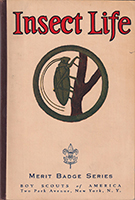
Requirements May 1925 until September 1944
l. Go into the country with the examiner and show to him the natural surroundings in which certain specified insects live, and shall find and demonstrate living specimens of the insects, telling something of their habits or of the nature of their fitness for life in their particular surroundings. The examiner shall ask for an insect from each of the five of the following groups without forewarning to the candidate but the scout shall have the choice of kind within each group.
1. (a) May-fly nymphs (b) caddis worms (c) anti-lion larva (doodle-bugs).
2. Larvae and pupae of mosquitos.
3. (a) Centipedes (b) scorpions (c) orb weaver spiders.
4. (a) Scale insects (b) plant lice.
5. (a) The nest of a solitary bee or wasp and its maker (mud daubers excluded) (b) bumble-bees and their nest.
6. (a) Black swimmers (b) whirligig beetles (demonstrate a peculiarity of their eyesight) (c) water striders.
7. (a) Carrion beetles (b) tumble bugs (c) leaf-beetles.
8. (a) Colony of carpenter ants or (b) of agricultural ants (c) black fly larvae (d) white ants.
9. (a) Crane-flies (b) robber-flies (c) damsel-flies and their nymphs.
10. Caterpillar of (a) cabbage butterfly (b) alfalfa butterfly (c) Monarch butterfly (d) sphinx moth (e) tiger beetles.
11. (a) Grouse locusts (b) meadow grasshoppers (c) katydids.
12. (a) Squash bugs (b) chinch bugs (c) larvae of gall wasps and their galls (d) other kinds of gall insects.
II. Make an artificial ants' nest suitable for observation and maintain a colony of ants for a period of at least two weeks. Make a record of interesting facts and habits observed. Or do the same with an observation hive of bees.
III. Make a collection of fifty species of insects. This collection will be judged upon 4 points: 1. correctness of names; 2. neatness of arrangement; 3. perfect condition of the specimens (clean, unbroken and properly mounted; 4. adherence to the following rules:
a. It is recommended that each species should be represented by two male and two female specimens when such specimens can be easily found and the sexes may be readily identified.
b. A neat written or typewritten label stating the name of the species (either common name or scientific or both to be pinned on the left on or above the row of specimens of each species.
c. The species of each family and order to be arranged together; the sequence of orders and the families to best followed in a textbook; the scientific name of each to be indicated by appropriate labels.
d. Entomological pins to be used when obtainable instead of common pins.
IV. Give evidence that he has bred through all its life stages from egg or young larvae to adult at least one species of insect. Mosquitos, blow-flies, cabbage butterflies, fruit-flies, and ants are suggested as easy species to rear.