-
Merit Badges
- Legend to identify Merit Badges
- 1910 British Merit Badges
- Square 1911 - 33
- Wide Crimped 1934 & 35
-
Narrow Tan Crimped 1936 - 42
- Tan Heavyweight Cloth with Silk Embroidery and Printed Back 1936 - 37
- Tan Heavyweight Cloth with Silk Embroidery and Plain Back 1937 - 38
- Tan Lightweight Cloth with Silk Embroidery and Plain Back 1938 - 39
- Tan Lightweight Cloth with Cotton Continuous Loop Embroidery and Plain Back 1939 - 42
- Tan Lightweight Cloth with Cotton Lockstitch Embroidery and Plain Back 1939 - 42
- Blue Background 1942 - 46
- Wartime 1942 - 46
- Khaki Narrow Crimped 1946 - 59
- Green Twill Gauze Back 1960 - 68
- Fully Embroidered Merrowed Edge 1960 - 72
- Unprinted Plastic Back 1972 - 01
- Printed Plastic Back 2002 - Current
-
Merit Badge Paper
- Merit Badge Applications
- Merit Badge Cards
-
Merit Badge Pamphlets
- Type 1 White Cover - Rectangle Drawing On Cover
- Type 2 White Cover 5-375" x 8" Title at Top
- Type 3A Tan Cover - 200 Fifth Avenue
- Type 3B Tan Cover - 2 line address New York City
- Type 3C Tan Cover - 2 line address New York N.Y.
- Type 3D Tan Cover - 1 line address New York N.Y.
- Type 4 Standing Scout Cover
- Type 5A War Cover
- Type 5B Red and White
- Type 6 Photo-Red Cover
- Type 7 Full Photo Cover or Bulls-eye Cover
- Type 8 Full Photo - Green Stripe Cover
- Type 9 Full Photo - Red Stripe Cover
- Type 10A Blue Stripe - Logo above bottom blue stripe - FDL centered
- Type 10B - Blue Stripe in bottom of photo area. FDL to left of text
- Special Covers
- Boy Craft Helps
- Merit Badge Counselor's Guides
-
Youth Position
- Junior Assistant Scoutmaster
- Senior Patrol Leader
- Assistant Senior Patrol Leader
- Patrol Leader
- Assistant Patrol Leader
- Troop Guide
- Scribe
- Quartermaster
- Instructor
- Chaplain Aide
- Den Chief
- Librarian
- Musician
- Webmaster
- Bugler
- Troop Historian
- Troop Representative
- Unit Representative
- Leadership Corps
- Honor Guard
- Leave No Trace Trainer
- Outdoor Ethics Guide
-
Patrol Medallions
- Patrol Medallions Introduction
- Legend to identify Patrol Medallions
- Patrol Shoulder Knot-Ribbons
- Felt Handmade Patrol Medallions
- Square Felt Patrol Medallions
- Round Broadcloth Patrol Medallions
- Red Twill Patrol Medallions
- Multi-Color Cloth Patrol Medallions
- Tan Cloth Patrol Medallions
- Patrol Medallion Back Patches
- Woodbadge Patrol Medallion
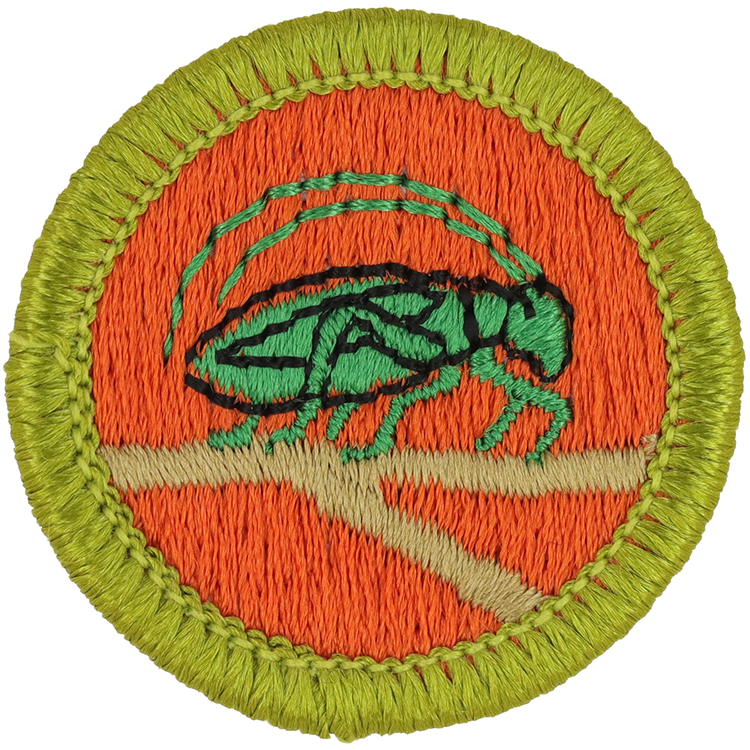
Fig. 1: InsStu-H5-Front
- Embroidery: Rayon thread
- Border: Merrowed
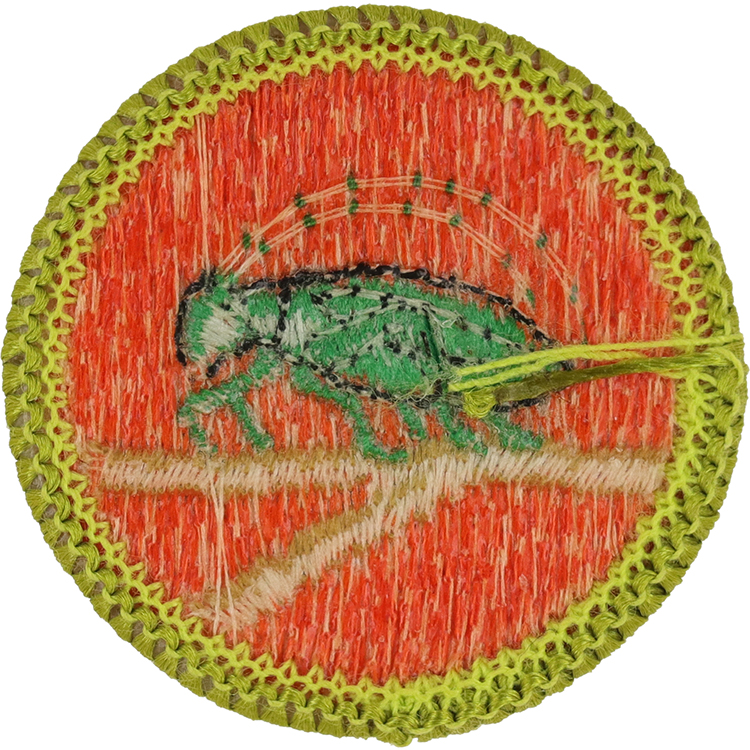
Fig. 2: InsStu-H5-Reverse
- Back: Molded plastic
Item Name: Insect Study 1990 - 2002
Item ID: InsStu-H5
Collector Rating: 1
Pamphlets Used to Earn this Badge
Requirements September 1987 until September 1993
1. Tell how insects are different from all other animals. Show the difference among insects, spiders, and centipedes.
2. Point out and name the main parts of an insect.
3. Collect and mount 50 different species. Include six orders and 18 families of insects. Label each with common and scientific names where possible.
4. Describe the things that distinguish the principal families and orders of insects.
5. Show your collection.
6. Compare the life histories of a butterfly and a grasshopper. Tell how they are different.
7. Raise a butterfly or moth from a caterpillar.
8. Tell things that make social insects different from solitary insects.
9. Observe an ant colony or a beehive. Tell what you saw.
10. From you collection, identify:
(a) Four species of insects helpful to humans. Tell how they are helpful.
(b) Six species of insects harmful to humans. Describe some general methods of insect control.
11. Tell how insects fit in the food chains of other insects, fish, birds, and mammals.
NOTE: Under the Endangered Species Act of 1973, some insects are or may be protected by federal law. The same ones and/or others may be protected by state law. Before doing any collecting, be sure that you know which may be on both lists and be sure that you do not collect protected species.
Requirements September 1993 until June 1994.
1. Tell how insects are different from all other animals. Show the differences between insects, spiders, and centipedes.
2. Point out and name the main parts of an insect.
3. Collect and mount 50 different species.* Include 6 orders and 18 families of insects. Label each with common and scientific names, where possible.
4. Describe the things that distinguish each of the families and orders in your collection.
5. Show your collection.
6. Compare the life histories of a butterfly and a grasshopper. Tell how they are different.
7. Raise a butterfly or moth from a caterpillar.
8. Tell the things that make social insects different from solitary insects.
9. Collect and watch an ant colony or a beehive. Tell what you saw.
10. From your collection, identify:
(a) Four species of insects helpful to people. Tell how they are helpful.
(b) Six species of harmful insects. Tell how they can be controlled.
11. Tell how insects fit into the food chains of other insects, fish, birds, and mammals.
*Some insects are endangered species and are protected by federal or state law. Be sure to check in advance to make sure that anything you collect is not protected.
Requirements June 1994 until January 2003
1. Tell how insects are different from all other animals. Show the differences between insects, centipedes, and spiders2. Point out and name the main parts of an insect.
3. Collect and mount fifty different species* Include six orders and eighteen families of insects. Label each with common and scientific names, where possible.
4. Describe the characteristics that distinguish the principal families and orders of insects.
5. Show your collection.
6. Compare the life histories of a butterfly and a grasshopper. Tell how they are different.
7. Raise an insect through complete metamorphosis from its larval stage to its adult stage (e.g., raise a butterfly or moth from a caterpillar).
8. Tell the things that make social insects different from solitary insects.
9. Observe an ant colony or a beehive. Tell what you saw.
10. From your collection, identify
(a) Four species of insects helpful to humans.
(b) Six species of insects harmful to humans.
Describe some general methods of insect control.
11. Tell how insects fit in the food chains of other insects, fish, birds, and mammals.
*Some insects are endangered species and are protected by federal or state law. Every species is found only in its own special type of habitat. Be sure to check natural resources authorities in advance to make sure that you will not be collecting any specimens from any habitat of a species that is known to be protected or endangered.