-
Merit Badges
- Legend to identify Merit Badges
- 1910 British Merit Badges
- Square 1911 - 33
- Wide Crimped 1934 & 35
-
Narrow Tan Crimped 1936 - 42
- Tan Heavyweight Cloth with Silk Embroidery and Printed Back 1936 - 37
- Tan Heavyweight Cloth with Silk Embroidery and Plain Back 1937 - 38
- Tan Lightweight Cloth with Silk Embroidery and Plain Back 1938 - 39
- Tan Lightweight Cloth with Cotton Continuous Loop Embroidery and Plain Back 1939 - 42
- Tan Lightweight Cloth with Cotton Lockstitch Embroidery and Plain Back 1939 - 42
- Blue Background 1942 - 46
- Wartime 1942 - 46
- Khaki Narrow Crimped 1946 - 59
- Green Twill Gauze Back 1960 - 68
- Fully Embroidered Merrowed Edge 1960 - 72
- Unprinted Plastic Back 1972 - 01
- Printed Plastic Back 2002 - Current
-
Merit Badge Paper
- Merit Badge Applications
- Merit Badge Cards
-
Merit Badge Pamphlets
- Type 1 White Cover - Rectangle Drawing On Cover
- Type 2 White Cover 5-375" x 8" Title at Top
- Type 3A Tan Cover - 200 Fifth Avenue
- Type 3B Tan Cover - 2 line address New York City
- Type 3C Tan Cover - 2 line address New York N.Y.
- Type 3D Tan Cover - 1 line address New York N.Y.
- Type 4 Standing Scout Cover
- Type 5A War Cover
- Type 5B Red and White
- Type 6 Photo-Red Cover
- Type 7 Full Photo Cover or Bulls-eye Cover
- Type 8 Full Photo - Green Stripe Cover
- Type 9 Full Photo - Red Stripe Cover
- Type 10A Blue Stripe - Logo above bottom blue stripe - FDL centered
- Type 10B - Blue Stripe in bottom of photo area. FDL to left of text
- Special Covers
- Boy Craft Helps
- Merit Badge Counselor's Guides
-
Youth Position
- Junior Assistant Scoutmaster
- Senior Patrol Leader
- Assistant Senior Patrol Leader
- Patrol Leader
- Assistant Patrol Leader
- Troop Guide
- Scribe
- Quartermaster
- Instructor
- Chaplain Aide
- Den Chief
- Librarian
- Musician
- Webmaster
- Bugler
- Troop Historian
- Troop Representative
- Unit Representative
- Leadership Corps
- Honor Guard
- Leave No Trace Trainer
- Outdoor Ethics Guide
-
Patrol Medallions
- Patrol Medallions Introduction
- Legend to identify Patrol Medallions
- Patrol Shoulder Knot-Ribbons
- Felt Handmade Patrol Medallions
- Square Felt Patrol Medallions
- Round Broadcloth Patrol Medallions
- Red Twill Patrol Medallions
- Multi-Color Cloth Patrol Medallions
- Tan Cloth Patrol Medallions
- Patrol Medallion Back Patches
- Woodbadge Patrol Medallion
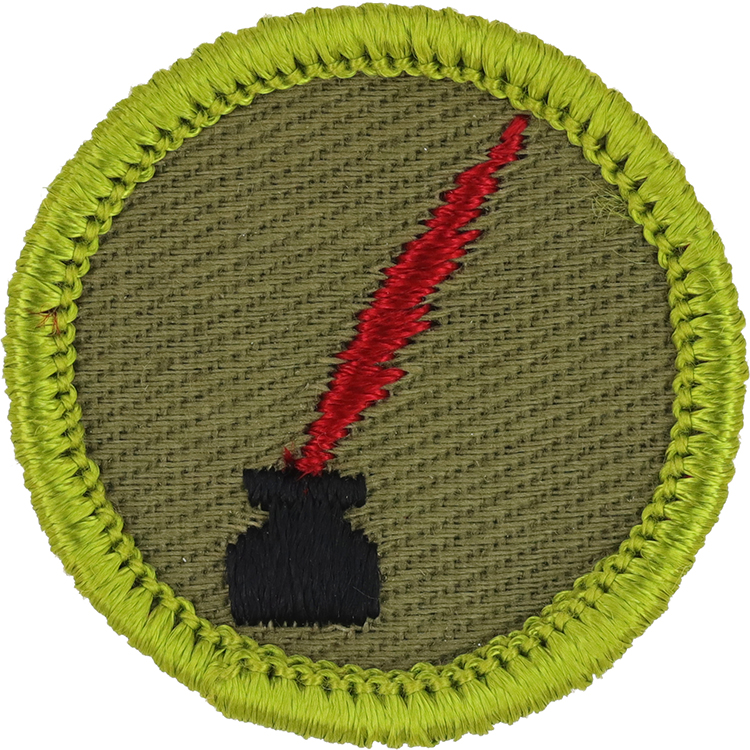
Fig. 1: Journa-F-Front
- Cloth: Green right twill
- Border: Merrowed
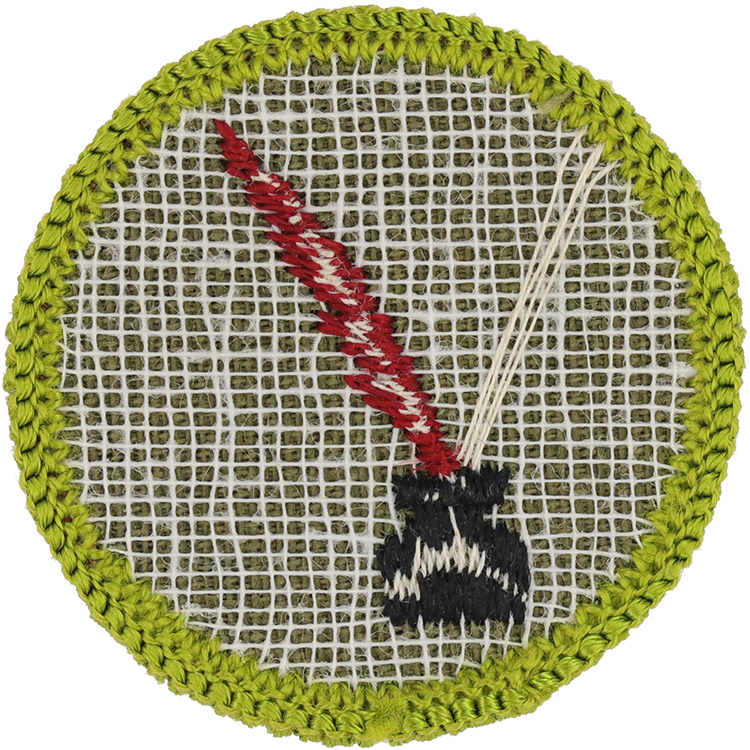
Fig. 2: Journa-F-Reverse
- Back: Gauze reinforced starched
Item Name: Journalism 1961 - 1968
Item ID: Journa-F
Collector Rating: 1
Pamphlets Used to Earn this Badge

Requirements January1952 until September 1961
Do any nine of the following:
1. Write stories covering satisfactorily the following assignments, demonstrating that you know the principles of good news writing, including the elements of a good lead paragraph: (a) a news incident; (b) a routine club or society meeting; (c) a lecture, sermon, or political address.
2. Write: (a) an editorial; (b) a feature or human interest story; (c) a review of a play, motion picture, radio or television show, concert, book, or art or photography exhibit.
3. (a) Explain how the articles in Requirements 1 and 2 differ. (b) Secure the publication of at least one of these articles.
4. (a) Prepare a simple set of headline styles which will serve all needs of a small newspaper, indicating type size and approximate count for each. (b) Using this schedule, write good headlines for the three stories in Requirement 1.
5. Present photographic or cartoon copy, or the suggestions for such copy, as an illustration for a news story, and write the caption for it.
6. Read and correct proof, using the conventional proofreader's signs.
7. Show that you knows what is meant by the following terms: point, font, pica, face, case, linotype, handset, galley proof, half-tone, electrotype, screen, stereotype, mat.
8. (a) Explain the steps necessary to copyright a book, magazine or newspaper; tell what rights are granted by a copyright, and for what period. (b) Explain what is meant by Freedom of the Press and why we have libel laws. Tell what plagiarism is.
9. Prepare a dummy for the printer of an eight-page newspaper or magazine, including the placing of different size advertisements to cover the equivalent of two pages.
10. Explain the process of preparing a modern newspaper for publication, demonstrating a satisfactory knowledge of the various departments and executives, and their functions. Explain the importance of the deadline.
11. Have contributed as a reporter, or as editor or a member of the editorial or business staff (either voluntary or paid) on a newspaper or a Local Council Troop, school, trade, farm, or club publication for at least six issues.
12. Present a scrap book, including unpublished copy as well as clippings of published material, filed under date and place of publication.
Requirements September 1961 until June 1972


1. Write stories worthy of publication of any three of the following assignments, demonstrating that you know the principles of good news or magazine writing: (a) a news incident; (b) a Scouting event; (c) a sports event; (d) an editorial requiring research on the subject; (e) a feature or human-interest story; (f) a critical review of a play, motion picture, or television show.
2. Do any five of the following: (a) Prepare a script for a five-minute radio or television newscast, using local, regional, or world-wide events. (b) Write good headlines for the three assignments covered in Requirement 1, following a standard head schedule but using different type style and size. Indicate face, type size, and count for each. (c) Take and submit at least one photograph to illustrate any one of the stories covered in Requirement 1 and write a caption for the photograph. (d) Know at least fifteen of the conventional proofreader's or copyreader's signs. Correct a proof or copyread a manuscript, using as many of these signs as necessary. (e) Explain the following terms: font, pica, face, machine-set type, handset, galley proof, halftone, electrotype, mat, copy, flush left, beat, copy desk, streamer, plagiarism, libel, and copyright. (f) Prepare a dummy for the printer of a four-page newspaper or magazine, including several different size advertisements. (g) Visit a newspaper or magazine publishing office. After the visit, explain the processes of preparing a modern newspaper or magazine for publication. Demonstrate satisfactory knowledge of the various departments and executives and their functions. Explain the importance of the deadline. (h) Describe the operation of a wire service. Describe how a syndicate differs from a wire service. (i) Investigate and report on journalism opportunities in the newspaper, magazine, and book-publishing fields, and in radio and television.