-
Merit Badges
- Legend to identify Merit Badges
- 1910 British Merit Badges
- Square 1911 - 33
- Wide Crimped 1934 & 35
-
Narrow Tan Crimped 1936 - 42
- Tan Heavyweight Cloth with Silk Embroidery and Printed Back 1936 - 37
- Tan Heavyweight Cloth with Silk Embroidery and Plain Back 1937 - 38
- Tan Lightweight Cloth with Silk Embroidery and Plain Back 1938 - 39
- Tan Lightweight Cloth with Cotton Continuous Loop Embroidery and Plain Back 1939 - 42
- Tan Lightweight Cloth with Cotton Lockstitch Embroidery and Plain Back 1939 - 42
- Blue Background 1942 - 46
- Wartime 1942 - 46
- Khaki Narrow Crimped 1946 - 59
- Green Twill Gauze Back 1960 - 68
- Fully Embroidered Merrowed Edge 1960 - 72
- Unprinted Plastic Back 1972 - 01
- Printed Plastic Back 2002 - Current
-
Merit Badge Paper
- Merit Badge Applications
- Merit Badge Cards
-
Merit Badge Pamphlets
- Type 1 White Cover - Rectangle Drawing On Cover
- Type 2 White Cover 5-375" x 8" Title at Top
- Type 3A Tan Cover - 200 Fifth Avenue
- Type 3B Tan Cover - 2 line address New York City
- Type 3C Tan Cover - 2 line address New York N.Y.
- Type 3D Tan Cover - 1 line address New York N.Y.
- Type 4 Standing Scout Cover
- Type 5A War Cover
- Type 5B Red and White
- Type 6 Photo-Red Cover
- Type 7 Full Photo Cover or Bulls-eye Cover
- Type 8 Full Photo - Green Stripe Cover
- Type 9 Full Photo - Red Stripe Cover
- Type 10A Blue Stripe - Logo above bottom blue stripe - FDL centered
- Type 10B - Blue Stripe in bottom of photo area. FDL to left of text
- Special Covers
- Boy Craft Helps
- Merit Badge Counselor's Guides
-
Youth Position
- Junior Assistant Scoutmaster
- Senior Patrol Leader
- Assistant Senior Patrol Leader
- Patrol Leader
- Assistant Patrol Leader
- Troop Guide
- Scribe
- Quartermaster
- Instructor
- Chaplain Aide
- Den Chief
- Librarian
- Musician
- Webmaster
- Bugler
- Troop Historian
- Troop Representative
- Unit Representative
- Leadership Corps
- Honor Guard
- Leave No Trace Trainer
- Outdoor Ethics Guide
-
Patrol Medallions
- Patrol Medallions Introduction
- Legend to identify Patrol Medallions
- Patrol Shoulder Knot-Ribbons
- Felt Handmade Patrol Medallions
- Square Felt Patrol Medallions
- Round Broadcloth Patrol Medallions
- Red Twill Patrol Medallions
- Multi-Color Cloth Patrol Medallions
- Tan Cloth Patrol Medallions
- Patrol Medallion Back Patches
- Woodbadge Patrol Medallion
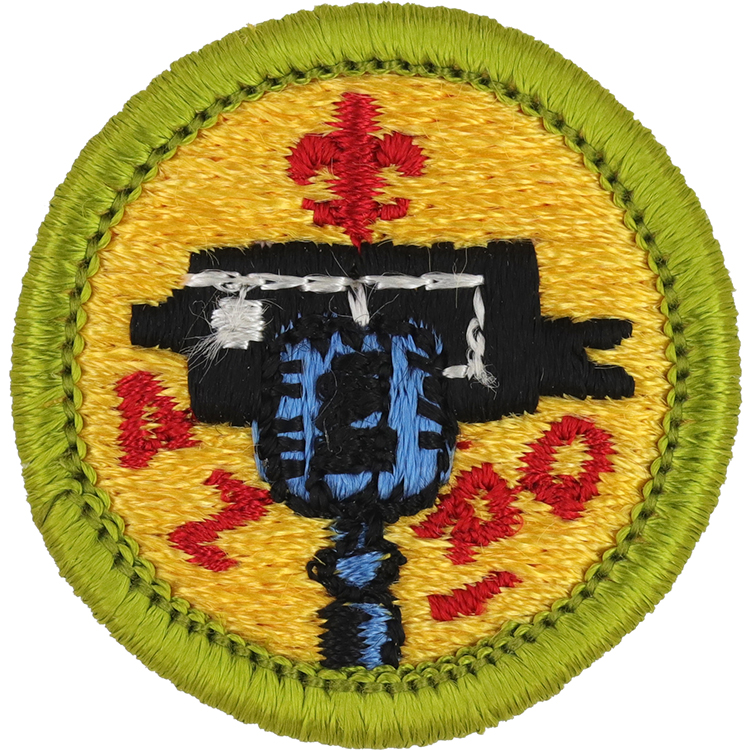
Fig. 1: Journa-H3-Front
- Embroidery: Cotton thread, dull sheen
- Border: Dk green merrowed
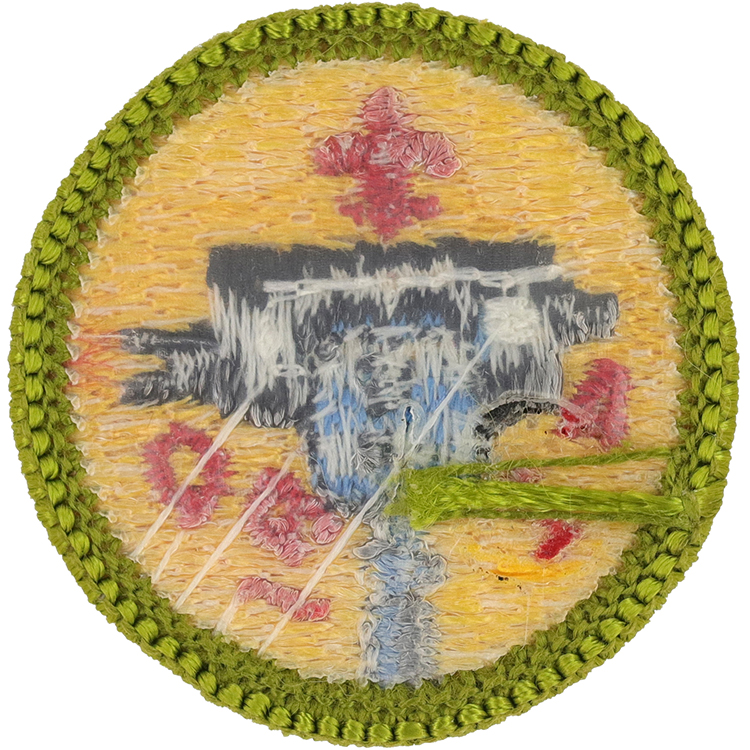
Fig. 2: Journa-H3-Reverse
- Back: Molded plastic
Item Name: Journalism 1976 - 1978
Item ID: Journa-H3
Collector Rating: 1
Pamphlets Used to Earn this Badge
Requirements June 1972 until July 1976
1. Write stories good enough for publication of any THREE of the following. Show that you know the principles of good news or magazine writing.
(a) A news story.
(b) A Scout story.
(c) A sports story.
(d) An editorial.
(e) A feature.
(f) A review of a play, movie, or television show.
2. Do FIVE of the following:
(a) Prepare a script for a 5-minute radio or television newscast. (b) Write good heads for the three stories covered in No. 1. Follow a standard head schedule but use different type style and size. Show face, type size, and count for each.
(c) Take and show a picture to illustrate any one of the stories covered in No.1. Write a caption for the picture.
(d) Show at least 15 of the proofreader's or copyreader's marks. Correct a proof or copyread a manuscript. Use as many of these marks as needed.
(e) Explain the following terms: font, pica, face, machine-set type, handset, galley proof, halftone, electrotype, mat, copy, flush left, beat, copy desk, streamer, plagiarism, libel, and copyright.
(f) Prepare a dummy of a four-page newspaper or magazine. Include several different size advertisements.
(g) Visit a newspaper or magazine office. After the visit, explain how a newspaper or magazine is prepared for publication. Explain the different departments and executives and what they do. Explain the importance of the deadline.
(h) Describe how a wire service works. Tell how a syndicate is different from a wire service.
(i) Look into and tell about jobs in journalism.
Requirements July 1976 until September 1989.
1. Do ONE of the following:
(a) Read two different newspapers and two different news magazines. From each of these, cut out stories about the same event. Put each item on a separate sheet of paper. Write an analysis of each, explaining where and in what way each story is objective or subjective and why each publication handled the story differently for a different purpose or audience.
(b) Listen on two radio news broadcasts and watch two television news broadcasts on the same day. List the different news items, features, and editorials on the broadcasts. Note the time in minutes and seconds for each story. Write an analysis explaining where and in what way each story is objective or subjective, and why the stories were treated differently for each audience by the two media.
2. Do either a or b:
(a) Newspaper and magazine journalism:
(1) Visit a newspaper or magazine office. Ask for a tour of the various divisions (editorial, business, and printing). During your tour talk to an executive from the business side about management's relations with reporters, editors, and photographers and what makes a "good" newspaper or magazine. If possible, go with a reporter to cover a news event.
(2) With the help of your counselor, prepare a newspaper layout, edit copy, and proofread a story after it has been set in type, and be able to explain the printing process
(b) Radio and television journalism:
(1) Visit a radio or television station. Ask for a tour of the various departments, concentrating on those related to news broadcasts. During your tour, talk to the station manager or other station management executive about station operations, particularly how management and the news staff work together, and what makes a "good" station. If possible, go with a reporter to cover a news event.
(2) With the help of your counselor prepare a radio or television news show format. Cut and splice tape or film. Explain what it takes to put a radio or television news broadcast on the air.
3. Do ONE of the following:
(a) Attend a news event. Write a newspaper news story about the event, a sidebar feature, and an editorial or critical review of the event.
(b) For the same event, for radio or TV, write a news story, a color story and an editorial or critical review.
(c) For the same event, take a series of photographs that would help to tell the story in pictures, including some news photos and some feature photos. Write captions for your photos and a brief story of the event.
4. Answer at least three of five questions about qualifications, educational preparation, training opportunities, wages, and personal satisfaction in a career in journalism.